Projects and Features
Steel frames for logistics expansion
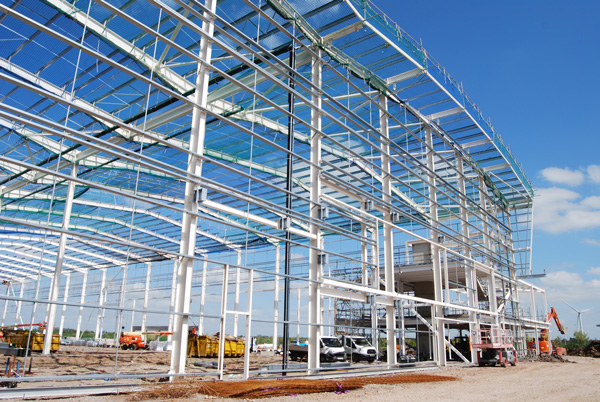
Strategically located within the UK’s logistics heartland, the Daventry International Rail Freight Terminal is continuing to expand with new steel-framed warehouses.
FACT FILE
Daventry International Rail Freight Terminal (DIRFT) warehouses
Main client: Prologis UK
Architect: Stephen George + Partners
Main contractor: Benniman Construction
Structural engineer: Tetra Tech
Steelwork contractor: Caunton Engineering
Steel tonnage: 1,853t
Encompassing parts of Leicestershire, Northamptonshire and Warwickshire, the area dubbed the ‘Golden Triangle’ has been the UK’s most strategic logistics location for decades.
This central East Midlands area, close to the M1 and M6 motorways, allows goods to be transported to anywhere in the UK within a matter of hours, while the nearby A14 also links the Triangle with Felixstowe, the UK’s largest and busiest container port.
One of the Triangle’s premier logistics parks is the Daventry International Rail Freight Terminal (DIRFT), which also benefits from three onsite rail freight terminals.
Originally developed in the 1990s, the site is one of Prologis UK’s flagship developments and home to a number of well-known companies, with DHL, Royal Mail and Tesco all having facilities on the site.
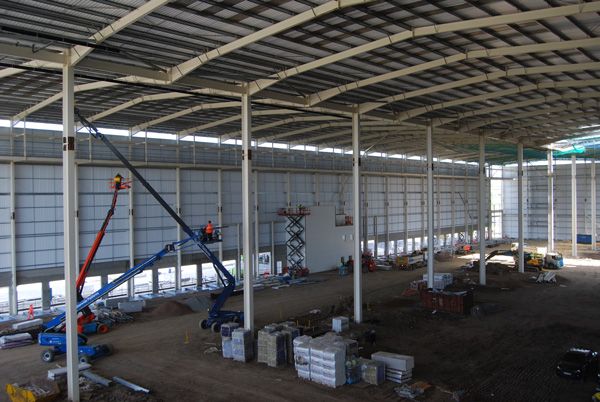
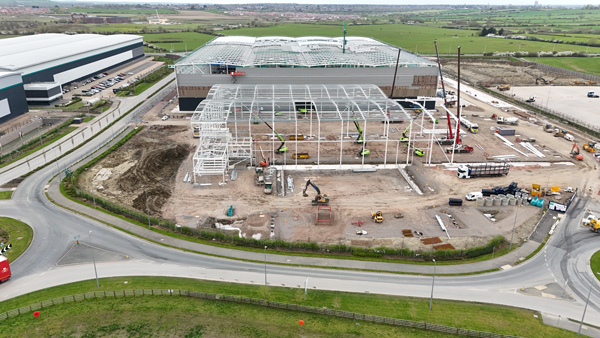
In order to satisfy continuing demand for logistics and distribution space, construction and infrastructure work are currently ongoing for the site’s phase three, which will initially deliver three build-to-suit projects, completing the northern gateway to DIRFT.
Two of these units (known as DC11 and DC107) are being built by main contractor Benniman Construction, with Caunton Engineering designing, fabricating, supplying and erecting the steelwork.
Designed to industry-leading sustainability standards, both buildings are targeting EPC A+ and BREEAM ‘Outstanding’ ratings, as well as net zero in construction.
DC11, the larger of the two units, is being built as a chilled distribution centre for XPO Logistics to service Arla Foods, while DC107 is a speculative development.
Arla Foods is the UK’s largest dairy cooperative, owning brands such as Lurpak, Anchor and Cravendale.
Fran Ball, Senior Vice President UK Supply Chain for Arla Foods UK, says: “Consolidating our chilled pallet operations into a single, advanced facility in Northamptonshire is a strategic leap forward for Arla.
“By partnering with XPO Logistics and Prologis, we are improving the resilience of a critical part of our supply chain and making meaningful progress on reducing waste and road miles.”
Phil Oakley, Senior Vice President, Prologis UK, adds: “Partnerships and developments like this play an important role in creating long term economic value for West Northamptonshire, helping to attract investment and underpin jobs across the region.
“At Prologis DIRFT, we’ve built a community with the capacity and skills to support high-performing logistics operations like this one.”
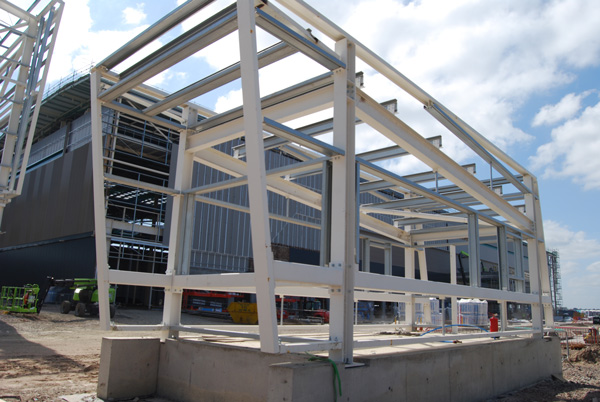
First to be erected, DC11 required 1,355t of steelwork to construct its 185m-long × 136m-wide and 24m-high warehouse frame.
Internally, the warehouse features four 34m-wide spans, which create the all-important open-plan space. The spans are formed with 17m-long rafters, which are spliced at the structure’s apex.
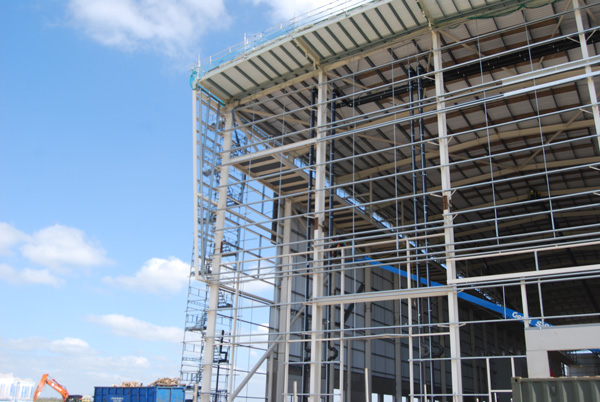
Higher than the many of the surrounding warehouse structures, in order to accommodate the produce chillers, the structure’s columns had to be spliced so they could be transported to site.
The internal valley columns (which are arranged in a hit-and-miss configuration that allows more column-free space) are plate girders. They were brought to site in two pieces – one main 18m-high section and top piece measuring 6m. Weighing up to 5.5t each, these columns represented the heaviest individual steel pieces on the job.
Likewise, the perimeter columns, which are 610mm × 229mm × 125kg/m UB sections, were also spliced. They consist of a main 12.2m-tall section and a top piece measuring 11.8m (creating a series of 24m-high columns).
The warehouse also includes a two-storey transport hub and an office block. The latter is positioned along one of the warehouse gable ends and sits above a row of docks (in total there are 48 docks within DC11).
The office first-floor and the second-floor, which is a plant deck, are both compositely formed with steel beams supporting metal decking and a concrete topping.
Using up to four cranes (ranging in size from 90t to 120t-capacity), DC11 was erected in six weeks.
Speculative design
Requiring just under 500t of steelwork, the smaller DC107 warehouse measures 136.9m-long x 72m-wide and is 18.3m-tall.
The building features two 36m-wide spans, consisting of 18m-long rafters connected at the structure’s apex. The spans are supported by perimeter columns and internal valley columns, which are also arranged (like DC11) in a hit-and-miss configuration.
The completed DC107 will include a two-storey office block, topped by a plant deck, as well as high-quality, resilient digital infrastructure to support robust and scalable connectivity.
Tariq Khan, Studio Director at Stephen George + Partners, says: “This warehouse unit represents contemporary logistics design, where future-proofing functionality, architectural quality and customer experience work hand-in-hand.
“Our approach focused on creating a building that not only performs efficiently, but also enhances everyday wellbeing, with features helping to elevate the overall working environment.”
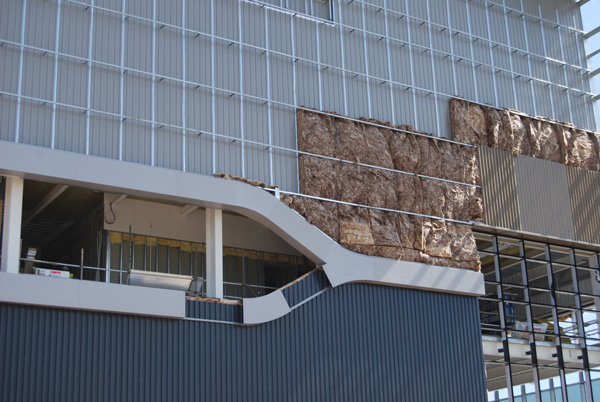
Creating some uniformity between the two warehouses, both have similar cladding finishes and cantilevering roofs at the gable ends, which are supported by triangular steel buttresses. DC107 will also have a glazed south facing external balcony.
Summing up, James Hemstock, Vice President Capital Deployment at Prologis UK, says: “With a clear focus on developing logistics real estate in the most desirable locations, we aim to meet growing demands and changing industry needs. We anticipate this new development will generate a high level of interest.”
Portal frame design
Dr Yigit Ozcelik of the SCI discusses how axial forces affect the stability of portal frames and why they must be carefully considered in design.
At the Daventry International Rail Freight Terminal (DIRFT), the first warehouse within Prologis UK’s development uses a series of long-span steel portal frames to provide four 34m-long spans, enclosing a 24m-high logistics space. Their ability to achieve long spans using relatively lightweight steelwork explains why portal frames remain the most widely used structural system for UK industrial buildings. Their relatively slender form means that they can be particularly sensitive to the influence of axial loads on global frame stability.
Portal frames are inherently sensitive to second-order effects because the frame relies on moment-frame action rather than bracing for stability. Under gravity loading, the rafters develop axial compression through arching action, while the frame simultaneously deflects laterally. As deflections increase, additional moments are generated through P–Δ effects, reducing the apparent stiffness of the frame and bringing it closer to instability than a first-order analysis predicts.
BS EN 1993-1-1 assesses the significance of second-order effects through the elastic critical load factor, αcr. The simplified second-order analysis approach, often referred to as the amplified first-order analysis, uses αcr to amplify the results of a first-order elastic analysis to account for global sway effects. On a related note, while the amplification factor αcr /(αcr − 1) is typically applied to horizontal actions, SCI recommends that it be applied to all actions in portal frame design. The method is only valid when axial compression in the rafters is not significant (NEd/Ncr ≤ 0.09), a condition frequently not met in portal frames. As a result, the amplified first-order analysis is often inapplicable in its standard form for orthodox portal frame design.
SCI therefore introduces a modified stability parameter, αcr,est , to account for the reduction in apparent frame stiffness due to axial compression in the rafters. This is obtained by applying a reduction factor of 0.8(1 − NEd/Ncr) to αcr, where Ncr is the elastic critical buckling load of the rafter pair over the complete span. The approach provides a more accurate representation of second-order effects when axial forces are significant.
In brief, the axial load in the rafters of a portal frame reduces its apparent stiffness, leading to amplified second-order effects. To account for this reduction, the modified stability parameter αcr,est must be used in place of αcr when amplified first-order analysis is adopted.