Projects and Features
Steel provides enterprising solution
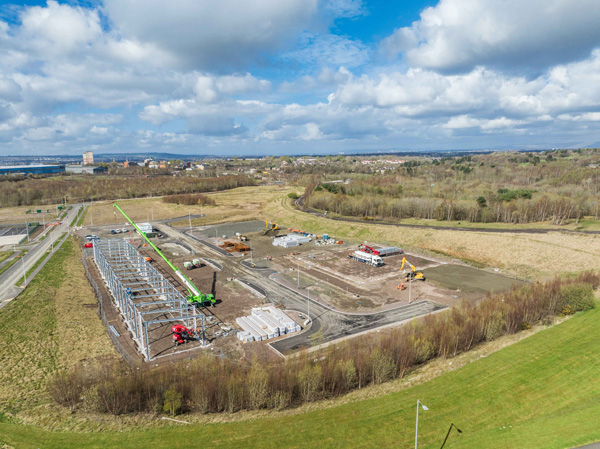
The regeneration of Ravenscraig is continuing at pace with the construction of much-needed commercial and industrial space.
FACT FILE
Ravenscraig Enterprise Park
Main client: Fusion Assets
Architect: Hypostyle
Main contractor: Luddon Construction
Structural engineer: Fairhurst
Steel tonnage: 200t
Once the site of Western Europe’s largest hot strip steel mill, Ravenscraig is being transformed into a new community, with thousands of homes, retail and leisure facilities, alongside business and industrial space.
Located on the outskirts of Motherwell, North Lanarkshire, the site covers an area of 4.5km² and has been described as one of the largest regeneration projects in Europe.
Where thousands of people once worked in steel production (Ravenscraig Steelworks closed in 1992), it is fitting that the material is again playing a pivotal role in the site’s rebirth.
Two of the first jobs to be completed, were both steel-framed structures; New Lanarkshire College (see NSC April 2008) and the Ravenscraig Regional Sports Facility (see NSC November 2009).
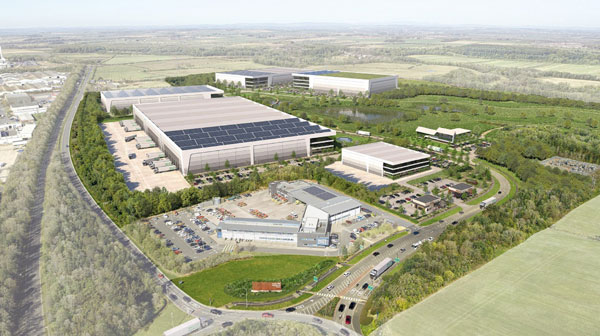
Now another steel-framed project is underway. Known as the Ravenscraig Enterprise Park, the six-acre site will eventually be transformed into 5,800m² of mixed-use commercial space. Designed to meet modern occupier requirements, the development will offer flexible, energy-efficient space capable of accommodating business, industrial and storage uses.
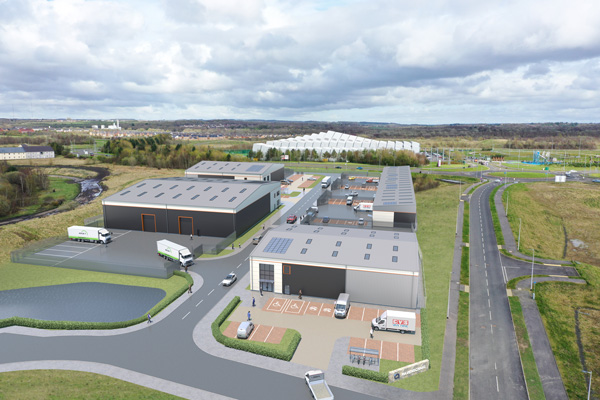
The first phase, which is currently underway, consists of two speculatively-built steel-framed structures that will on completion offer 2,713m² of space within six separate multi-purpose units. A second phase, consisting of two larger warehouses is expected to start later this year.
North Lanarkshire Council successfully bid for £4.4 million for the first phase, comprising £3.05m from Glasgow City Region City Deal and £1.39m from the Scottish Government’s Vacant and Derelict Land Fund.
The investment, which aims to address a lack of available modern, high-quality commercial and industrial premises, is being delivered through Fusion Assets, the council’s property development and regeneration company.
Russell Wilkie, Director of the Ravenscraig regeneration project, says: “It’s excellent news that work is beginning on site adding to the momentum of the Ravenscraig regeneration. These new facilities will bring new jobs and investment to the area, helping to create a sustainable, self-sufficient community and a positive future for local people.”
Councillor Alex McVey, Convener of Enterprise, adds: “The project funding is a major boost for North Lanarkshire and will help us unlock the potential of the site, creating high-quality space for businesses to grow and thrive.
“There is an urgent demand for modern, high-quality commercial and industrial spaces for existing and new businesses across the Glasgow City Region. The project will help attract more companies to the area, bringing vacant and derelict sites back into use creating jobs and supporting the local economy.”
The arrival of new space at Ravenscraig is said to have come at a pivotal time for the industrial market across the wider Central Belt, where vacancy rates remain low and the supply of modern, high quality accommodation is constrained, leaving demand continuing to outpace availability.
Ravenscraig has benefited from significant public and private investment as part of its long-term regeneration, and this latest phase represents a further step in unlocking its full commercial potential. Strategically positioned within the Glasgow City Region, the site offers convenient connectivity to both the M74 and M8 motorways, providing direct access to key markets, labour pools and national transport networks.
Main contractor Luddon Construction, started work on the first phase earlier this year, preparing the brownfield plot for the steel erection programme to commence. As well as constructing access routes, the two buildings’ foundations, which comprise of a vibro stone column solution, were also installed.
According to the project’s design team, a steel-framed option was the best method for this job as it easily and efficiently provided the required clear spans and speed of construction.
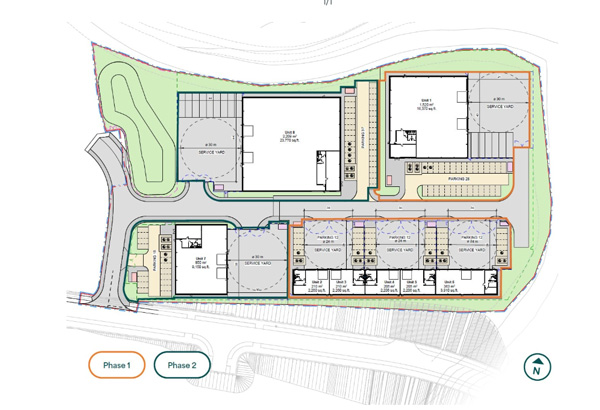
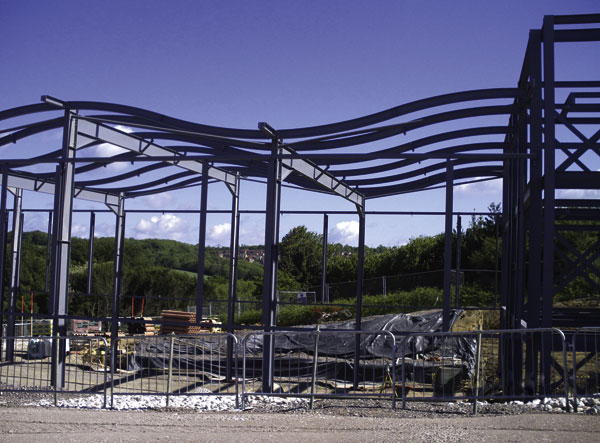
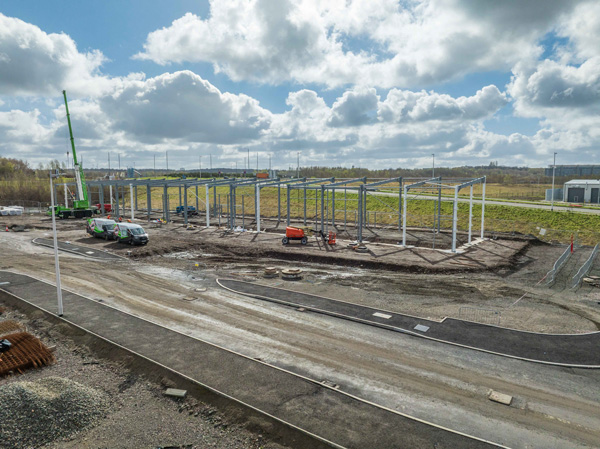
Using a single mobile crane, the smaller of the two portal-framed buildings was erected first. Accommodating units two to six, the mono-pitched structure is 101m-long, has an 11.9m-wide clear internal span and reaches a maximum height of 7.66m (5.5m on the opposite side of the five-degree pitch).
The supporting perimeter columns are set at 5.9m centres, helping to create four industrial units measuring three bays wide and a slightly larger Unit 6, which is five bays wide.
A series of non-structural internal walls divide the building into its five parts.
Each unit has an internal welfare and office zone, with its own dedicated door, as well as a large goods-in/goods-out shutter door, with access to a service yard.
Second to be erected, unit one is a single warehouse building measuring 47m-long and featuring a six-degree duo-pitched roof that reaches a maximum height of 8m (7m to the underside of haunch).
Creating the all-important column-free space that warehouse projects require, the structure comprises a single internal span, which is formed with a pair of 18.96m-long rafters.
The rafters were spliced together before being lifted into place as complete 37.92m-long sections.
Offering some flexibility to the future tenant, unit one’s internal office space has been designed with a capping slab, which could allow the area to be enlarged with the addition of a mezzanine deck.
Summing up, Murray Collins, Managing Director of Fusion Assets, says: “We are grateful to North Lanarkshire Council for their continued support and look forward to delivering much needed modern energy efficient commercial facilities to the local area, bringing with it new jobs and investment.”
Work on phase one is expected to be complete by November.