Projects and Features
Steel creates city centre landmark bridge
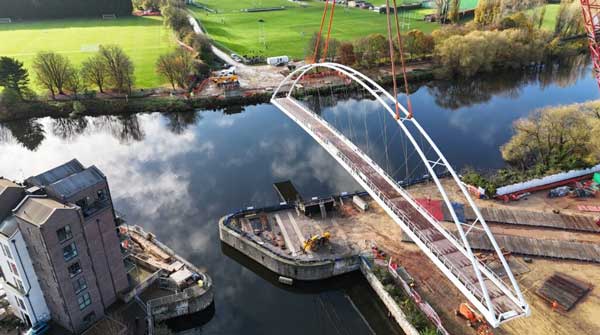
The first bridge to be built over the River Trent at Nottingham in more than 60 years has been successfully installed and will open in the spring.
FACT FILE
Waterside Bridge, Nottingham
Developer: Nottingham City Council
Architect: Amey
Main contractor: Balfour Beatty
Structural engineer: Ramboll
Steelwork contractor: Briton Fabricators
Steel tonnage: 175t
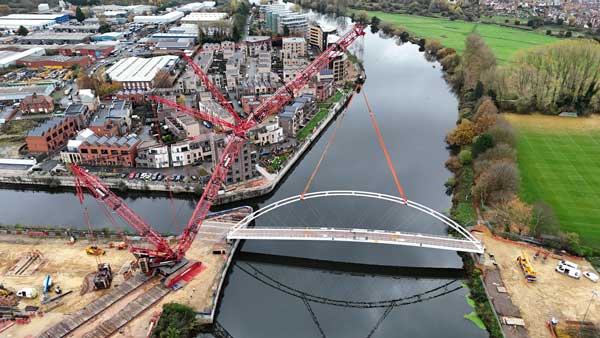
Having been fully assembled onsite, the 175t Waterside Bridge was lifted into place across the River Trent on Monday 10th November using a single 1,250t-capacity crawler crane.
The installation process was successfully completed in four hours and was a testament to the months of preparatory works and planning that the project team had undertaken.
Councillor Linda Woodings, Executive Member for Regional Development, Growth and Transport at Nottingham City Council, says: “This was a big milestone moment for our project to build a new walking and cycling bridge over the River Trent – it was thrilling to be at the riverside and see the new bridge land on its supports just as planned.”
The landmark bridge will be the final project to come out of the City Council’s Transforming Cities Fund programme, which began in 2020, following a successful bid for over £160 million of central government funding for projects which encourage inter-city connectivity and lower carbon journeys.
The new traffic-free bridge will be a key link between the regenerating Trent Basin area (which includes new homes and schools) and the south side of the river with its many sports facilities including Nottingham Forest FC’s City Ground, Trent Bridge Cricket Ground and Nottingham Rugby Club.
The aspiration is that by enhancing connections between communities, green spaces and riverside paths, the bridge will make it easier for people living and working in the Nottingham area to travel in a more sustainable way, linking those living in the city centre with green space south of the river.
It will also help the city towards its Carbon Neutral 2028 ambition, as well as improving local air quality and congestion levels by enabling people to travel without needing a car.
Working on behalf of main contractor Balfour Beatty, locally-based Briton Fabricators were the steelwork contractor for the project.
The company fabricated the 87m-long Network arch bridge at its Hucknall facility, which is less than eight miles from the project’s site.
Measuring 5.2m wide, the bridge deck was fabricated in three large sections, which allowed the structure to be transported to site.
Overall, the cambered deck includes two fabricated box girders, measuring 750mm × 560mm and 20mm thick, which are connected by a series of 30 RHS cross members (measuring 250mm × 150mm × 10mm).
Supported by the girders and cross members, the bridge deck is formed with 8mm-thick steel panels, installed in 12m-long lengths.
The three bridge deck sections also included a steel balustrade, which is welded to the top of the girders.
The Network arch, which was also fabricated in thirds, is formed with two curved 457mm-diameter × 16mm-thick CHS tubular beams that are connected by nine sets of bracings.
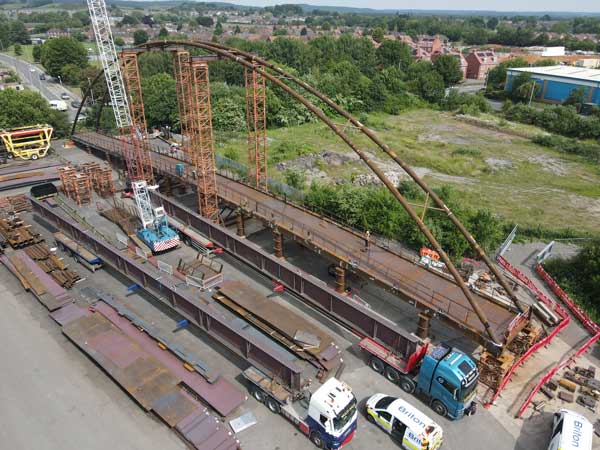
In order to ensure the bridge sections (six in total) would fit together seamlessly once they were delivered to site, Briton Fabricators undertook a trial erection of the bridge at its facility.
The bridge sections were supported on trestles and assembled using temporary bolted connections. Once fully erected to its 20m height, the bridge formed an impressive, albeit temporary, addition to Hucknall’s skyline.
After the successful trial erection, the bridge was disassembled and all of the steel sections were transported to Jack Tighe’s Doncaster and Scunthorpe facilities, where they were painted. The fully coated bridge steelwork was then delivered to the River Trent project site.
“The Waterside Bridge was always going to be a steel structure, because it offered the easiest and most cost-effective method of construction,” says Balfour Beatty Project Manager Andrew Gee.
The project team’s only debate was how to install the steel structure and minimise working over the water.
“Launching the bridge over the river was an option, but lifting the fully-assembled structure into place proved to be the best method for this project,” adds Mr Gee.
Prior to lifting the bridge into place, the sections were reassembled on a plot adjacent to the north abutment and each connection was fully butt welded to form the architectural finish.
During the six-week assembly programme, the bridge deck was positioned on trestles and the arch was temporarily supported by two towers. Once it was welded and thoroughly checked, it was ready for its installation.
Only windy conditions could have delayed the bridge installation, but with reasonable, if a little wet, weather, the bridge lift went ahead as planned.
During the lift, the weight of the bridge required the crane to be counterbalanced and sat on specially built tracks, designed to carry its weight. The crane successfully lifted the bridge onto its new concrete abutments following a carefully choreographed lift plan arranged by Balfour Beatty, Briton Fabricators and heavy lift specialist Mammoet.
With the steel structure in its final position, further work has included installing an anti-slip surface to the deck, building ramps and steps at both ends of the bridge, and installing lighting.
Another smaller 25m-long steel footbridge, which provides access over the Trent Basin entrance was also fabricated by Briton Fabricators. The bridge was delivered to site in one piece and installed using a 500t-capacity crane.
Summing up, Councillor Bert Bingham, Cabinet Member for Transport and Environment at Nottinghamshire County Council, said: “We’re delighted to see this fantastic new bridge being constructed over the Trent. It’s a real testament to partnership working and will play a key role in connecting our communities, supporting active travel and making it easier for everyone to get around the area—whether on foot or by bike. We look forward to seeing the positive impact it will have for residents and visitors alike.”
Bending specialist supplied complex curved sections
Working closely with Balfour Beatty and Briton Fabricators, bending specialist Angle Ring supplied the complex curved steel sections for the Waterside Bridge.
The precision bent components were manufactured to exact specifications to ensure they met the demanding requirements of the bridge design and installation process.
The sections consisted of eight 457mm O/D x 16mm wall circular hollow sections, bent to a 23,800mm centre-line arc with a 59mm radius and 36 rectangular hollow sections bent on the X-X axis to a 39,900mm inside radius with a 4,014mm centre-line arc at 5.746°
The tubular sections were butt welded to achieve the required lengths before bending, resulting in single-piece curved components that offered the precision and continuity needed for the trial assembly and final lift.
Videos
A time-lapse of the launch of the Waterside Bridge in Nottingham, as seen from the North bank of the river…
…and seen from the South bank of the river.