Technical
AD 540A: Vertical shear resistance of composite slabs and anchorage
Revision Note
The guidance on reinforcement anchorage has been updated to align with our understanding of how the second generation of Eurocodes should be applied.
In the design of composite slabs, the vertical shear resistance has typically not been critical. However, it is becoming more common for composite slabs to be required to support heavy concentrated loads. When these are placed close to the support the vertical shear resistance may become critical. The vertical shear resistance of a composite slab is determined in accordance with clause 9.7.5 of BS EN 1994-1-1:2004 which refers designers to clause 6.2.2 of BS EN 1992-1-1:2004. In EN 1992 the tension reinforcement that contributes to the vertical shear resistance (by affecting the assumed concrete resistance) must be sufficiently anchored beyond the cross-section considered to justify the assumed level of tensile force. Typically the provision of this level of anchorage has simply been assumed, without any explicit checking of sheeting continuity or fixity. The purpose of this AD note is to explain why this assumption, whilst clearly questionable, has been satisfactory. For future designs, more rigorous checking using the principles contained in this AD is recommended.
Generation 1 resistance
For composite slabs, the tensile reinforcement that contributes to the vertical shear resistance comprises the steel sheeting, and any reinforcing bars present in the troughs. Mesh placed high up in the slab is assumed not to be in tension and therefore ignored (the assumptions about what is in tension and what is not reflect the standard UK practice of assuming slabs are simply supported even when the concrete is continuous). The area of sheeting and bars is included in the design vertical shear resistance, VRd,c via the term ρ:
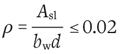
where:
Asl is the area of anchored tensile reinforcement (normally calculated per metre width of slab).
bw is the effective width at the height of the centroid of the combined tensile reinforcement (this width will comprise a number of ribs when calculated over the same total width as used to determine Asl).
d is the effective depth of the section, taken as the depth from the top surface to the centroid of the tension forces.
For typical UK composite slabs with only one layer of mesh reinforcement close to the top of the slab and no bars in troughs, the area of the tensile reinforcement, Asl is therefore taken as the effective area of the steel sheeting alone. To mobilise the full area of the sheeting in yielding, the anchorage length (i.e. contact area) should be large enough to generate the required level of shear bond between the concrete and steel. This force may be supplemented by end anchorage. However, as ρ is limited to 0.02, for many composite slabs the full area of the steel sheeting is not required to generate the maximum concrete resistance. It is also worth noting that the concrete resistance is a function of the cube root of ρ, meaning it is not overly sensitive to reductions in Asl.
Generation 2 treatment of vertical shear and concentrated loads
Design resistance
The design vertical shear resistance of composite slabs in the second generation of Eurocode 4, includes the contribution of the sheeting. The new rules allow some (50% is recommended, and likely to be adopted by the UK, but this is for national determination) of the shear buckling resistance of the profiled steel sheeting to be added to the concrete resistance. To achieve this level of resistance, the sheeting has to be sufficiently ‘held in place’ for the webs to fail in shear buckling. In the second generation of Eurocode 4, the shear buckling resistance is limited to the design value of permanent vertical shear forces applied during construction. However, we believe this to be an error and expect this to be addressed by the UK National Annex.
Treatment of loads
As well as revising the resistance model, the second generation of Eurocode 4 provides useful insight into how one should deal with uniformly distributed loads and concentrated loads placed near the support, which may be onerous in terms of providing anchorage.
Uniformly distributed loads
According to the second generation document, for a uniformly distributed load, the design vertical shear resistance of a composite slab should be checked at a cross-section at a distance d from the support. Only anchorage more than a distance d beyond the cross-section being checked may be considered as effective, i.e. only anchorage up to the edge of support may be considered for this case. This means that the minimum anchorage length provided by discontinuous sheeting may only include the sheeting bearing width. The anchorage can be increased by the sheeting fixings (sheeting nails or thru-deck welded shear studs) as well as any contribution due to the sheeting having deformed ribs (also known as ‘crushed ends’). The end anchorage by deformation of the ribs at the end of the sheeting is not insignificant for re-entrant sheeting, but likely to be very limited for trapezoidal sheeting.
Concentrated loads between d and 2d from a support
According to the second generation Eurocode 4, for a single concentrated load located at a distance aq between d and 2d from the support, the vertical shear resistance should be verified at a cross-section d from the load (i.e. at the edge of support when the load is at d). In recognition of the fact that some of the load will pass straight into the support, the contribution of this load to the design shear force VEd may be reduced by multiplying it by 0.5aq/d in accordance with clause 10.7.5(1). In this case (load at d) the anchorage of tensile reinforcement is therefore considered from the edge of support.
Concentrated loads closer than d from a support
Presumably because they will be rare (or could be avoided), Eurocode 4 makes no comment on single loads closer than a distance d from a support, although Eurocode 2 does. For a single concentrated load located less than d from the support, according to clause 8.2.1(11) of the second generation of Eurocode 2 a strut-and-tie model may be used. Such a model would require sufficient reinforcement anchorage to resist the ‘tie force’. It also notes that the shear verification may be omitted, provided that:
- τEd ≤ 2τRdc,min;
- the flexural reinforcement is fully anchored at the support and at the load introduction.
where:
τEd is the shear stress over the cross-section.
τRdc,min is the minimum shear stress resistance given by expression 8.20 of BS EN 1992-1-1:2023.
Multiple moving concentrated loads
For a series of moving concentrated loads such as MEWPs, vertical shear should be verified with the closest wheel positioned at 2d from the support, with the vertical shear resistance verified at a cross-section d from the support. Anchorage of tensile reinforcement for this cross-section is therefore as noted above. As the spacing between wheels is larger than 2d, a series of moving concentrated loads closer than 2d from the support does not need to be considered according to the National Annex for the second generation of Eurocode 2 as the shear force at the support would reduce, because of reductions permitted for concentrated loads close to a support.
Conclusion
While the anchorage provided for discontinuous sheeting may not be enough to increase the ρ term to its maximum value 0.02 (note this limit is not maintained in the second generation document), the current rules for vertical shear resistance of composite slabs ignore any vertical shear resistance of the steel sheeting. Whilst explicit calculation considering the specific details of any given case is recommended, the design vertical shear resistance of composite slabs with discontinuous sheeting is unlikely to be less than that assumed using current practice (i.e. that the sheeting is fully anchored). This is because loss in concrete resistance due to limited sheeting anchorage will be compensated by including the web crushing resistance of the steel sheeting.
Contact: Liam Dougherty
Telephone: 01344 636555
Email: advisory@steel-sci.com