Projects and Features
West End offices in the frame
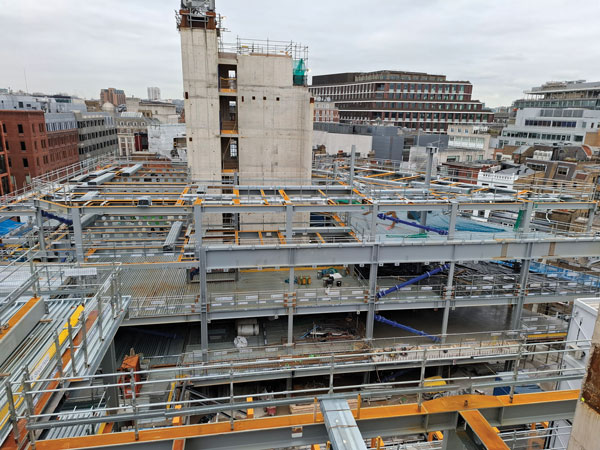
Transforming a large swathe of London’s prestigious Mayfair district, the South Molton project is maximising the available floor space with a steel-framed solution for its two office buildings.
FACT FILE
South Molton, London
Main client: Grosvenor, Mitsui Fudosan
Architect: Hopkins Architects
Main contractor: Skanska
Structural engineer: AKT II
Steelwork contractor: Severfield
Steel tonnage: 2,300t
Adapting to the historic street pattern and fabric of Mayfair and covering two acres, South Molton is a wide-ranging scheme that will create a new destination in the heart of the capital’s West End.
A stone’s throw from Bond Street underground station, the project’s site is bounded by South Molton Lane and Davies Street to the east and west, and Brook Street to the south.
Overall, the scheme will deliver new shops, cafés and restaurants, alongside two office blocks, residential properties, a restored pub and a boutique hotel.
According to Grosvenor, the opportunity to deliver this scale of new, world-class office space in Mayfair is exceptionally rare. Benefiting from the new amenities and public spaces they are creating at South Molton, the offices are set to be some of the capital’s most prestigious addresses.
The project is being delivered in three separate phases, with the largest phase (the office blocks) being undertaken by Skanska.
Providing corporate HQ opportunities in one of the West End’s most sought-after locations, the two steel-framed eight-storey office blocks at 60 Brook Street and 56 Davies Street, comprise 6,596m² and 7,246m² respectively.
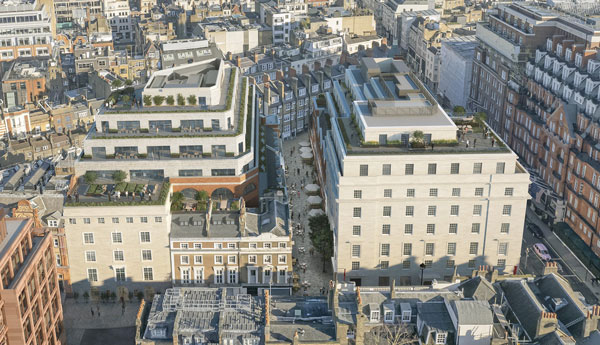
The office buildings are separated by a small thoroughfare known as Davies Mews (closed throughout the construction programme) that bisects the site from east to west.
In the completed scheme, Davies Mews will become a lively street, served by some of the numerous retail outlets and restaurants, accommodated within the ground floor of both office buildings.
As well as retail, and food and beverage outlets, the ground floors in each building will also incorporate the main entrance lobbies for the offices floors, which occupy every floorplate from level one upwards.
Both steel frames start at ground floor slab and sit above concrete substructure basements. Because an Elizabeth Line underground tunnel runs beneath the north building, it has a single subterranean level, while the south building is able to have a deeper two-level basement.
“One of the reasons for choosing a steel-framed method for the project was the need for a lightweight solution, because we are building above important transport infrastructure,” explains AKT II Associate Director Simone Colella.
Following a demolition programme, the basements were formed during the project’s enabling works package. A piled secant wall was installed around a portion of the south building’s footprint, as well as a raft foundation for each building.
In line with Grosvenor’s sustainability commitments, the project is targeting net zero carbon in operation and construction, minimising embodied carbon and waste wherever possible, with offsetting strategies in place to ensure the development is carbon neutral at practical completion.
Helping the project achieve its sustainability targets (the offices are aiming for BREEAM ‘Outstanding’), approximately 31t of reused steel has been incorporated into both buildings’ steel frames.
A proportion of the reused material was sourced from steelwork contractor Severfield’s own internal stock, with the remainder coming from stockist Cleveland Steel & Tubes.
Reusing materials also extends to the building’s fabric, as both structures incorporate retained façades; a red brick two-storey façade wraps around the southern elevation of the Davies Street building, while another four-storey (red brick and render) façade is retained on the Brook Street office.
Elsewhere, Portland Stone facades were carefully removed during the demolition works and taken away to be cleaned. Retaining the area’s historic streetscape, the material will be reinstated to clad the new steel-framed buildings along their two main elevations.
Another aspect of local history, which is being retained as part of Skanska’s package is the Running Horse pub. The refurbished establishment will sit next to the Davies Street building, while two neighbouring buildings have also been retained up to second-floor level and incorporated into the scheme as meeting rooms.
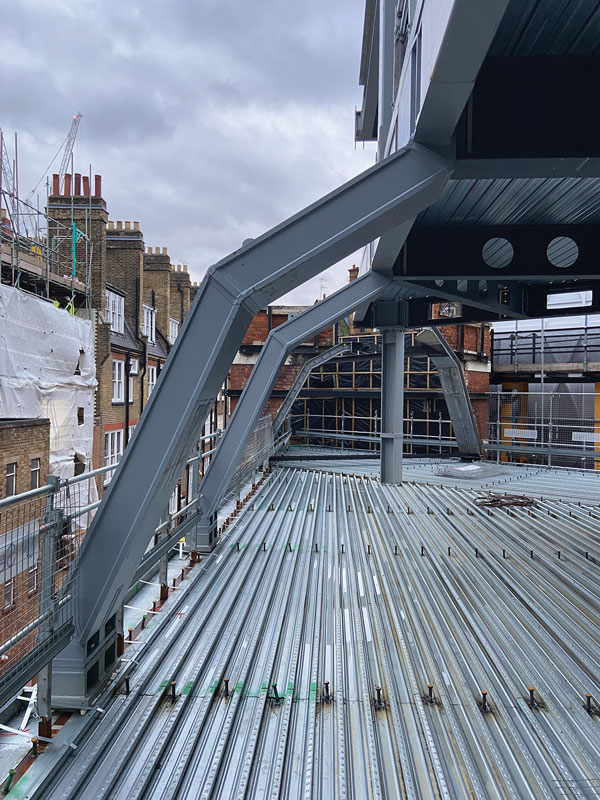
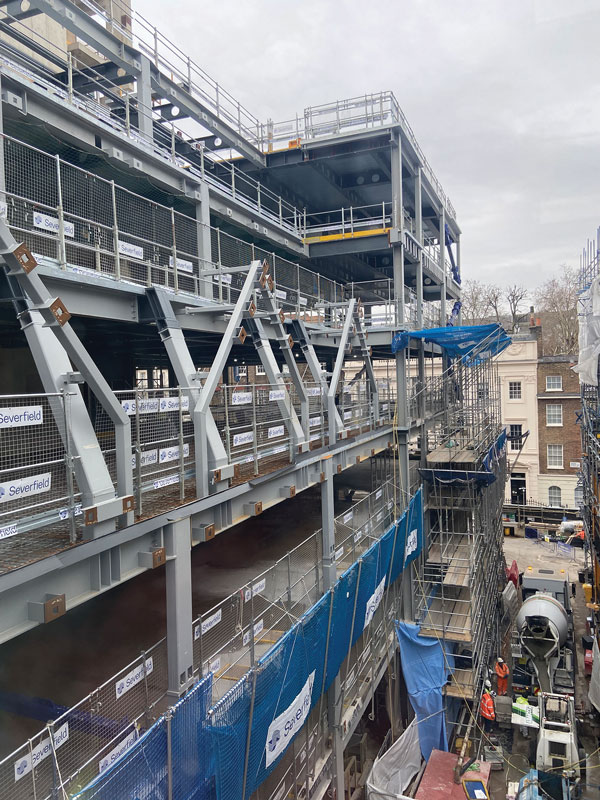
New steel floors sit above the retained buildings, with their columns sat on the existing party wall and also supported by an 8m-long cantilever Vierendeel truss.
Both steel framed blocks are arranged around centrally-positioned concrete cores that provide the majority of the structural stability.
Radiating out from the cores, long span cellular beams have been used to accommodate the building services within their depth. With minimal internal columns, the beams, which are up to 10.5m-long, also create the clear open-plan floorplates that modern offices require.
The beams support a composite metal decked flooring solution, which was a late addition to the project’s design.
Skanska Project Director Paul Roberts explains: “Initially, the office block’s design included precast flooring, supported on steel beams, but this was altered to Electric Arc Furnace (EAF) metal decking, which became available just before we started construction. This change gave the project a significant embodied carbon saving, and was 14 weeks quicker to install.”
Providing plenty of outdoor breakout space for the office occupants, one of the standout design features is the numerous terraces that cascade down both buildings above level four.
The terraces require a series of large transfer beams, to support the required set-backs (steps) in the building’s steel-framed structure.
Some of the heaviest steel elements that Severfield has supplied to the scheme are four plate girders, located along the southern elevation of the Davies Street building (overlooking Davies Mews). The girders are 4m-long, 5.3m-long, 9.8m-long and 11.5m-long respectively, with the heaviest weighing 9.8t.
These large steel elements, positioned at the underside of the fifth floor, support the fourth and third-floors via hangers, thereby allowing two rows of columns to be omitted from the building’s lowest floors. This creates some extra column-free space for the ground, first and second floors.
South Molton is due to complete in July 2027.