Projects and Features
Forging ahead

A large steel-framed building, designed to accommodate nine overhead cranes, is providing the space for a new machine shop, part of a £1.3 billion recapitalisation programme at one of Sheffield’s most historic steelmakers.
FACT FILE
Sheffield Forgemasters
New Machine Shop building
Main client: Sheffield Forgemasters
Architect: Bond Bryan
Main contractor: McLaughlin & Harvey
Structural engineer: Arup
Steelwork contractor: BHC
Steel tonnage: 12,500
Helping to underpin UK defence manufacture, one of the world’s most advanced, large-scale, machining facilities is under construction in Sheffield.
The New Machine Shop building (NMS), which is being built by Ministry of Defence-owned Sheffield Forgemasters (a company that can trace its history back 250 years) will, on completion, house 24 new machines including some of the world’s largest vertical turning lathes.
Complementing the firm’s existing facilities, this game-changing project is being carried on recently purchased land that was formerly occupied by Cammell Laird’s Brightside Steel Works, once part of the Vickers empire which Sheffield Forgemasters inherited in 1983.
Commenting on the scheme, Craig Fisher, the company’s Programme Director (Recapitalisation), says: “The scale of the building will make it an iconic landmark for the city, clearly seen from the M1 Motorway near to Meadowhall.
“We are delivering a facility of national significance, which will not only help support UK industries for generations to come but also support the local economy in South Yorkshire.”
Befitting a project being undertaken in Steel City, the NMS requires the installation of a large-scale steel-framed superstructure. The frame will provide 30,000m² of floor space and is 273m-long × 109m-wide and 29.5m-tall to the eaves.

The requirement for large column-free spaces and a quick installation programme made a steel-framed structure the only viable solution.
As well as creating the necessary open-plan areas – the building has three internal spans of 34m, 36m and 38m, running the entire length of the structure – the steel frame needs to support nine overhead gantry cranes.
Servicing the machines with steel castings (which can be up to 360t in weight), each span will have three cranes, one 250t-capacity unit and two 150t-capacity units.
The crane movements will transmit significant loadings into the frame and consequently the supporting steelwork has been designed to be very stiff, rigid and able to absorb the forces and transfer them into the piled foundations.
The overhead cranes will operate along six rows of (crane) beams that run the full length of each span. They are supported on a series of 4.3m-deep trusses, which in turn are supported by 19m-tall lattice columns. In total, there are 84 × 20m-long truss sections, each weighing 27t.
As well as supporting the crane beams, the trusses also connect to a series of steel maintenance gantries and walkways.
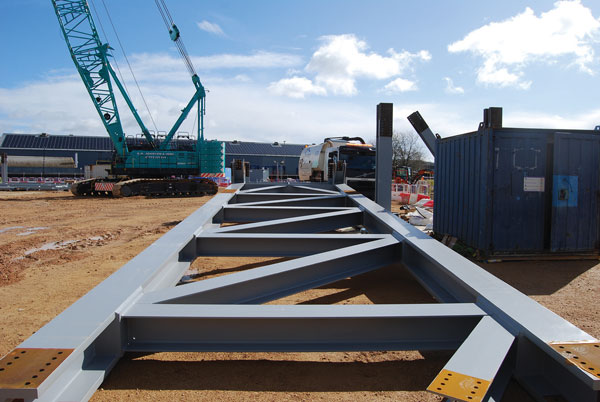
The large lattice columns are 3m-wide along the building’s perimeter and in the structure’s two valleys, where there are two adjacent rows of crane beams to support, they are 4m-wide.
There are 68 fully-welded lattice columns in the steel frame, weighing up to 30t each. They were brought to site as complete sections, before being installed using 135t-capacity crawler cranes.
“The lattice members are generally spaced at 20m centres, providing enough room for the numerous openings and access points along the building’s perimeters,” explains Arup Principal Structural Engineer, Adrian Bull.
“While internally, the column spacings create areas for storage and welfare hubs.”
As the NMS is so long, it requires two movement joints, each running the full width of the structure and splitting it into three segments.
Positioned either side of the movement joints there are a series of 4m-wide × 23.7m-long fully-welded lattice bracings, that provide some extra stiffness to the columns. Along the perimeter positions, the bracings are slimmer UC sections.
Working alongside the lattice members and trusses, the roof of the building and its supporting steelwork has been designed as a traditional portal frame.
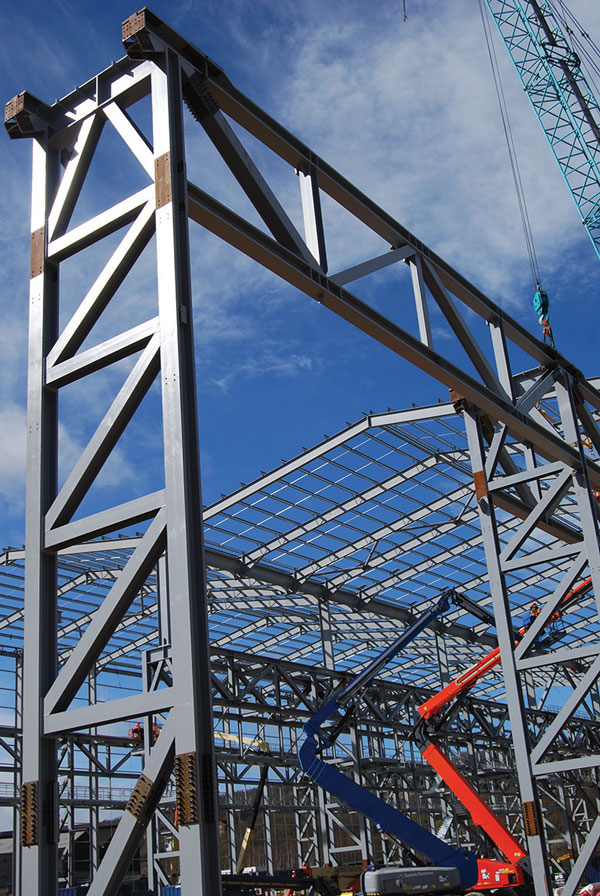
The NMS roof is supported by a combination of 9m-tall portal sections, connected to the top of each lattice column and a series of 29.5m-tall 356mm × 406mm × 467kg/m and 356mm × 406mm × 551kg/m UC column sections, arranged at 7m centres along the building’s perimeters.
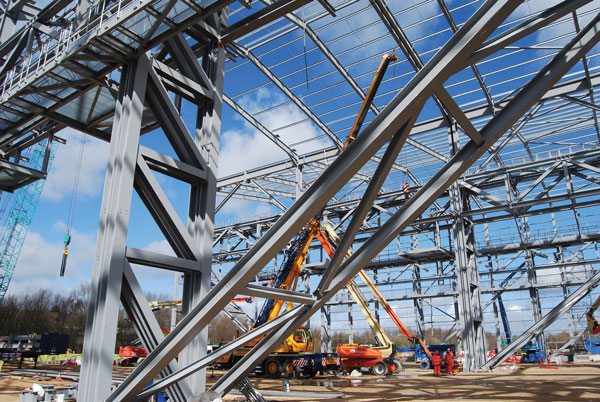
Each span of the roof is formed with a series of rafters, which were brought to site in halves, lifted into place using two mobile cranes and bolted together in the air.
Along the internal valleys, the roof has a hit-and-miss configuration, with no intermediate UC columns for support, just the portal stubs on top of the lattice members.
Following on behind the installation of the steel frame, the NMS cladding and M&E packages will begin, alongside some extensive internal groundworks. As well as forming the ground floor slab, a number of pits – up to 8m-deep, have to be formed to accommodate machinery and conveyor systems.
Once areas are clad, BHC will begin to install eight external steel stair towers, which are 29m-high and 6.5m × 4m-wide.
Positioned along both main elevations, the free-standing, colour-galvanized black towers provide access to the cranes and gantry walkways, as well as the roof, via two bridges.
After the NMS steel erection programme, BHC will immediately start the erection of the adjacent SAW Building (which as the name indicates, will on completion accommodate large steel sawing machines).
Measuring 105m-long × 33m-wide and 27m-high to the eaves, this structure has a similar design to the NMS, with lattice columns supporting crane beam trusses and a portal-framed roof creating the building’s single span.
Summing up, BHC Project Manager Bobby McCormick, says: “The work has presented a number of technical challenges, particularly around fatigue-driven connection design, which required careful engineering and attention to detail throughout.
“In total, 178 lattice columns and crane supporting trusses were fabricated across our two heavy-duty production bays, showcasing both our capacity and capability.
“Planning and coordination were critical during the logistics phase. We arranged the delivery of 178 abnormal loads, averaging around 10 per week, working closely with the relevant authorities to ensure each movement was carried out safely and efficiently. This joined-up approach was instrumental in maintaining programme certainty and achieving on-time delivery.”
The NMS and SAW building are both due to be complete and operational by 2029.
Forge expansion
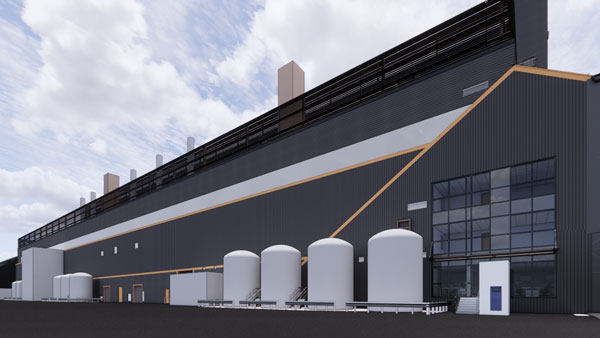
Complementing the construction of the NMS, Sheffield Forgemasters is also constructing another steel-framed building that will house the UK’s largest open-die forging-line.
The 12,700m2 structure will sit adjacent to the existing forge building on the company’s Brightside Lane site and as well as housing a new 13,000t press, it will include offices and a water pumping station.
Gareth Barker, Chief Operating Officer at Sheffield Forgemasters, says: “The new facility will significantly improve our throughput of large, complex forgings and will enable us to push the envelope in terms of forging techniques and processes, as well as improving accuracy and reducing downtime.”
The project is being undertaken by main contractor VINCI, with Billington Structures fabricating, supplying and erecting the steelwork.