Projects and Features
Gateway to learning
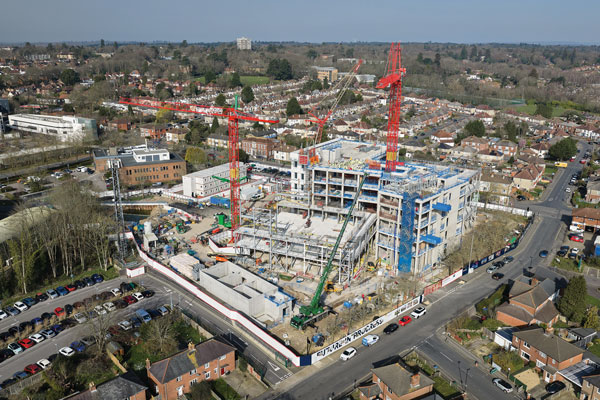
The University of Southampton’s latest education building has utilised a hybrid framing solution, including two steel-framed blocks, satisfying its need for flexible teaching, lecture and seminar spaces.
FACT FILE
University of Southampton, North East Quadrant B75 Building
Main client: University of Southampton
Architect: Sheppard Robson
Main contractor: Kier Construction
Structural engineer: Arup
Steelwork contractor: Bourne Steel
Steel tonnage: 625t
Forming a new gateway to its Highfield Campus, construction work is underway on the North East Quadrant project at the University of Southampton.
Central to the ambitious scheme is the B75 building (named to celebrate 75 years since the University was granted a Royal Charter by HM Queen Elizabeth II). The five-storey 15,000m² building will include a range of lecture theatres, event teaching spaces and seminar rooms, alongside a café, nursing room and a variety of indoor and outdoor social spaces designed to create a bustling student environment.
Professor Mark E. Smith, Vice Chancellor of the University of Southampton, said: “The new building symbolises our dedication to fostering an innovative and inspiring learning environment for our students and faculties. This space will be a hub of creativity, collaboration and academic excellence, ensuring that the University of Southampton continues to be a sector leader in education.”
John Boughton, Managing Director of Kier Construction Southern, says: “Our work at the University brings together leading supply chain partners, whose combined expertise is key to delivering this state of the art building for Southampton.
The impressive progress of the steel and concrete frames is a testament to the collaboration on the project – from design experts to experienced operatives – everyone is playing their part in bringing this flagship project to life.”

Aiming to achieve a BREEAM ‘Excellent’ rating, the project is set to be the University’s most sustainable building to date. The space has been designed with a fabric-first approach, maximising the use of natural ventilation where possible. The use of passive, energy saving materials throughout will reduce the operational energy demand by 40%, meaning cost and carbon savings throughout the building life cycle. Solar panels will be added to part of the roof, and an air source heat pump will heat the building.
To this end, the building’s structural framing has used a hybrid approach, with different methods used throughout the scheme, depending on the area’s intended function.
B75 has four distinct blocks, but with no movement joints separating them, each is interconnected, locked together and gains stability from the centrally-positioned core block.
The stability-giving core block is formed with in situ concrete and contains lifts, toilets, and the main atrium and circulation routes.
The west block has been constructed with post-tensioned concrete and will accommodate a student teaching hub. It has been designed with flexibility in mind and, with the addition of extra partitions, it could become a teaching space in the future.
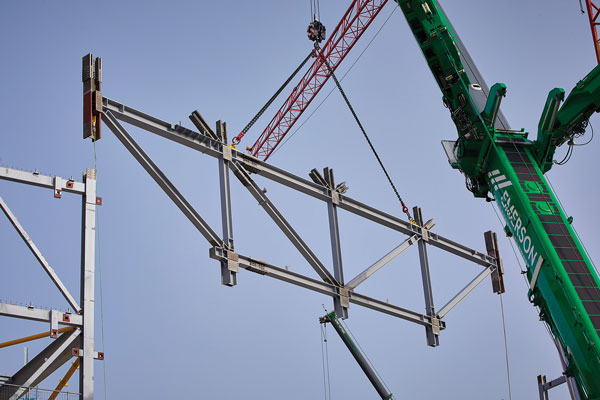
The two remaining areas – the south block and the four-storey east block – have been designed as steel-framed structures supporting precast flooring planks.
Arup principal engineer Ben Woodward, says: “In keeping with the client’s brief, we’ve used a hybrid design with different framing solutions to suit each particular area of the building.
“For the two blocks that need to have column-free floorplates, steelwork was the most efficient method of construction, while the use of precast planks provided a quick installation programme – alongside the steel – and gave us the required acoustics.”
Working on the relatively confined site, situated within a ‘live’ university environment, logistics and planning have played a key role on the project. Following on from the groundworks and installation of foundations, the two concrete blocks were constructed first, with the steel erection package following on behind.
This initially gave the concrete team space in which to work, but once the first two blocks were up, they then provided the stability for the steel frames.

The steel-framed south block is the largest of the four areas. It features a stacked-up design, with a 120-person semi-circular lecture theatre at ground-floor, spanned-over by a 400-capacity seminar space at first-floor level.
The first-floor seminar space is a double-height zone, with a series of 21m-long plate girders forming the ceiling, as well as the floor of another double-height, column-free space (a 220-person lecture theatre) at the third floor.
Splitting the block in half and supporting around 60% of south block’s floor space, a large 26m-long × 11m-deep truss is positioned at third floor.
“As thetruss is so deep, it was fabricated and brought to site in two sections, which were individually lifted into place using a 400t-capacity mobile crane,” explains Bourne Steel Project Director Duncan Wyatt.
The remainder of the steelwork, including the plate girders, has all been installed using the project’s tower cranes.
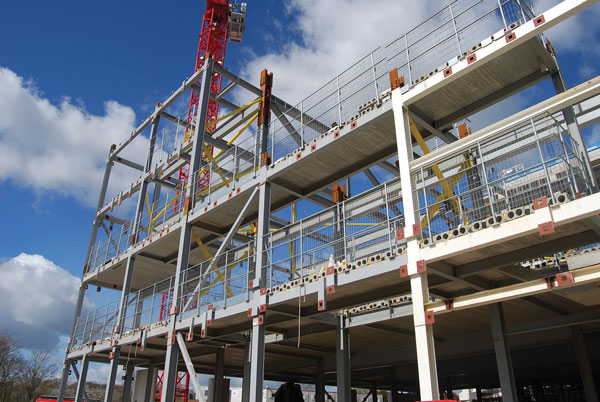
On its western side, the truss supports the plate girders that form the third floor as well as the UB sections that create the block’s roof. On the eastern side of the truss, there is another series of 12m-long beams, forming five floors of seminar spaces.
Where the south block connects to the core, a bespoke design feature has been used. During the steel erection sequence (temporary condition), the south block truss exerts some significant forces on the frame, pulling columns away from the core.
To counteract this, the steel connections to the concrete core, feature slotted holes within the base plates, allowing movement during the temporary condition. Once the building reached its permanent condition, whereby all of the steel frame was up and the precast planks had all been installed, a series of tension controlled bolts (TCBs) were installed to connect the steel framed south block to the core, locking the two areas together.
The smaller east block features floorplates with spans of up to 18m-long, with only one row of internal columns located along the elevation that connects to the core block.
Creating the desired multi-functional teaching zones, the first floor is a double-height space, with the second floor designed as a 7m-wide mezzanine, to be used for back-of-house storage.
B75 is scheduled for completion in Autumn 2027 ready for a new cohort of medical students to begin their studies in a state of the art learning environment.