Projects and Features
Trusses span retail destination
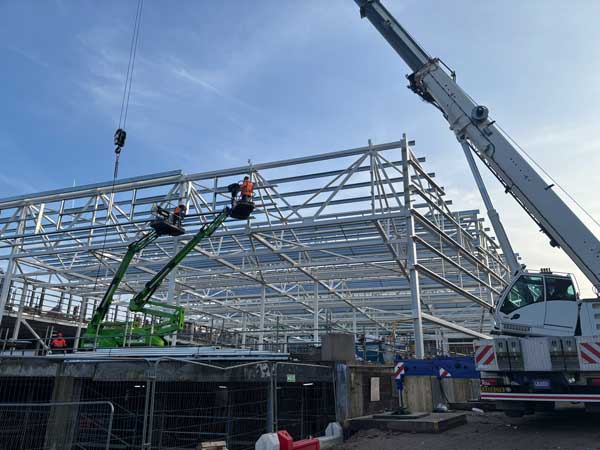
Phase one of a transformative mixed-use scheme in Wigan town centre includes the development of a new steel-framed indoor market hall.
FACT FILE
Wigan Indoor Market Hall (Fettlers)
Main client: Wigan Council
Master developer: Cityheart
Architect: jm architects
Main contractor: Galliford Try
Structural engineer: SGI Consulting
Steelwork contractor: Leach Structural Steelwork
Steel tonnage: 400t
Helping the traditional market town of Wigan keep pace with changing shopping and entertainment preferences, the Fettlers development is set to create a centrally located retail, leisure, commercial and residential destination.
Being built on the former Marketgate and Galleries shopping centre sites, the scheme is said to be one of Greater Manchester’s most ambitious projects. It will breathe new life into the town centre, creating a vibrant destination where people can live, shop, work, visit and socialise.
Alongside Fettlers, a number of other projects are continuing to gather pace across the town centre. These include Civic – the new flex office and creative hub, which has already opened in the former Civic Centre – a new building at Wigan & Leigh College’s Parsons Walk campus (see NSC October 2025), Cotton Works at Trencherfield Mill, and STACK, coming to the former Debenhams unit in the Grand Arcade shopping centre.
According to Wigan Council, this construction activity is a testament to the fact that investors are looking outside the main cities and seeing that their returns are better in the smaller towns.
One of the first buildings to get underway at Fettlers is a new steel-framed indoor market hall, which will play a big part in the scheme’s aspirations and vision. The completed market hall will have a diverse range of offerings, including traditional market stalls, a food hall, bars, shops, seating areas and a large screen as well as workspace.
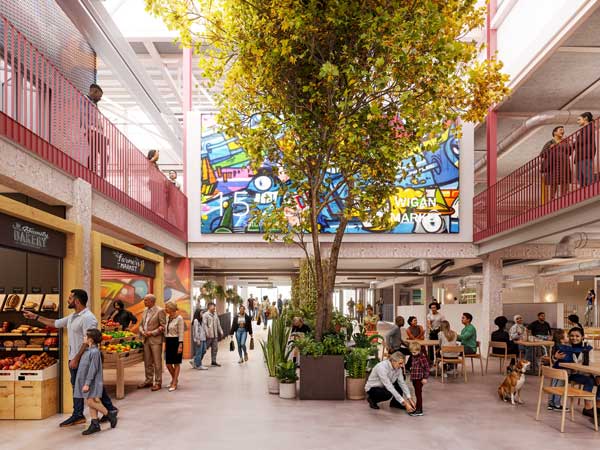
Adjacent to the market hall, phase one also includes a Hampton by Hilton hotel and a three-storey steel-framed office pavilion.
Overall, the development’s site covers a much larger area, and later phases are set to include a leisure building, new public square and more than 400 new homes.
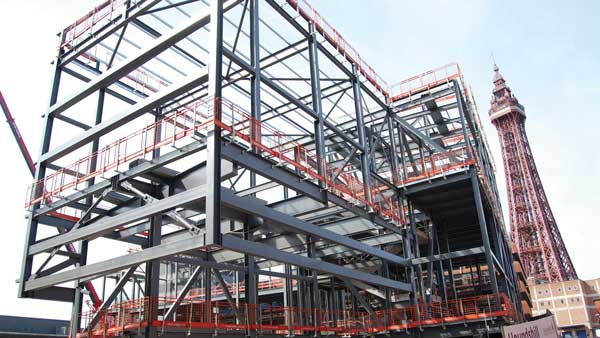
Structural steelwork was chosen as the framing solution for the market hall as the material offered the most efficient way of creating the required internal spans. Its lightweight attributes have also come to the fore, as the steel frame is founded on a retained two-storey concrete structure.
Once part of the 1970s-built Marketgate shopping centre, the concrete structure has been incorporated into the overall design and forms the hall’s two floors (lower and first).
Because the site slopes from north to south, the lowest floor is at basement level at the Standishgate end (the main shopping thoroughfare of the town centre) and at ground-level at the northern end. Likewise, the main entrance to the hall (on Standishgate) is at ground-level, which then becomes the first floor at the opposite end of the building.
Retaining the concrete structure has presented the scheme with some sustainability benefits, as there was less demolition during the enabling package, which in turn lessened the construction programme’s embodied carbon.
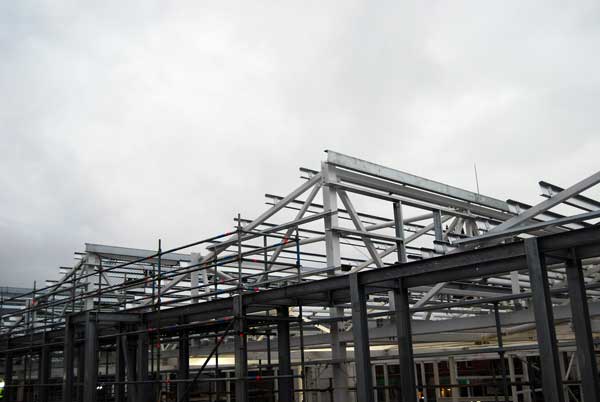
Another benefit is the fact that following extensive load path assessments, the retained structure’s existing foundations have been reused to support the market hall’s (lightweight) steel frame.
Some new piles have also been installed as approximately one-fifth of the market hall is not located on top of the retained structure and required new foundations to support a steel-framed podium.
Amounting to more than 4,000 individual pieces, the steelwork started to be installed in August 2025. Some of the initial steel elements to be erected were within the retained concrete structure, framing new openings that had been opened up to accommodate staircases and risers.
Measuring approximately 110m-long and up to 40m-wide, the majority of the hall is topped with a saw-tooth canopy roof, a design that provides a nod to Wigan’s industrial heritage.
The design allows the incorporation of north lights that will allow natural light to penetrate into the building.
The roof is formed with a series of steel trusses, supported by 18m-high columns, founded on the uppermost level of the retained concrete structure, as well as some higher columns within the new steel-framed area.
The retained concrete structure’s columns are spaced at 6m centres, but in order to create a more open-plan upper floor for the market, new steel columns are sat above every other column, forming a larger 12m × 12m grid.
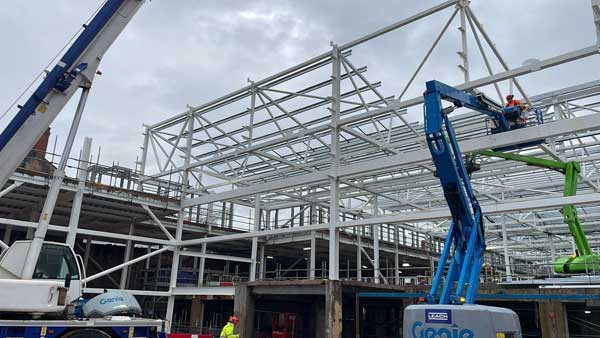
Using this grid, the north lights are positioned within a series of triangular 12m-long × 2.5m-tall trusses that span between the hall’s columns in an east to west configuration. Connecting these trusses, are another series of 12m-long Warren trusses that span the roof in a north-south direction.
The exception to the larger grid pattern is along the northern boundary where a plant deck (which is adjacent to the canopy roof) has columns set at the 6m × 6m pattern.
Planning and logistics proved to be key to a successful steel erection programme. The retained structure could not support the weight of a crane, so for the majority of the package, a 70t-capacity mobile crane, positioned next to the retained structure, was used.
The roof trusses were delivered to site in sections, which were assembled during the erection process.
Once the two supporting columns were in place, the procedure required the bottom boom of the truss to be installed first, which then allowed the remainder of the steel sections to be subsequently assembled.
In order to erect the initial steel sections that form the Standishgate entrance, a much larger capacity crane with a longer reach was required.
“Access to the site for steel deliveries was only available from one point, which was on the opposite side of the site and away from the shopping street,” explains Leach Structural Steelwork Estimating & Preconstruction Director, Karl Hunter.
“This meant we needed a 150t-capacity crane with a fly jib, which had to lift 1.9t steel sections across a distance of 56m, right over the retained concrete structure.”
The Fettlers indoor market hall is due to be complete and open for business by the end of this year.