SSDA Awards
MERIT – The Whale on the Wharf (Skyscraper), London
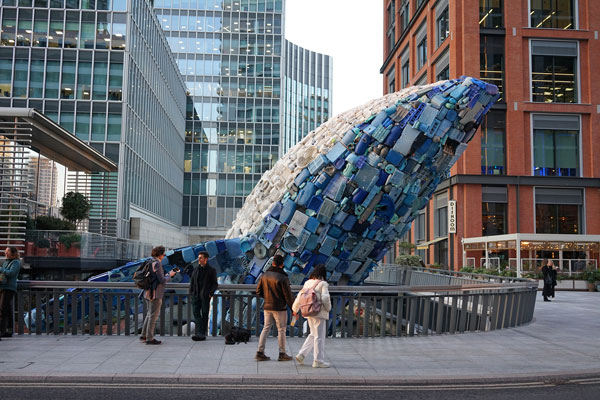
A sculpture depicting a breaching whale is fabricated from reclaimed steelwork and clad with five tonnes of plastic recovered from the Pacific and Atlantic Oceans.
FACT FILE
Artist: StudioKCA
Structural Engineer: Thornton Tomasetti
Geotechnical Engineer: A-squared Studio
Main Contractor: DiveCo Marine Ltd
Client: CWG
Permanently installed within Wood Wharf in London’s Docklands, the Whale on the Wharf (Skyscraper) is a 12m-tall public artwork depicting a whale breaching from the water.
The illusion of the marine mammal emerging from the dock is made possible by a submerged structural steel frame. Although the sculpture is relatively lightweight, its asymmetric pose and wind loading on the cantilevered spine generate significant tension within the supporting system. These forces are transferred through the steelwork into concrete foundations below the water.
The dock location created some complex engineering and installation challenges. The sculpture stands in approximately 5m of water, directly above underground railway tunnels and close to Grade I-listed dock walls. With limited visibility beneath the surface, construction required carefully coordinated marine operations and a detailed sequence for divers, lifting equipment and the installation team.
The underwater foundations were formed using precast manhole rings as cofferdams. Steel plunge columns had to be positioned accurately within them before concrete was poured underwater. The submerged frame was protected using a marine-grade paint system, combined with cathodic protection to address the demanding exposure conditions.
The 4t supporting frame was fabricated almost entirely from reclaimed steel sections, recovered from decommissioned pipelines, cancelled projects, surplus stock and demolished buildings.
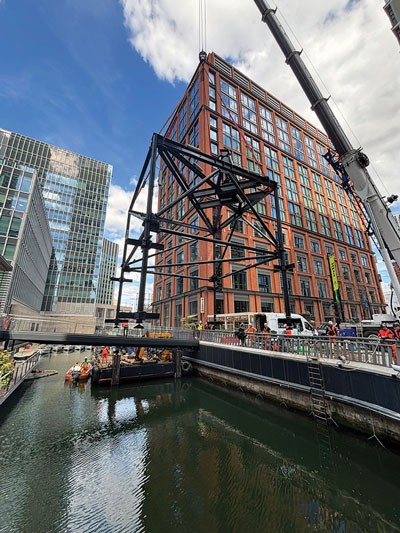
Offsite fabrication allowed the structure to be assembled and checked before being transported by barge from Tilbury along the River Thames and moored within the dock ahead of installation.
Steel was selected because it could be fabricated, transported and erected efficiently within the constrained marine environment. It also provided a compatible connection with the sculpture’s original steel spine. Once the supporting frame and spine were installed, reclaimed plastic panels were attached to complete the artwork.
“I’ve been welding and building with steel since I was 16. I’m comfortable with it as a material and I appreciate its strength, longevity, and reliability over time,” says StudioKCA Principal Jason Klimoski.
“It seemed like the right choice and is the structural material for many of our sculptures. We also like that steel can be recycled, reused, and/or repurposed in the future, and that fits with the concept for the sculpture.”
As well as the steelwork, circular economy principles also extended to the foundations. The concrete incorporated spent coffee grounds collected from local cafés and converted into biochar.
Overall, the completed structural elements achieved total A1-A3 emissions of 10,788kgCO₂e, compared with an estimated 28,600kgCO₂e for virgin steelwork and conventional concrete. The reclaimed steel reduced its contribution from an estimated 9,829kgCO₂e to 1,593kgCO₂e.
In summary, the judges say, the Whale on the Wharf is a remarkable 12m-tall sculpture, supported by a repurposed steel structure and crafted from five tonnes of ocean plastic. Delivered through exceptional collaboration, including complex marine logistics and diving coordination, it combines thoughtful engineering, innovative low-carbon design and a compelling environmental story, setting a new benchmark for purpose-driven structures.