Projects and Features
Lighting up the Games
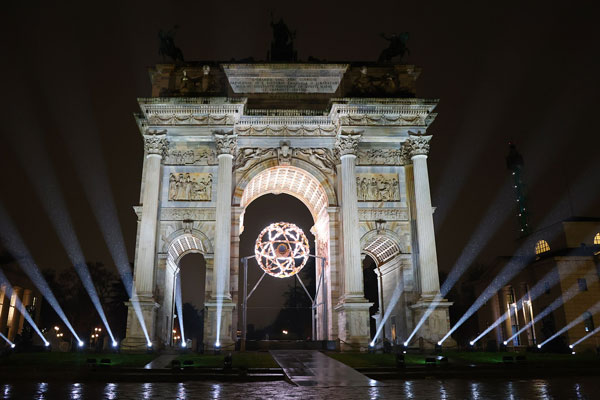
The twin hosts of the Milano Cortina 2026 Winter and Paralympic Games each had their own intricately engineered and expanding cauldrons to accommodate the all-important Olympic flames.
FACT FILE
Milano Cortina 2026 Winter Olympic and Paralympic cauldrons
Main client: Balich Wonder Studio
Structural engineer & steelwork contractor: Stage One Creative Services
Steel tonnage: 15t
Breaking with tradition, the Milano Cortina 2026 Winter and Paralympic Games were the first in Olympic history to be hosted by two cities.
The fourth occasion that Italy has held an Olympic Games (one summer and three winter games), the concept of co-hosts was promoted as a sustainable and low-cost model. Easing financial burdens and the need to construct new venues, existing infrastructure (including venues used when Cortina held the 1956 winter games) was used across Northern Italy.
With two host cities, there was a requirement for two cauldrons – so each could have a vessel to support and accommodate the all-important Olympic flames. Every Games, summer and winter, since 1928 has had a ceremonial cauldron, as the lighting of the Olympic flame symbolises the opening of the competition and the continuity between the ancient and modern games. Conversely, the extinguishing of the flame forms a major element of the Games’ closing ceremony.
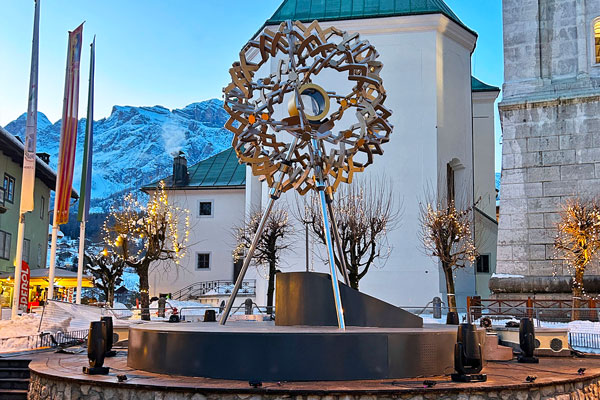
This year, two identical cauldrons were located within Milano’s landmark Arco della Pace and at Piazza Dibona in Cortina d’Ampezzo.
According to the International Olympic Committee (IOC), the cauldrons are a powerful symbol of harmony between the two host cities and were created by Marco Balich in collaboration with designers Lida Castelli and Paolo Fantin.
Having previously been involved with numerous high-profile sporting events, including all of the Olympic Games since Athens 2004, Yorkshire-based Stage One Creative Services were contracted to design, fabricate, supply and install the cauldrons.
Time, or the lack of it, is the norm when it comes to large global events, as Stage One’s Engineering Director, Nic Kidd, explains: “We had five months to design, manufacture and complete this project.
“To make the most of our short timeframe, we built a concept prototype concurrently with main design, so that we could learn what worked and what didn’t. We also designed and manufactured simultaneously with our UK-based LED subcontractor and Australia-based burner assembly subcontractor.”
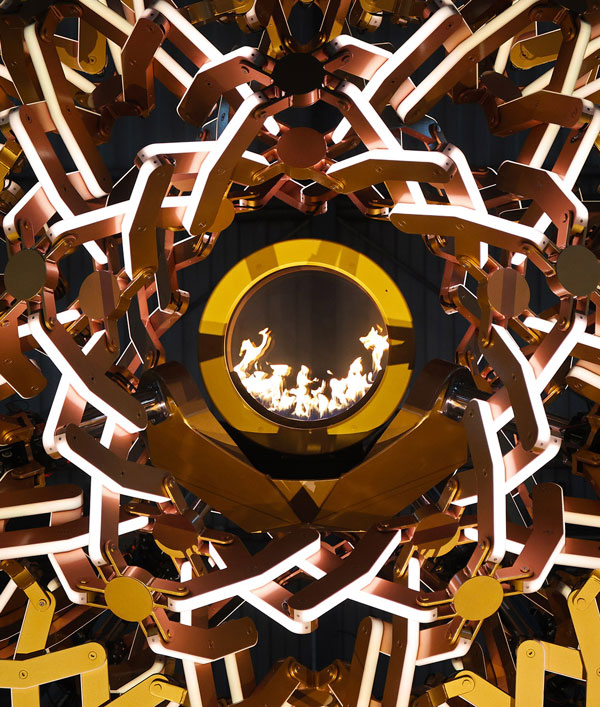
Surrounding the flames, which were enclosed in a glass and metal burner container, the two identical cauldrons are spherical in shape and feature a series of interlacing aluminium struts, offering a nod to the famous geometric designs or knots, created by Leonardo da Vinci.
Made of aeronautical aluminium, among the strongest and lightest materials, the cauldrons are dynamic structures that generate an opening and closing movement, said to bear witness to the continuity of time and the natural alternation between day and night.
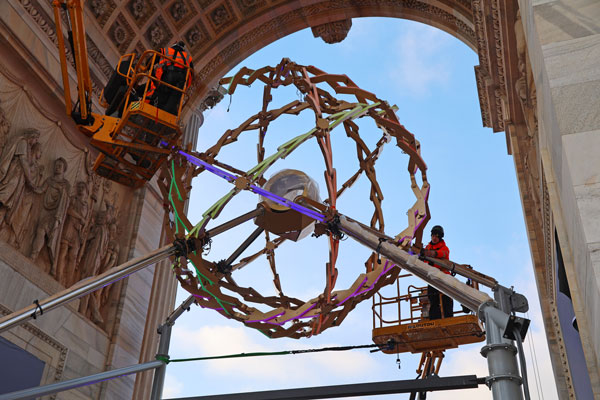
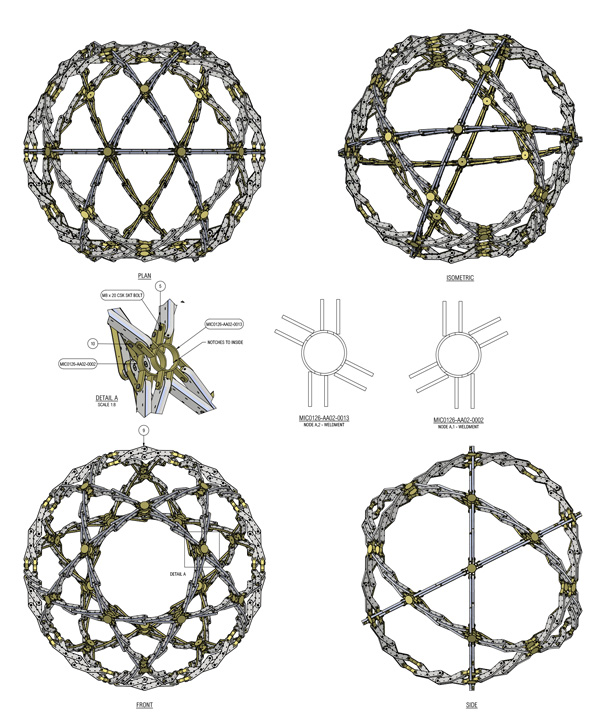
Because they open and close, the cauldrons feature variable geometry. They have a diameter that expands from 3.1m when closed to 4.5m when open. Their complex mechanical systems both integrate 1,440 components, mounted on pins and bearings.
Each cauldron sphere weighs 1,200kg and incorporates more than 50 fixed nodes and 60 opening and closing scissor units. In turn, each scissor includes four struts, meaning each sphere has 240 struts that also support LED lighting.
The symmetrical geometry allows each of the cauldron’s support legs to pass through nodal points in the structure.
“Various means of support were considered, including suspension, however the Milano cauldron was not allowed to touch the arch stonework in any way, so it had to be self-supporting,” says Mr Kidd.
“It was decided to use four angular stainless steel legs, supported by a steel main frame and base, with the latter hidden under a timber plinth.”
In Cortina, the cauldron was much lower to the ground, so it was supported on a steel tripod, which was also supported on a steel main frame, also positioned beneath a plinth. The frames and the associated drive mechanisms also acted as ballast for the two cauldrons.
Keeping the design as sleek as possible, the stainless steel legs accommodate slots to hide the power and data cabling as well as the mechanical drive mechanisms. In Milano, the four tubular legs consist of two at 5.2m-high and two at 3.9m-high members, while in Cortina the three legs are all 4.5m-high.
At Stage One’s Tockwith facility, the cauldrons were each test built, before being dismantled and transported to Italy for their final re-assembly.
For ease of transportation, the cauldrons were split into sub-assemblies comprising four struts built into a scissor. Each scissor came complete with pre-assembled LED power and data cabling.
Meanwhile, the steel frames and bases were shipped in the largest pre-assembled sections possible and then bolted together on site. Each cauldron required two trucks, plus a third vehicle for drive mechanisms and site kit.
Once onsite in Italy, the two cauldron installations required the same list of procedures, although the Cortina job was said to be slightly easier because it was built closer to the ground and only required a single cherry-picker.
Installing the cauldron within Milano’s Arco della Pace offered up a set of unique challenges. Cranes could not be used as there was insufficient headroom, so each assembly had to be manoeuvred into place and installed using a combination of cherry-pickers and telehandlers.
For both cauldrons, the erection of the base steelwork was the first part of the installation sequence. This was followed by the assembly of the legs and the positioning of the burner, which had to be installed before the surrounding sphere was completed.
Requiring numerous dimensional and positional checks, the leg nodes were installed, followed by the cauldron scissor assemblies and struts. Simultaneously, all of the mechanical drive mechanisms and LED power and data cabling needed to be installed and checked. To complete the tasks, a final movement test was then completed on each sphere.
Both cauldrons lit up their respective locations for the duration of the Winter Games (6-22 February) before being extinguished during the games’ closing ceremony.
They were relit for the Paralympics (6-15 March) and definitively put out at the conclusion of the Paralympic Closing Ceremony.