Projects and Features
Healthcare trusts in steel
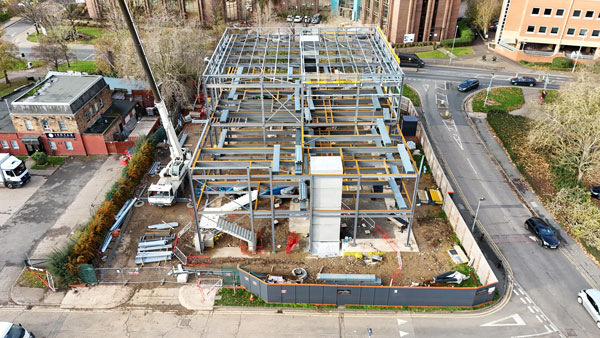
Having changed its design to a traditional steel-framed solution, a healthcare facility in Peterborough is making quick and efficient progress.
FACT FILE
Peterborough Community Diagnostic Centre
Main client: North West Anglia NHS Foundation Trust
Architect: Pinnegar Hayward Design
Main contractor: Tilbury Douglas
Structural engineer: Adept Consulting
Steelwork contractor: Shipley Structures
Steel tonnage: 95t
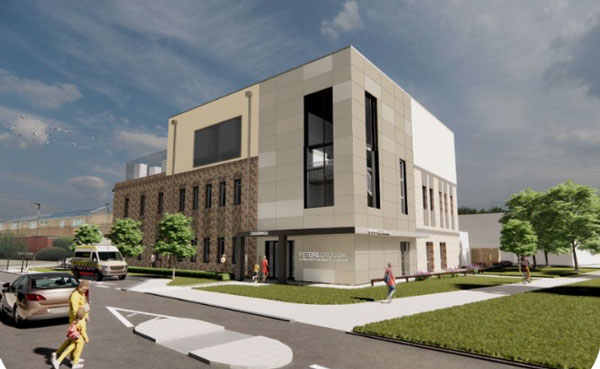
Located in Peterborough city centre, a new Community Diagnostic Centre (CDC), is quickly taking shape with the aid of steel construction.
The state-of-the-art steel-framed healthcare facility will be run by North West Anglia NHS Foundation Trust (who also run the nearby Peterborough City Hospital) and will offer patients more choice on their place of treatment, and help to reduce waiting times for important diagnostic tests.
The three-storey CDC will offer CT, MRI, DEXA, X-ray, Ultrasound & Fibroscan, as well as Cardiology and Respiratory diagnostic services.
“The CDC is of huge benefit to our local communities,” says Hannah Coffey, the Trust’s Chief Executive. “We know that waiting times for tests to help diagnose a condition are longer than we want them to be, and this can create additional anguish as well as a delay in treatment. The CDC will help us reduce waiting times and give patients a better experience, ensuring they receive results quicker. We are very excited to see this project evolve.”
Construction work started in 2025, following the demolition of the site’s previous building (an NHS City Health Clinic). Main contractor Tilbury Douglas, initially undertook an extensive groundworks programme to prepare the plot for the project’s steel frame.
“Because of the poor ground conditions, we remediated the site to a depth of 2.5m, before installing a ground beam/raft foundation solution on top of the engineered fill,” explains Tilbury Douglas Project Manager David Ross.
Originally, the project was going to be built with a modular cold-rolled steel design, but this was later changed by the client and the design team to a traditional beam and column steel frame.
“This has proven to be a better option, as it has allowed us to efficiently form the required internal spans,” adds Mr Ross.
The steelwork contractor for the scheme was locally-based Shipley Structures, who initially installed the building’s two precast lift shafts. Positioned at either end of the CDC, the shafts provide no stability to the steelwork, but as the frame wraps around them, installing the cores first, made the steelwork programme quicker and more efficient.
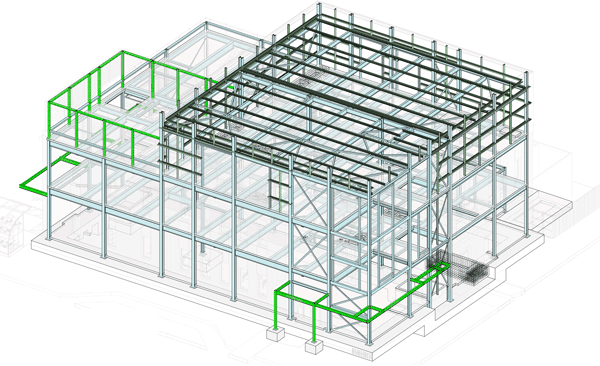
Arranged around a regular column grid pattern, the majority of the building’s steel frame features two 11m-wide clear span areas, supported by perimeter columns and only six centrally-positioned internal columns, thereby creating plenty of open-plan floor space.
The steel frame’s stability is derived from strategically-positioned perimeter cross bracing (located in areas where there are no windows or doors) as well as the diaphragm action from the compositely formed floors.
A composite flooring solution consisting of steel beams (the heaviest weighing 1.65t) supporting metal decking and a concrete topping has been used for the CDC’s first and second floors.
This method has also proven to be the most efficient solution for the project, as the metal decking packs were lifted into their respective areas by the same crane used for the main steel erection before being installed by the flooring subcontractor.
A 75mm-thick concrete topping has been used on both floors, as this thickness was deemed suitable to alleviate noise and vibration from the air-handling and plant equipment that will be located on the uppermost level.
Approximately two-thirds of the CDC’s second floor will accommodate a fully-enclosed plant room, which sits adjacent to an outdoor plant deck, which is surrounded by a steel-framed screen.
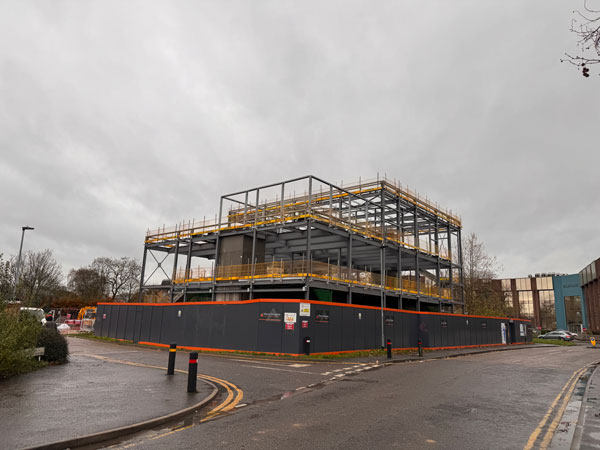
The different uses of the top floor, has required a series of transfer beams, positioned at the underside of the second floor, that support the set-backs designed to accommodate the plant areas.
Sat on a concrete slab, the ground floor of the CDC will house all of the scanning and clinical areas, alongside the main entrance and waiting room. Above this, the first floor will accommodate the facility’s admin offices and consultation rooms.
Steel deliveries to the town centre site could have been challenging, as it is surrounded by residential properties and businesses. However, to help negotiate the narrow city centre streets, some of the steel columns were spliced, for easier transportation. Once on site, all of the steelwork was installed using a single mobile crane.
Summing up, Dr Gary Howsam, Chief Clinical Improvement Officer at NHS Cambridgeshire & Peterborough, said: “We are delighted that work is progressing on the new Community Diagnostic Centre in Peterborough. Once open, the centre will provide local people with the opportunity to access much-needed diagnostic tests closer to home, giving them more choice about where and when they have their tests.”
Following the fit-out, which will be carried out by Tilbury Douglas, the completed CDC is due to be handed over to the client in October.