Projects and Features
Shopping for steel
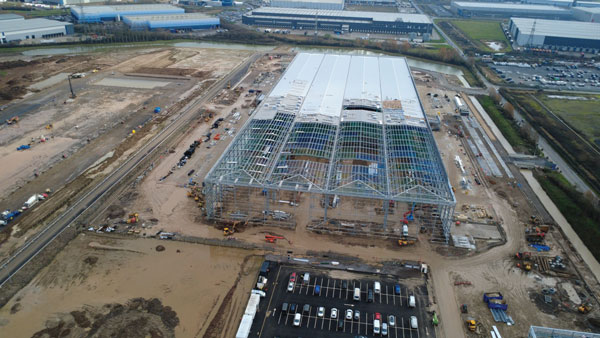
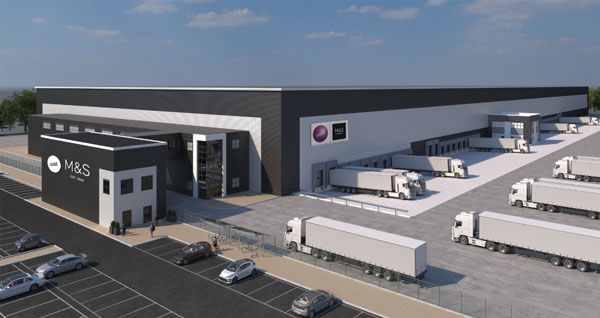
Highlighting Avonmouth’s strategic location, a new distribution centre being built on the site of a former pharmaceutical works, will form part of a major retailer’s investment in its food supply chain.
FACT FILE
M&S Distribution centre, Avonmouth
Main client: Stoford
Architect: SGP
Main contractor: Winvic Construction
Structural engineer: Stantec
Steelwork contractor: Caunton Engineering
Steel tonnage: 1,945t
Designed to the highest sustainability standards and due to be completed this summer, a 36,232m² high-spec warehouse is the latest logistics scheme to be built at Avonmouth.
Being developed by Stoford, with Winvic Construction as main contractor, the warehouse, which is targeting BREEAM ‘Excellent’, has been pre-let to Marks & Spencer (M&S) on a 20-year lease.
Strategically located within the Avonmouth-Severnside Enterprise Area, (which has hybrid consent to deliver circa 185,000m² of new industrial, warehouse and logistics space), the facility is in a key logistics hub, close to the M5 and M4 motorways as well as major port facilities.
Dan Gallagher, Joint Managing Director, Stoford, says: “This project demonstrates confidence in Avonmouth as one of the UK’s most important distribution locations and will provide M&S with a facility that meets the highest standards of design and sustainability.”
Sarah Stocken, Food Logistics Project Manager at M&S Food, adds: “This distribution centre will play a key role in modernising our supply chain to increase capacity in our network.
“Not only will it help us deliver for our customers but also provide a brilliant working environment for colleagues when it opens.”
A steel-framed solution has been used to create the warehouse, as the material offers the most-efficient and quickest way of constructing a large open-plan structure.
Traditionally, steelwork has dominated the single-storey non-domestic building (warehouses) market and year-on-year it maintains more than a 90% market share, compared to other construction materials.
Caunton Engineering has fabricated, supplied and erected 1,945t of steelwork for the project (1,660t of hot-rolled and 285t of cold-rolled). Measuring 299.5m-long, the steel portal-frame includes four 27m-wide spans, each formed with a series of centrally spliced rafters.
Using two mobile cranes, the 13.5m-long rafters were lifted into place individually and bolted together mid-air, once they were in their final position.
The long spans are essential and will accommodate extensive temperature-controlled environments, comprising a 900m² freezer section operating at -18°C to -20°C, and 20,000m² of chiller chambers maintaining temperatures between +1°C and +3°C. Surrounded with insulated wall and roof panels, the freezer and chiller areas are designed as boxes within boxes.
The chiller is the largest area and is accommodated within two-thirds of the warehouse (approximately 200m-long). A steel-framed chiller wall separates this area from the freezer and ambient areas.
Sustainability takes centre stage as the warehouse will include rainwater harvesting, a roof-mounted PV system, LED lighting, Air Source Heat Pumps (ASHP), EV charging infrastructure and green roof cycle shelters, supporting M&S’s long-term environmental objectives.
The facility will be equipped with temperature monitoring and control systems linked to a monitoring station, with data logging and alarm functions for compliance. Two on-site generators will provide backup power to protect stock during outages, while ventilation systems, rapid-rise doors, air curtains and pressure relief vents minimise frost ingress. Insulated docks, inflatable shelters, and overhead evaporator and condenser units will maintain the cold chain throughout loading and storage operations.
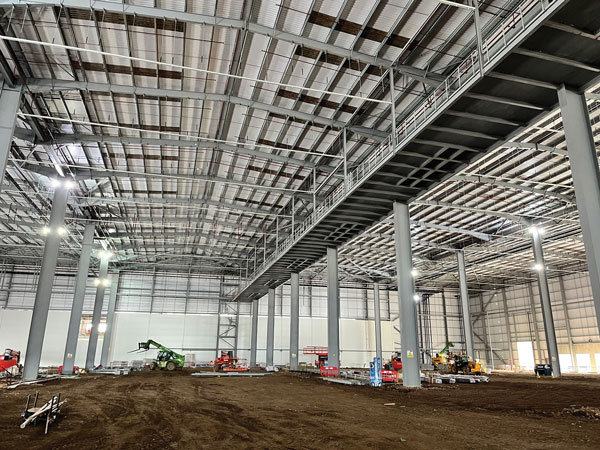
Much of the internal M&E and ventilation equipment is supported from the three rows of internal valley columns. Because of the increased loading on these members, the internal columns are 20m-tall fabricated plate girders, weighing up to 6.5t each.
With fewer imposed loadings to absorb, the 20m-tall perimeter columns are standard U/C sections weighing up to 2.5t each.
Running the entire length of the chiller zone, one row of valley columns supports a steel gantry, fabricated, supplied and erected by Caunton, along with its associated handrails, ladders and metal mesh flooring.
Winvic Construction Project Director Richard Black, says: “It was invaluable that Caunton were able and willing to pick up smaller items of work such as the CAT ladders, wall supports and gantry, items that would normally have been the design and installation responsibility of a metalworker.
“It helped with value engineering and was programme critical that we picked up these items at an early stage and as part of the main frame design and installation.”
As well as the main warehouse structure, the steelwork package has included an attached and integrated two-storey office block, two attached single-storey transport hubs, and a stand-alone two-storey vehicle maintenance unit (VMU).
Attached to one of the warehouse gable ends, the office block’s first floor and roof (which supports a plant deck) are compositely formed with steel beams supporting metal decking and a concrete topping.
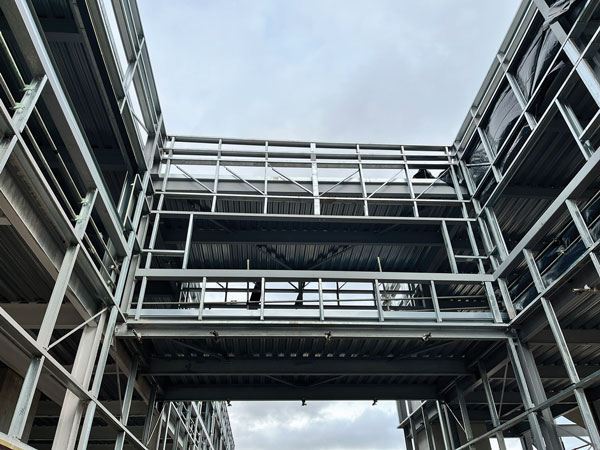
Providing access to the staff car park, a steel footbridge connects to the office first floor, spanning over a service road and linking to a steel-framed stair tower on the opposite side of the thoroughfare.
Prior to the steelwork erection programme starting, the site underwent some extensive pre-development works, including asset recovery and demolition of the former pharmaceutical manufacturing facility, upfilling (up to 3m-high), utilities installation, and new drainage infrastructure.
The project also incorporates the installation of three culverts to carry an existing drainage channel beneath a newly constructed access road.
Piled foundations were then installed, providing a robust working platform, which was utilised by the steelwork programme’s cranes.
Summing up and highlighting the importance of health and safety on the construction site, Mr Black says: “More important than design interfaces and costs, was the attitude towards health and safety demonstrated by Caunton and its installation team.
“At no point in the delivery of the steelwork have we (Winvic) felt it necessary to address any issues on site, as they were fully on board with all of our standards and methods.”