Projects and Features
Gateway to economic growth
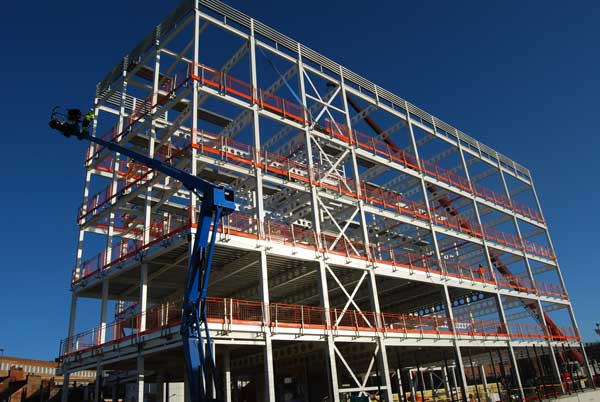
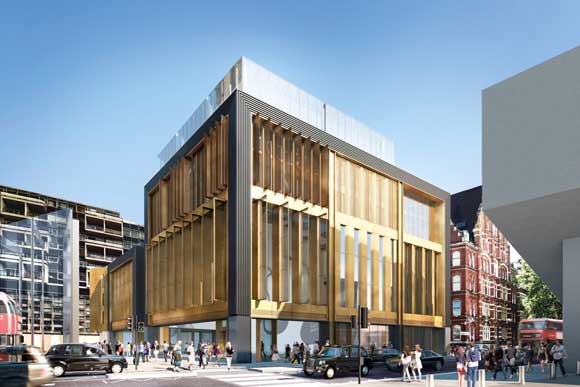
Situated in a prominent city centre location, the steel-framed Gateway One building will become Doncaster’s new digital technology hub.
FACT FILE
Gateway One, Doncaster
Main client: City of Doncaster Council
Architect: Bond Bryan
Main contractor: Willmott Dixon Construction
Structural engineer: BJB Consulting
Steelwork contractor: Billington Structures
Steel tonnage: 500t
Helping to unlock the Government’s Artificial Intelligence (AI) ambitions, Doncaster is positioning itself as a north of England technology hub, with the construction of Gateway One.
The five-storey steel-framed building will provide working space for world-leading AI companies, innovative local businesses and global entrepreneurs, seeking an alternative to the Golden Triangle of Cambridge, London and Oxford.
Located opposite Doncaster’s main railway station – making it ideal for commuting – the project forms the first phase of a much wider vision to regenerate this part of the city centre.
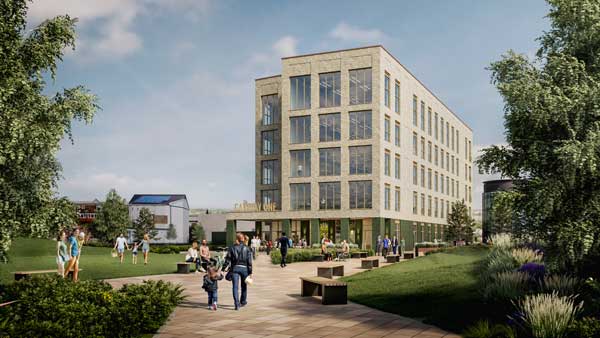
As well as the building, the project also includes a public realm, which will provide a landscaped link between the railway station and Gateway One.
Commenting on the project, Mayor of Doncaster, Ros Jones, says: “Our aim is to create a new digital hub, which will bring exciting new opportunities for Doncaster including jobs, economic growth and increased footfall. It will put the city at the forefront of the changing economy and technological advancements as we strive to become a regional Artificial Intelligence (AI) Growth Zone.
“We want Doncaster to become a front runner in digital technology as we are already emerging as a centre of excellence for AI. This building will act as a magnet for leading digital and tech companies looking for opportunities to scale and grow their business.”
Starting on site in March 2025, main contractor Willmott Dixon’s initial task involved the demolition of some existing buildings, which cleared the plot in readiness for construction to get underway.
Preliminary works also included the installation of foundations, which consisted of 114 CFA piles, which are up to 10m-deep.
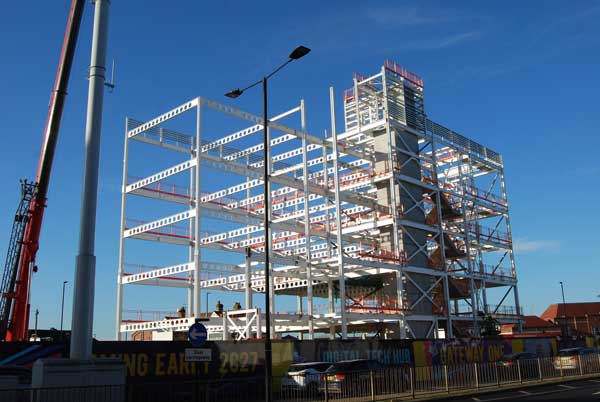
Supported on the piles, the steel framed structure starts at ground-level and incorporates a braced core, which is positioned along the Trafford Way elevation (facing away from the station) and accommodates precast stairs and a precast lift shaft.
“During the feasibility phase, multiple floor plan layouts were considered on how best to locate the vertical distribution stairs and lifts,” says BJB Consulting Associate Chris Neill.
“The chosen location for the core offered the greatest office layout flexibility for future tenants and creates 11m clear spans along the entire length of the building.”
Creating the desired flexibility, all of the office floorplates, which feature just two internal columns, have been designed as single open-plan spaces. However, there is the option to add a partition wall, sub-dividing each floor into two office areas.
In preparation for the possibility of two separate tenants, the core’s stair and lift area has been designed with two entrances on each floor.
Installed in sections that weighed up to 15t each, the core’s lift shaft was the project’s heaviest item to be lifted into place, and required the use of a 160t-capacity mobile crane. For the steel erection, Billington Structures used a smaller 90t crane, as the heaviest members are column sections weighing 1.2t.
Like most inner-city sites, space is at a premium on this project, as there is just enough room for a single crane to be positioned. The site is surrounded by busy roads and the railway station’s access routes, all of which must be kept clear of construction traffic.
Using the project’s one delivery pit lane (on Trafford Way), steelwork had to be brought to site on a just-in-time basis.
The design of the steel framed structure includes a ground floor main entrance lobby situated alongside two retail units, while above there are four open-plan office levels. The roof will accommodate a plant deck and an array of photovoltaic panels.
The ground floor façades will be clad with green glazed brickwork, matching a nearby pub, while the upper floors will have a more traditional buff coloured brickwork.
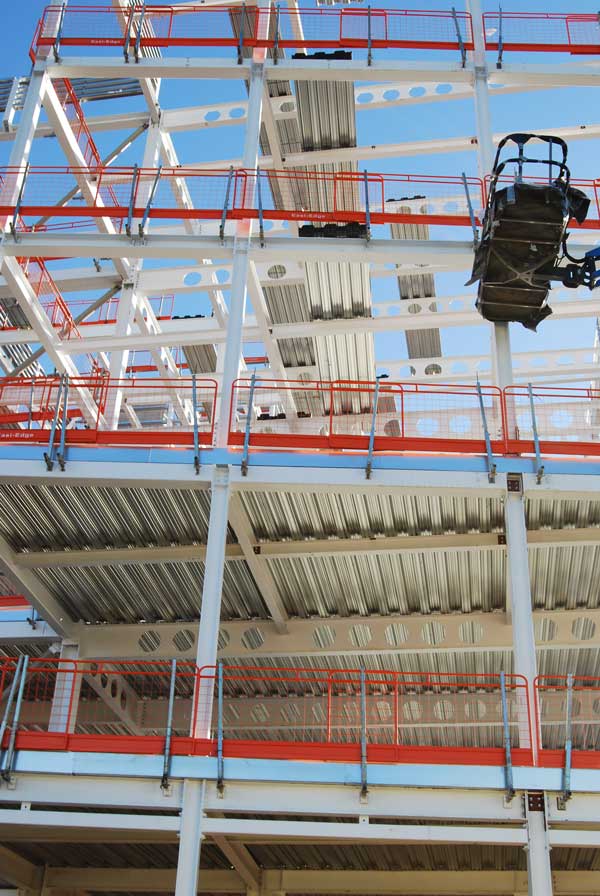
Forming the 11m-long internal spans are a series of bespoke fabricated cellular beams. As well as accommodating the building’s M&E services within their depth, the beams also support metal decking and a concrete topping, forming a composite flooring solution.
“There was an aspiration to have fully exposed structural soffits within the office areas and cellular beams offer a visually pleasing solution,” says Willmott Dixon Senior Build Manager Dan Lewis.
“To maintain sensible storey heights, it was important that the M&E distribution could be easily integrated and contained within the structural beam depths.”
The choice of a metal decked flooring solution was also driven by the exposed steel and soffit aspiration. According to the design team, metal decking provides a uniform light reflective surface, whereas the alternative solution of precast planks can have a variability in colour shades and is also prone to damage and chipping during erection.
Metal decking allows more adaptability in case of late design changes and as it is a lightweight solution, savings were made on the steel frame and foundation designs.
Working in tandem with the diaphragm action of the composite floors, the steel frame gains its stability from bracing.
Along the front and rear elevations, traditional cross bracings, located in structural bays and behind the brickwork façades, have been used.
Meanwhile, the two gable end elevations are fully glazed and therefore the decision was made to make a feature out of the vertical bracing, using CHS’s in an inverted V configuration.
“This also allowed the theme of the exposed structural frame to follow through into the elevations. The steelwork fabricator worked closely with ourselves and the architect to ensure the bracing connections were compact enough to be concealed by the raised access floor and perimeter bulkhead,” adds Mr Neill.
Summing up, Sally Jameson MP for Doncaster Central, says: “Gateway One will anchor the AI industry here in our city centre and bring fantastic opportunities for home grown talent. It will be good for jobs, good for businesses and good for growth in Doncaster.”
Aiming to achieve EPC A and BREEAM ‘Excellent’ ratings, the Gateway One project is due to complete in February 2027.