50 & 20 Years Ago
Triton Court, Finsbury Square, London EC2
For the Royal Mutual Insurance Society Ltd
SSDA COMMENDATION
1985
Architects: Sheppard Robson Architects
Structural Engineers: Ove Arup & Partners
Steelwork Contractors: The Cleveland Bridge & Engineering Co Ltd; Tubeworkers Ltd
Triton Court was formerly Royal London House, the headquarters office building of the Royal London Mutual Assurance Society. The building comprised of three separate structures built around a central lightwell between 1901 and 1929 including the impressive tower building which for several years was the highest in London.
The brief aimed at restoring the building’s former prestige to create an attractive office environment fit for technologically advanced occupants. To satisfy these aims, access was to be centralised to replace existing entrances and modern services including air conditioning installed. Two additional floors of offices were to be added at roof level to provide a total floor area of 28,000m2
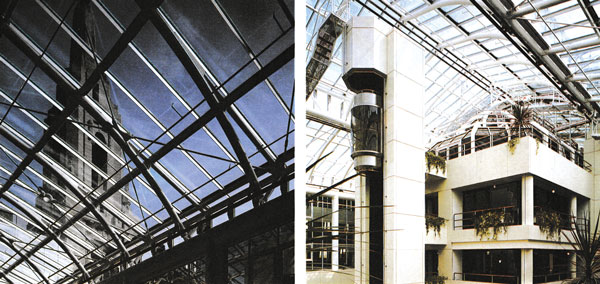
The scheme required the demolition of almost half of the existing floor space to make way for an enlarged central lightwell and new lift, staircase and service cores. The two additional floors were designed within a mansard arrangement and the lightwell was covered with a steel structure supporting a patent roof. This allowed the use of the atrium as a central circulation distribution space with access for all occupants of the three zones of offices, each having its own potentially separate reception area.
The atrium also gives access to the squash courts and viewing gallery, a sports centre, a cafe and a restaurant. Externally, new windows were added, existing stonework was repaired and cleaned and rooftop plant rooms were given a cladding of reflective glazing.
The structure of the existing buildings was of steel and tests carried out on the old steel frame indicated a low carbon content similar to Grade 43. The allowable design stress then used was about 30% lower than that allowed for mild steel today and advantage was taken of this by the addition of two floors without strengthening the existing frame. A special feature of the new building structure is the atrium roof, approximately 26m square in a stepped pitched roof form. The structural concept is that of a simple three pin arch. The break in the pitched profile that forms the step in one leg of the arch carries all vertical load by two principal beams. The thrust of the arch action is taken on the lower inclined plane which acts as a large girder, avoiding the use of a tie across the atrium space. The main longitudinal trusses were brought o site in two sections and welded at mid span.
The new steel frame construction of 950 tonnes provides about 50% of the volume. Construction commenced in June 1982 allowing a six month demolition period. Completion was achieved 24 months later in June 1984 at a total cost of about £30 million.
Judges’ Comments
Restoration of this important site, facilitated by the adaptability of the original steel frame, has been skilfully carried out.
Originally published in
BCSA NEWS, February 1986