50 & 20 Years Ago
Nene Bridge, Peterborough
For Cambridgeshire County Council
SSDA COMMENDATION
1985
Structural Engineers: Peterborough Development Corporation
Steelwork Contractors: Fairfield Mabey Ltd
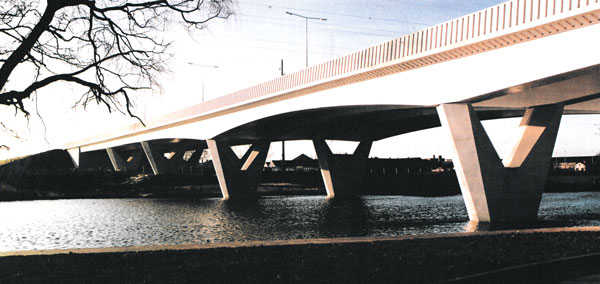
The five spans of Nene Bridge carry the newest link in Peterborough’s parkway system over the River Nene, a main railway track and sidings, a riverside walkway and small service road. Frank Perkins Parkway, which is carried on Nene Bridge, provides a dual carriageway link between the A 1, the City Centre and the Eastern Industrial Area.
The bridge is a continuous structure restrained at the south river pier, with movements joints at each abutment. The deck is curved in plan, 155m long and 25m wide made up of five spans 27m, 27m, 31m, 40m and 30m with skews at the supports of up to 15 degrees. The deck is made up of four steel box girder beams acting compositely with the deck slab. The box girders are 2m wide at the top with raking web plates tapering to the bottom flange, varying in depth from 2.5m to 1.2m, designed to the Merrison Rules and fabricated to BS 5400 Part 6. The fabricators skill in achieving the final form specified by the designers demonstrated ability to work to close tolerances and enthusiasm for the project.
By adopting steel for this bridge it was possible to work over the railway within the very restricted possessions available between trains, the time of construction being considerably shortened. The reduced weight of the bridge enabled more slender piers to be built and reduced the costs of the foundations. By working off the girders the temporary works were very small and there was little disruption to adjacent land users.
The substantial embankments required to raise the road and achieve the bridge clearances over the railway and river makes the bridge a dominant feature of the flat riverside scene and dictated a design that would enhance the otherwise featureless area with its distant view of the medieval Cathedral.
The curved soffit of the principal river span is reflected in the adjacent spans, blending into the horizontal soffit of the distant railway spans. In spite of the inner complexity of the box girders their external simplicity was essential to the whole design concept and the slender piers are many faceted to give changing views to users of the adjacent leisure facilities. The high, solid parapets were a requirement of British Rail. The value of the 750 tonnes of steel employed was £900,000. Work on the bridge stated in April 1983 and it opened for site traffic in May 1984.
Judges’ Comments
A pleasing design demonstrating the flexibility and capability of steel construction in meeting
demanding geometric and site requirements.
Originally published in
BCSA NEWS, February 1986