Technical
AD 555: Laser screed machines used during the construction of composite slabs
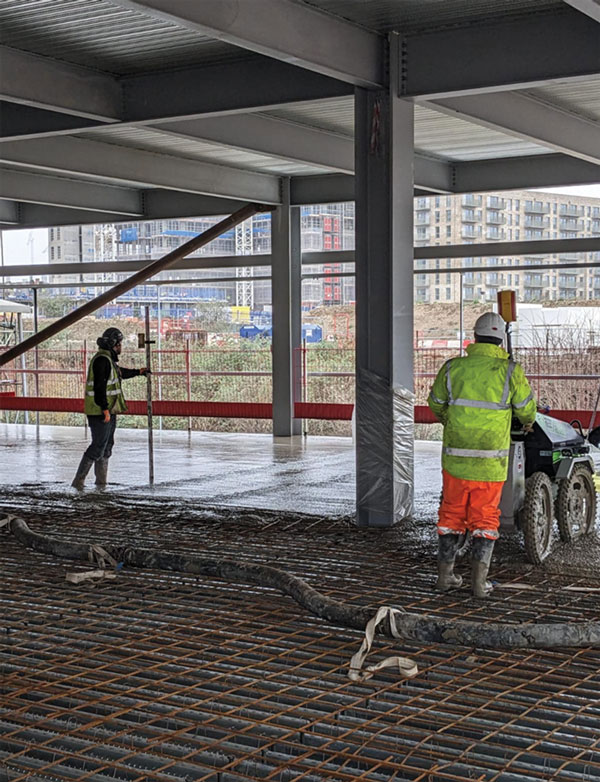
It has come to SCI’s attention that some contractors are using large laser levelling machines when pouring composite slabs (as shown in Figure 1), and it is important to note that the weight of such machinery will not normally have been considered in the design. This note explains why such machines should not be used unless they have been specifically accounted for.
The temporary construction stage usually governs the choice of the steel sheeting. For typical composite slabs, the recommended construction imposed loading is 1.5 kN/m² over a 3m × 3m ‘working area’. This loading value allows for a reasonable number of construction operatives, impact, the heaping of concrete during placing, hand tools, and small items of equipment and materials for immediate use.
Laser screed machines can be used to level wet concrete to a constant plane, with some weighing over 800kgs. The combined weight of the laser screed machine, the operatives and the ponding of concrete from the deflection of the steel sheeting may be larger than the allowable temporary construction loading considered in codified design. Additionally, the concentrated loads from the wheels may cause local damage to the ribs of the steel sheeting, which will decrease its stiffness, therefore leading to an increase in deflections and extra weight of concrete due to additional ponding. There is therefore a ‘snow balling’ effect.
Therefore, unless these machines have been specifically accounted for in the design of the steel sheeting, they should not be used during the construction of composite slabs.
It is worth reminding readers of another important consideration when the constant plane method of construction is used, namely that considerably more concrete will be needed and thicker slabs will result from combined deflections of the supporting steelwork and steel sheeting itself. These can far exceed recommended limits for deflection of the sheeting alone. Levelling to a fixed datum should not be adopted without first confirming with the designer that the extra weight of concrete ‘ponding’ has been allowed for in the design. A preferred alternative is to pour the concrete to a fixed thickness, recognising this may not lead to a level upper surface. Further information on composite slab pouring methods is given in AD 410.
Good practice guidance on the design and construction of composite slabs can be found in SCI’s P300 and the Concrete Society’s TR 75.
Contact: Liam Dougherty
Telephone: 01344 636555
Email: advisory@steel-sci.com