Projects and Features
One in, one to go
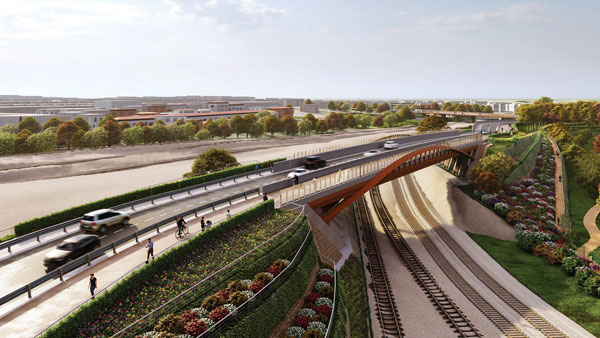
The first of two steel bridges, set to serve the large York Central mixed-use development, has been lifted into place with the second due to be installed soon.
FACT FILE
York Central bridges
Main client: Homes England
Main contractor: John Sisk & Son
Structural engineer: Tony Gee & Partners
Steelwork contractor: Severfield
Steel tonnage: 1,000t
Working during an overnight rail possession, the Severus Footbridge was recently lifted into place across multiple railway tracks including the East Coast Main Line, marking a significant milestone for the wider York Central development.
One of the largest city centre brownfield site developments in the UK, York Central is expected to deliver 2,500 homes, more than 120,000m² of commercial, leisure and retail space, extensive parkland and public realm, as well as major improvements to the National Railway Museum.
Located on a former railway goods yard to the west of York’s main station, the large site is set to create a new neighbourhood for the historic Yorkshire city.
As it is surrounded by railway lines, access to the site is restricted and so two new steel bridges are being constructed as part of the initial works for the development.
Both spanning the main railway lines that serve the city, the Severus Footbridge and the East Coast Main Line (ECML) Road Bridge will provide the York Central site with the necessary pedestrian, cycle and vehicular access that will spur the development forward.
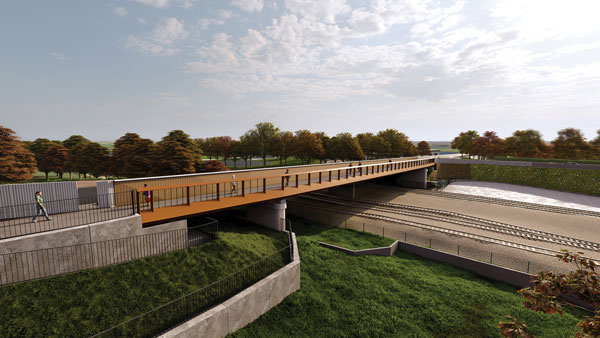
The Severus Footbridge sits beside an existing road bridge, which currently accommodates pedestrians and cyclists. The new structure will give walkers and non-motorised traffic their own dedicated crossing, keeping them away from vehicles.
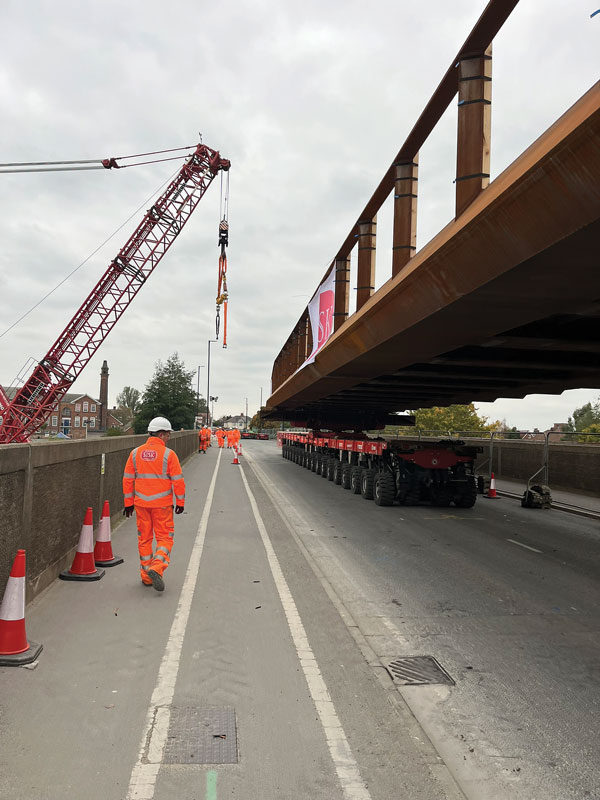
The 4m-wide footbridge has a total length of 75.5m, with a 52m-long central span situated between two supporting concrete piers. Brought to site in numerous transportable pieces, the entire structure was welded together, during a three-month programme, in a compound close to its final location.
“Steel was chosen for the two bridges as it offers a practicable method of delivery, considering they span major railway lines that can only be closed for minimal amounts of time,” says Tony Gee & Partners’ Executive Director Karen Hoad.
“The bridges are also fabricated from weathering steel, which requires minimal maintenance, while there is also a safety aspect as the material is less reflective, causing minimal glare to passing train drivers.”
Steelwork for the footbridge consists of two main outer girders, measuring 2.3m-deep and 800mm-deep respectively, which were fabricated and delivered to site in three sections.
The deeper box girder is connected to 37 cantilever beams that provide maintenance access between the new footbridge and existing road bridge. The shallower girder contains a weathering steel handrail that will support a glass panel guardrail, which will provide views looking east towards York Minster.
Connecting the two outer box girders together and supporting the 38 × 6mm-thick steel deck plates, are a total of 37 cross bracings, with 50mm-thick flanges and 40mm-thick webs.
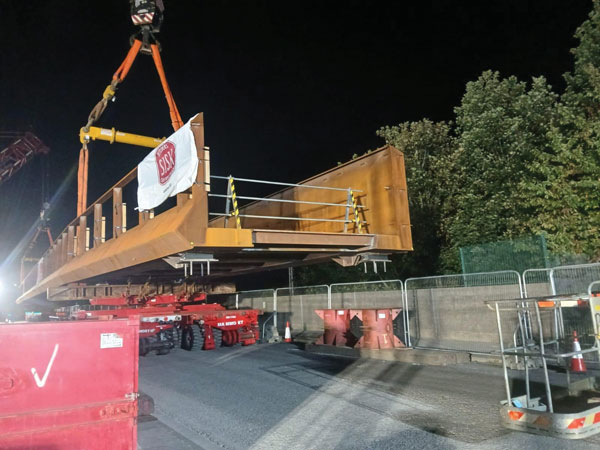
The installation of the fully assembled footbridge took place over the weekend of 18 and 19 October. Using two 600t-capacity mobile cranes, positioned either side of the tracks, the steel structure was lifted into place after being transported to the middle of the existing Water End road bridge.
The procedure commenced with some preparatory works on Friday night, before two self-propelled modular transporters (SPMTs) moved the structure from its assembly compound and onto the nearby Water End (which leads to the existing road bridge) on the Saturday morning.
The steel structure was then moved along the road and onto the road bridge and readied for the final lifting operation.
“Once it was out of the compound and on the road, one of the SPMTs had to be replaced with another unit,” explains Severfield Projects Associate Director Gareth Day.
“An SPMT with more axles was needed to distribute the steelwork’s weight more evenly, as the existing road bridge wouldn’t have coped with the axle loads from the larger SPMT used to transport the bridge out of the compound.”
Network Rail’s possession of the tracks lasted from 2am to 6.30am on Sunday morning. During that time, the footbridge, which weighed 320t, was successfully lifted into its final position, while the project team continually checked and surveyed the bridge bearings and made sure the structure fitted perfectly.
Work is continuing on Severus Footbridge and its surrounding infrastructure. It is due to open in early 2027.
Second bridge
Meanwhile, a few hundred metres away, the second steel bridge of the York Central scheme is being constructed.
The 86m-long East Coast Main Line (ECML) Bridge will act as a major gateway to York Central. Its 17m-wide deck will accommodate a two-lane road, segregated paths for pedestrians and cyclists on the eastern pavement and a dedicated pedestrian route on the western side.
It consists of seven box girders, which are being fabricated and delivered to site in transportable sections, and then fully welded into the required lengths.
The five central girders are assembled from six separate pieces. The two outer girders have eight sections, as they include a pair of additional pieces to form the bridge arches.
Delivered to site separately, the arch’s hangers are also being welded into place, during the initial assembly, while the outer girder’s fascia panels are bolted into place.
Due to commence this spring, the weathering steel structure will be lifted into place over the railway lines using a single 1,250t-capacity crane. One girder will be installed at a time, during a series of rail possessions.
Video