
Projects and Features
Longitudinal and transverse material properties for cold-formed structural elements
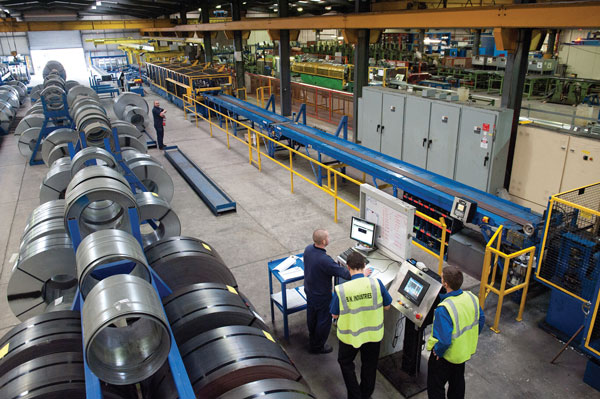
Andrew Way of the SCI and Stephen Hall of Hadley Group examine the complexities of material properties for thin-gauge steel. The potential difficulties in the specification process are highlighted for certain steel grades which have designations based on their transverse material properties.
There are many steel grades, produced to several product standards that are used for cold-formed members and sheeting. BS EN 1993-1-3:2006 provides rules for the design of cold-formed members and sheeting, along with a list of steel grades which conform to the requirements of the standard. The steel grades that conform to the requirements are listed in Table 3.1a of the standard. However, note 2 of clause 3.1(3) highlights that there are additional steel grades that may conform to the requirements given in Table 3.1b of the standard. The UK National Annex to BS EN 1993-1-3:2006 states that materials listed in Table 3.1b may be used.
The 2nd Generation Eurocode, BS EN 1993-1-3:2024, provides Tables 5.1 and 5.2, which contain an expanded list of steel grades. The 2nd Generation standard states that it is applicable to the materials listed in both Tables. The difference between Tables 5.1 and 5.2 is that materials in Table 5.1 conform to harmonized product standards, while the materials in Table 5.2 conform to EN or ISO product standards.
The tables in the standards give the basic yield strength (fyb) and ultimate tensile strength (fu) for each grade listed. These properties are intended for use in design in accordance with both BS EN 1993-1-3:2006 and the 2nd Generation version. This all appears quite straightforward until the values are examined more closely.
For several of the steel grades listed, the values stated in the BS EN 1993-1-3 tables do not correspond to the nominal values stated in the specific steel product standards. This is because in some of the steel product standards it is stated that the nominal values are measured in the transverse direction and other product standards declare the nominal values in the longitudinal direction, see Figure 2.
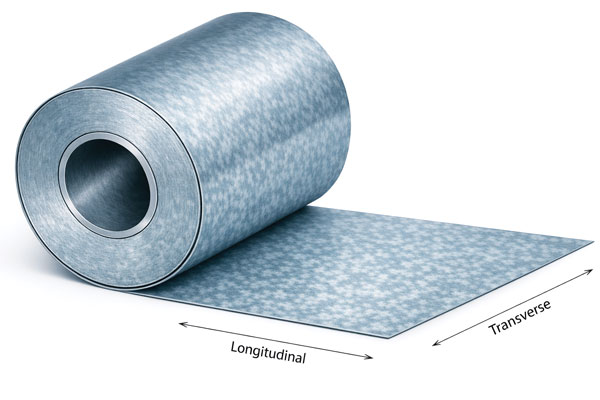
Further complexity exists as for some of the product standards the direction in which the nominal properties are to be measured depends on the width of plate, strip or wide flat being produced.
Anisotropy
Due to a phenomenon called anisotropy, material properties (e.g. strength and ductility) for rolled steel products are dependent on the direction of measurement relative to the processing direction. In other words, the properties measured longitudinally to the processing direction will be different to those measured transversely to the processing direction. For design purposes BS EN 1993-1-3 requires the longitudinal properties to be used and these are what are provided in Tables 5.1 and 5.2 for the 2nd Generation standard. In the Generation 1 version, only one set of grades which are designated in the transverse direction are published with altered values appropriate for the longitudinal direction. Designers should consider using the values published in the 2nd Generation standard to ensure properties are relevant to the longitudinal direction and referenced against current material standards.
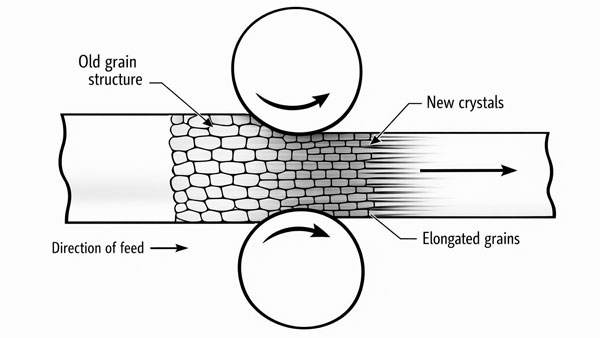
Anisotropy is caused by the rolling process in the steel mill causing the grain sizes to become elongated in the longitudinal direction, see Figure 3. The Hall-Petch effect is a fundamental principle in materials science that explains how the yield strength of a steel increases as its average grain size decreases. The detailed relationship goes beyond this, however it can be approximately described as the grain sizes being longer in the longitudinal direction resulting in the yield strength being lower compared to the transverse direction.
Steel grades suitable for cold-forming
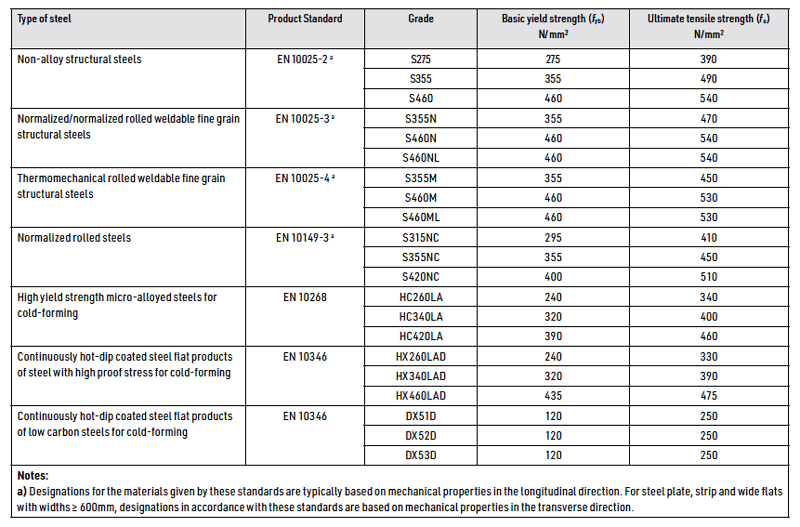
The steel grades given in Table 1 are taken from Tables 5.1 and 5.2 of BS EN 1993-1-3:2024, and are the grades designated based upon mechanical properties measured in the transverse direction, or measured in the transverse direction subject to product width. It can be seen from Table 1 that in many cases the number in the grade designation is the same as the basic yield strength but this is not true for all grades and therefore the designer and specifier must be alert to this subtle distinction.
The steel grades given in Table 1 designated in their transverse directions are used within construction applications less frequently compared to those given within BS EN 1993-1-3 with designations based upon their longitudinal properties.
Typical applications
Those grades in accordance with EN 10025-2, EN 10025-3, EN 10025-4 and EN 10149-3 are produced without any surface coating. This can limit their suitability for cold-formed members and sheeting used in the built environment. For these grades, their designations are only relevant to the transverse direction once sheet widths exceed 600 mm and therefore might only be used for the largest or widest of cold-formed products, often requiring hot-dip galvanizing as a secondary operation once formed.
Grades of steel given by EN 10268 are also uncoated as standard and are more frequently used within other industries such as automotive. Unusually, this standard provides tables of mechanical properties for both the transverse and longitudinal directions, improving the feasibility of obtaining a mill test certificate for the required longitudinal direction and providing additional justification for the values given by BS EN 1993-1-3.
Steel grades in accordance with ISO 4997 are similarly supplied uncoated. Their use within Europe, including in construction applications, is less frequent.
The grades from EN 10346 given in Table 1 are arguably those most commonly used in construction applications. These grades are pre-coated and are particularly suited to cold-forming. Applications for high strength (HX) low alloy (LA) grades might include framing elements and profiled sheeting, especially where profiles are complex and require enhanced formability during production. The DX grades are described as deep drawing steels, and BS EN 1090-4:2018 does not permit their use for profiled sheeting. Of note is the fact that BS EN 10346 does not provide minimum values for yield strength or ultimate tensile strength for DX51D. To use DX51D in the design of cold-formed members, BS EN 1993-1-3 provides values for basic yield and ultimate tensile strength. The value differs between the 2006 and 2024 version, and this difference may be a result of the nuances of the measured direction. The values given in the 2024 version should be used. These DX deep drawing grades are often used in the built environment for non-structural applications which fall outside of the scope of BS EN 1993-1-3 and BS EN 1090-4. For example, drylining, cable management and drainage. Where they are used structurally, applications tend to be limited to accessories such as edge trims, timber connectors and flashings.
For relevant products, the steel grades used in production will typically be stated on the manufacturer’s BS EN 1090-1 Factory Production Control Schedule.
Mill test certificates
Justification for mechanical properties typically comes in the form of a mill test certificate (MTC), Type 3.1 in accordance with EN 10204. This is referenced within BS EN 1090-4:2018 as a requirement for declaring material characteristics. BS EN 1090 is the execution standard of steel structures and aluminium structures, with Part 4 being the technical requirements for cold-formed structural steel elements and cold-formed structures for roof, ceiling, floor and wall applications.
Mill test certificates will be issued based on the product standard requirements, therefore material properties will be tested based on the direction given by the product standard. For example, products designated based on their transverse properties will have mill test certificates issued with transverse material properties.
Supplementary testing
It has been observed that steel supplied to product standards based on transverse direction values may show some variation in properties when measured in the longitudinal direction, compared with those presented in BS EN 1993-1-3.
For materials designated based upon their transverse properties, it may not be possible for the manufacturer to obtain a MTC Type 3.1 for steel properties measured in the longitudinal direction. As such, specifiers of these material grades should use due diligence to justify the longitudinal properties used in design.
Where materials given within Table 1 are specified, the designer has several options for justifying the mechanical properties. These may include:
- Completing coupon tests in accordance with BS EN 1993-1-3:2006 § 3.2.1 (or BS EN 1993-1-3:2024 Annex A.2)
- Empirical experience, which may also include design assisted by testing
- Engaging with the supplier to discuss the feasibility of a longitudinal MTC Type 3.1. (This may be unlikely since the transverse direction is designated by the standard. Where this is possible orders may be subject to other criteria, for example minimum quantities.)
The designer must satisfy themselves that the approach taken is compliant with the assumptions and rules given by the Eurocodes.
Regardless of the approach used, for any material procured from Table 1, a MTC Type 3.1 must still be provided in accordance with BS EN 1090-4:2018 and will typically give properties in the transverse direction only.
The UK National Annex for the 2nd Generation EN 1993-1-3 is expected to provide similar guidance to that presented here.
Conclusions
BS EN 1993-1-3 provides rules for the design of cold-formed members and sheeting and allows the use of a large number of steel grades.
Rolled steel sheet, strip and wide flats will have different material properties in the longitudinal and transverse directions.
The longitudinal properties should be used for structural design purposes.
Some steel grades have nominal properties designated based on their transverse properties, in these cases the designer must be satisfied that the longitudinal values used in design are achieved.
Supplementary testing may be required as mill test certificates provided as standard may not provide information on the longitudinal material properties.