
Projects and Features
Down on the farm
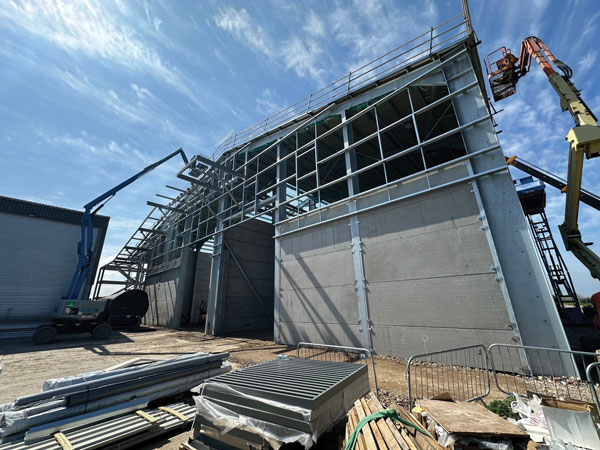
Providing proof that steel-framed structures are ideal for the agricultural sector; the material’s numerous design and construction attributes have come to the fore on a recently completed grain store project in east Kent.
FACT FILE
Birchington Grain Store, Kent
Main client: St Nicholas Court Farms
Steelwork contractor & structural engineer: Shufflebottom (part of Embrace Steel)
Steel tonnage: 187t
Durability, speed of construction and low maintenance are just three of the reasons why a steel-framed option is a popular framing solution for agricultural buildings across the UK and Ireland.
Clients like the material as steelwork is fabricated offsite and then supplied in erectable pieces, that often only require a single crane for the installation.
A small force can usually erect a steel-framed agricultural building in a matter of weeks, causing little or no disturbance to the surrounding farming operations.
In the past, timber was the dominant form of construction in the agricultural sector, but the material is susceptible to damp and rot. Alternatively, steel is more resistant to water and pests, while its components are bolted together, creating a secure and durable joining system, which is stronger than using nails.
Steelwork also efficiently creates long clear spans, allowing the structures to be designed for numerous uses, such as cattle sheds, barns, storage facilities for agricultural equipment and grain stores.
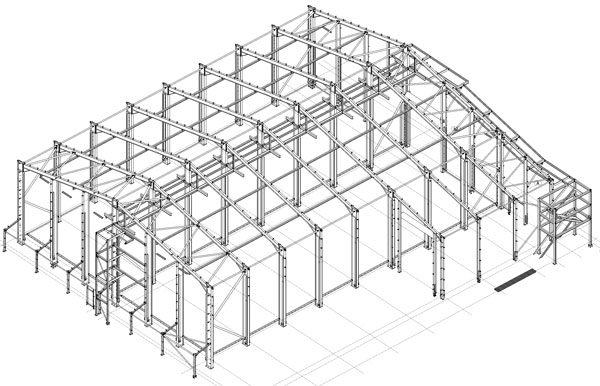
All of these attributes came to the fore on a recently completed scheme for St Nicholas Court Farms in Birchington, Kent, where Shufflebottom designed, fabricated, supplied and erected a new grain store.
St Nicholas Court Farms is a large third-generation family-owned business that farms more than 3,500 hectares in east Kent. Since its inception in 1959, it has grown and adapted positively to new technologies, such as renewables. It owns and runs two anaerobic digestion (AD) plants and has multiple solar installations, central to its production methods.
Alongside commercial crops such as milling wheat, oilseed rape, spring oats and peas, the farm also grows a mix of energy produce (maize, whole crop rye/triticale and grass silage) that support the AD plants. The natural oxygen-free process creates two products that help to reduce the farm’s reliance on fossil fuels: biogas, used for electricity or heat generation, and/or digestate, a nutrient-rich residue used as a biofertiliser.
Shufflebottom Commercial & Technical Director Richard Wigley, says: “The farm required a large agricultural building, capable of handling a 9.25m level grain fill, allowing the product to be stored efficiently during harvests and then moved easily when required.
“The focus was on creating plenty of clear internal space, straightforward access and a layout that works for modern farming operations, while ensuring the building would stand up to long-term use.”
Built to agricultural specification and CE marked to Execution Class 2, the grain store measures 46m-long × 33m-wide and 10.6m-high to the eaves.
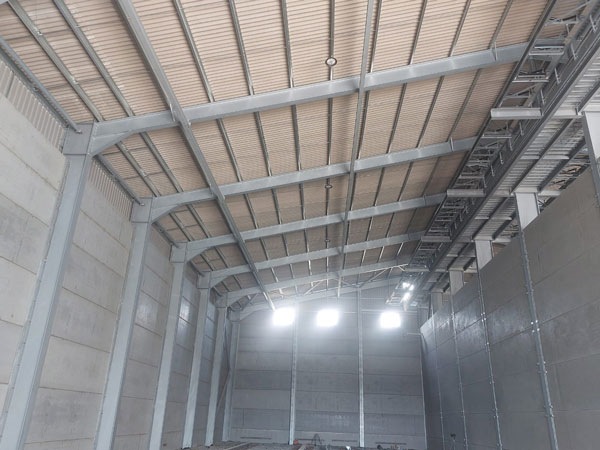
Attached to one elevation, the store also includes a 17.25m-long × 9m-wide lean-to extension (with a roof height varying from 10.6m to 8.6m), while along one gable end there is a connected 33m-long × 2.5m-wide fan house.
The steel-framed store was designed to accommodate 10,000t of grain in order to support busy harvest periods. Every part of the building was planned to suit bulk grain storage, with careful attention paid to loads, access and everyday practicality. By working closely with the farm team and grain equipment suppliers, the final design was tailored to suit the site and the way the building would be used throughout the year.
A project of this size requires good planning and coordination. Early discussions with the client helped ensure the required grain fill level and operational needs were fully understood before work began.
Clear communication throughout the build helped keep the project running smoothly and allowed the structure to be completed on time and as planned.
Following on from the installation of the foundations, the steel portal frame was erected using a single mobile crane. Spaced at 5.7m centres, the main building’s perimeter columns and its single row of internal members are 838mm x 292mm x 176mm UC sections.
The store’s roof is formed with a series of 16.5m-long rafters that were individually lifted into place with bolted connections at either end, fixing them to the perimeter and central columns.
The project also demanded the incorporation of features such as ventilation, drying systems and concrete panels, that form the 9.2m-high grain walls, and provide added strength and flexibility to the building.
Shufflebottom also provided a cladding solution, which included fibre cement roofing sheets and single skin box profile sides.
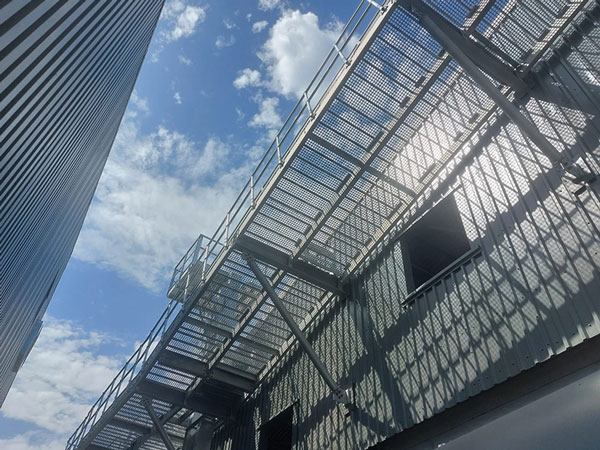
To allow access to the building from an elevated area, a stair tower and an external walkway (also in Shufflebottom’s package) were installed to the front of the building. In addition, the steel package also included a catwalk along the entire length of the building to provide access to the internal machinery, along with three ladders (two internal and one external).
Summing up St Nicholas Court Farms’ Director Jim Pace, says: “Shufflebottom has been fantastic to work with on our new grain store. The quality of the steelwork is excellent, and the team has been professional and efficient throughout.”
Agricultural buildings – a world of their own?
Agricultural buildings have their own design standard and require at least the same consideration as any other building – often with more challenging loading and design constraints, writes SCI’s David Brown.
Agricultural buildings should be designed to BS 5502-22 + A1:2013, which specifies some very particular requirements for the design – slightly surprising for those who might think an agricultural building is somehow a poor cousin to a “normal” commercial single-storey building. BS 5502-22 requires that the structural design is completed to the Eurocodes – no permission here to continue to use BS 5950. Wind, snow and other variable actions are similarly to be taken from the relevant Eurocode.
One surprising feature of BS 5502-22 is the concept of design classification. Agricultural buildings may be Class 1 or 2, depending on the consequences of collapse. The standard says that agricultural buildings should generally be designed as Class 2, which means that all loads are to be multiplied by a factor of 0.9. There is no reduction applied to the design of Class 1 buildings. In principle, this is the same as the guidance in Table B3 of BS EN 1990 where a multiplication factor of 0.9 may be applied to the partial factors for Reliability Class 1 (Consequence Class 1 in Table B1) structures. This approach of reliability differentiation is generally not adopted in the UK.
Grain stores like the one constructed at Birchington are specified as Class 1, because grain stores have the additional complication of lateral loading from the stored product. BS 5502-22 helpfully gives densities and the angle of repose of many different stored materials, including different types of grain, so that the lateral loads can be calculated.
BS 5501-22 gives advice on Execution Class, recommending EXC 2 for Class 1 buildings and EXC 1 for Class 2 buildings. Selection of Execution Class is covered in the UK National Annex to BS EN 1993-1-1 where although specification of EXC 1 is not encouraged, it might be appropriate for Class 2 agricultural buildings, which have a shorter design life of 20 years and are entered infrequently.
Normal design and good practice detailing guidance obviously apply to agricultural buildings, despite often seeing older buildings still standing which appear to be missing essential components. Buildings must be braced longitudinally, by discrete bracing members or by elements such as concrete or blockwork built between columns. Inner flanges must be restrained where required by design and the lateral load at the tops of gable columns must be accommodated in the design.