Projects and Features
Travel Hub spurs town centre regeneration
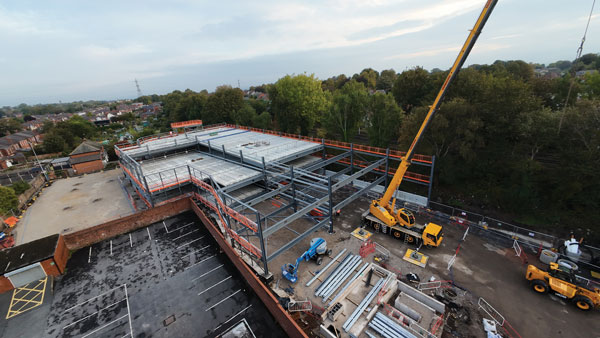
Structural steelwork is playing an important role in the initial phase of the multi-million-pound regeneration of Prestwich town centre.
FACT FILE
Prestwich Travel Hub
Main client: Prestwich Regeneration (joint venture between Muse and Bury Council)
Architect: Jon Matthews Architects
Main contractor: VINCI Building
Structural engineer: Civic
Steelwork contractor: Hambleton Steel (part of Embrace Steel)
Steel tonnage: 313t
Four miles north of Manchester city centre, the suburb of Prestwich is undergoing a £100 million makeover, which is set to revitalise its town centre.
The overall plans, being developed by Prestwich Regeneration (a joint venture between Muse and Bury Council) includes a multi-storey travel hub, library, retail units, a new market, community spaces and residential dwellings, with most of the construction earmarked for land currently occupied by the existing Longfield Centre shopping precinct and its surface car park.
Muse Senior Project Manager Hugh Taylor, says: “The transformation of the Longfield Centre will create a vibrant new heart for Prestwich, a welcoming space where the community can come together to meet, socialise and enjoy village life. We’re making great progress on the travel hub, which marks just the beginning.”
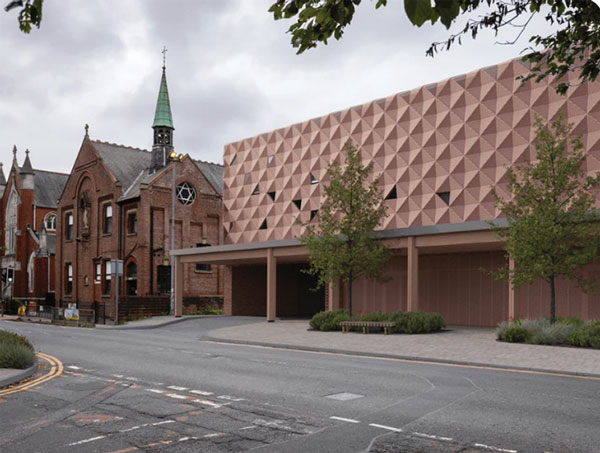
Creating a long-term parking solution for the village and somewhere to park while the other phases of construction work take place, the initial part of the development consists of the steel-framed Prestwich Travel Hub.
Being built by VINCI Building, the three-storey hub will provide 301 car parking spaces (including disabled and electrical bays), electric vehicle charging points and 76 cycle storage spaces. The facility will also provide two City Club parking bays, allowing people the flexibility to hire a car for the day and return it to the hub at their convenience.
Councillor Eamonn O’Brien, Leader and Cabinet Member for Strategic Growth, said: “It’s incredibly exciting to see the first phase of this transformation now underway, especially knowing that it marks just the beginning of what’s to come. Our vision is to create a vibrant, sustainable village centre that serves the whole community.”
The Prestwich Travel Hub project has been designed to be as efficient as possible, minimising the environmental impact of the materials used, while enabling the main contractor to utilise suppliers from within the UK to further minimise the impact on the environment.
This ethos includes the choice of a steel-framed solution for the hub. The material, which has been sourced and fabricated in the UK by steelwork contractor Hambleton Steel, offers the project team the required speed of construction that will minimise any disturbance to the neighbourhood, while also providing the long clear spans wanted for a car park.
“Steelwork was chosen as the construction method for the Travel Hub structure because it offers benefits such as high strength, durability, and resistance to fire, pests, and the weather. The material is also cost-effective, due to offering faster construction, less maintenance, and lower long-term costs,” says VINCI Building Project Manager Adam Lynch.
Civic Associate Thomas Audsley, adds: “The material choices that have been adopted simplified the coordination and ensured there were no encroachments into the parking bays, as you sometimes find in car park structures.
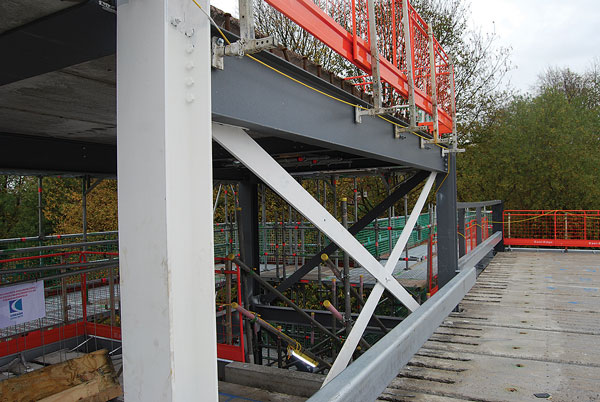
“By utilising steel-framed construction, we only had to adopt one central line of columns within the internal footprint of the structure, which allowed us to achieve longer spans.”
Work on the hub, which is being built on a site previously occupied by another surface car park (Fairfax Street), began during the summer of 2025.
Prior to the steelwork erection starting, the entire site was remediated as part of the groundworks programme.
The site was underlain by a significant and varying depth of peat across the majority of the plot. Due to the inherent poor bearing conditions and significant risk in leaving the peat within the ground, a remediation package created the required ground conditions.
Once a piling mat was in place, the team used a single rig to install a series of piled foundations, of varying depths, to support the hub’s steel columns.
In-filling the majority of the site, the hub is approximately 100m-long x 32m-wide. Because of its length, the braced steel frame incorporates three movement joints across its width.
The positioning of one movement joint has necessitated an unusual, but vital steel detail to be incorporated into the frame.
Between level one and ground floor, one column could have interfered with the all-important vehicle circulation route. To avoid this, the column has been transferred onto the end of two cranked cantilevering beams, which in turn abut the movement joint.
Creating an efficient car parking layout, the single line of internal columns as well as the perimeter members are spaced at 7.5m centres, with the connected floor beams creating two spans of 16m.
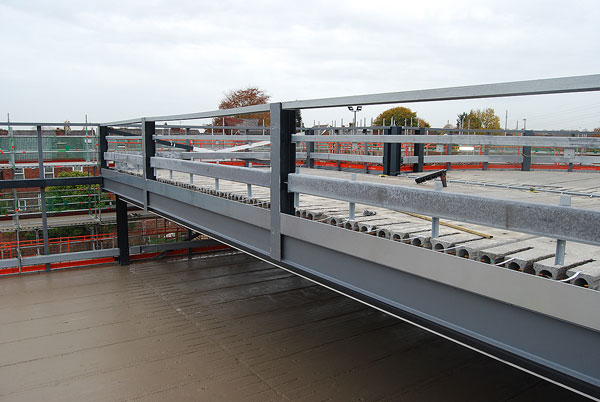
The steel beams forming the first and second floors support precast planks, a method that is commonly used for car park structures due to its inherent robustness under both loading and environmental conditions.
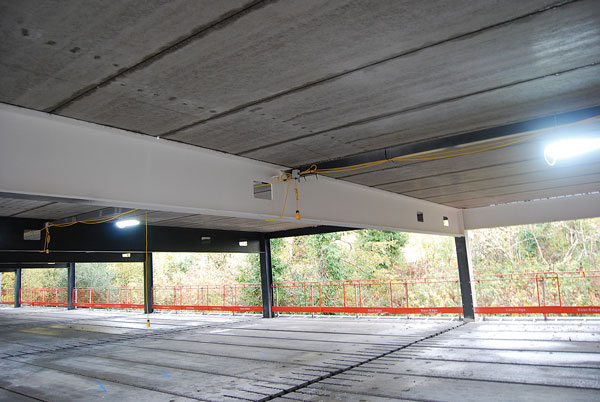
“A precast floor solution was chosen as it allowed us to efficiently design the steel frame by keeping primary beams on column lines, with the precast planks able to span the full 7.5m bay width,” adds Mr Audsley.
Allowing vehicles to access and exit from the multi-storey hub, the upper floors of the structure have been designed with a split-level configuration, whereby each side of the hub has a slope. When built with a steel frame, this layout will generally provide the best combination of economy and operating efficiency.
The entrance to the hub is on Fairfax Street and this elevation also provided the only entry point for materials during the construction.
Starting at the furthest point from the entrance, the steel frame was erected using a single 60t-capacity mobile crane.
Positioning the crane was important, as the erection team needed to ensure that lifting duties were not carried out over the residential properties, church and Manchester Metrolink that surround the site.
The columns were erected as full-height sections, while the heaviest steel items were the beams, which weigh up to 4t each.
As well as the steel frame, Hambleton also installed precast stairs and a lift shaft, and more than 600 floor planks that weigh up to 2t each.
It is anticipated that the Travel Hub will be fully complete by July 2026.