
Projects and Features
Top of the form
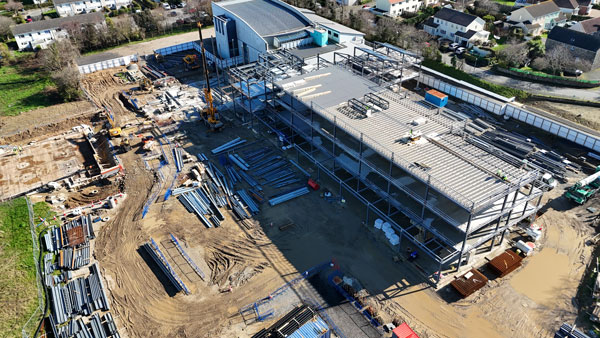
Consisting of a structural steel frame supplied from the mainland, Les Ozouets Campus will replace five current sites to become Guernsey’s new further education centre.
FACT FILE
Les Ozouets Campus, Guernsey
Main client: States of Guernsey
Architect: Design Engine
Main contractor: Rok
Structural engineer: RGA Consulting Engineers
Steelwork contractor: Hambleton Steel (part of Embrace Steel)
Steel tonnage: 480t
Structural steelwork, fabricated in North Yorkshire and transported across the English Channel, is helping to create a new educational campus on Guernsey.
Once complete, Les Ozouets Campus will be a centre of excellence for post-16 academic, technical, vocational and professional learning. It will include a range of modern specialist facilities designed to deliver teaching and learning across the varied post-16 curriculum, including engineering workshops, labs, arts centres, specialist studios and resources, which will equip students with the skills they need in 21st-century employment.
The current construction programme being undertaken by main contractor Rok will deliver two interlinked steel-framed buildings, known as the Main Building, and the Construction and Engineering Building.
A key consideration for the new buildings is their sustainability and making sure they fit comfortably into their surrounds. The design incorporates strategies to minimise environmental impact and includes high-level insulation, efficient window glazing, and low-energy heating and ventilation systems.
The project has also been designed around a number of outside spaces that will also encourage biodiversity and ecology as well as promote student and staff wellbeing.
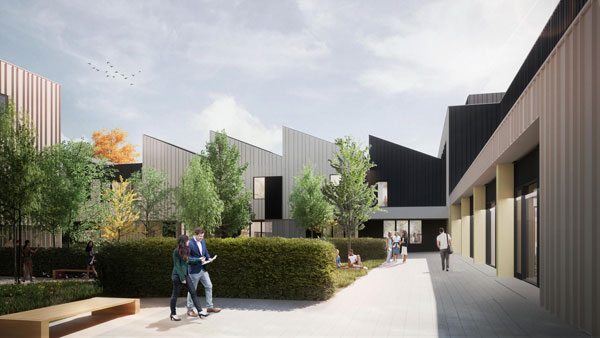
Central to the design is the choice of structural steel frames.
According to the design team, steel was considered to be the best option for the project as it satisfies the embodied carbon strategy by offering an efficient and lightweight solution that can be supported on pads, thereby minimising the amount of concrete required in the foundations.
Design Engine Architects’ Consultant, David Gausden, says: “Architecturally we required a solution that allowed some plasticity to push and pull the building forms, to create recessed entrances, covered routes and the saw-tooth roof above workshops and art rooms.
“The further education sector is also very prone to change, flexing to the demands of an ever-changing work environment.
A steel frame could accommodate both compositional variation and future flexibility and was deliverable on the island.”
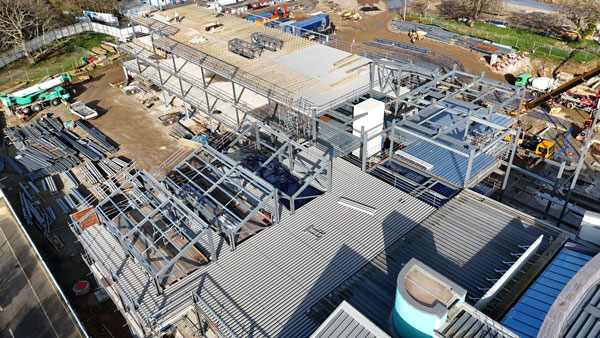
Even allowing for the transportation costs and the associated logistics, the use of structural steelwork is said to have been a cost-effective choice.
Hambleton Steel is fabricating and supplying the steelwork, with locally-based Siteweld, responsible for the erection package.
From its North Yorkshire fabrication yard, the steelwork was transported to Portsmouth, from where it travelled by cross-Channel ferry to the island of Guernsey.
“The majority of the steelwork was fabricated into lengths that fitted the haulier’s 13.6m-long trailers,” explains Hambleton Steel Contract Manager Lee Shardha.
“However, we did have two loads that included some 18.4m-long cambered beams, which we managed to transport on the same sized trailers.”
Because of Guernsey’s narrow roads, the steelwork deliveries required a police escort from the port to the Campus.
Once onsite, the steelwork was erected using mobile cranes. The largest structure is the Main Building, which is set to offer 5,300m² of teaching space. It is a three-storey braced frame that integrates with the site’s existing Princess Royal Centre for Performing Arts (PRCPA).
The Main Building wraps around two elevations of the PRCPA and will create a new and enlarged lobby and entrance area, within both interlinked buildings. Framed with exposed 323mm-diameter CHS columns, the entrance will be accessed via a new piazza, located next to the Main Building.
“Where the new extension interfaces with the PRCPA, the existing curtain walling was retained and protected to keep the building weather-tight,” explains Miguel Martins, Associate at RGA Consulting Engineers.
“Transfer beams were installed to support the existing steel roof beams, avoiding temporary propping. This allowed the new and existing structures to be integrated safely, maintaining roof stability and reducing temporary works costs.”
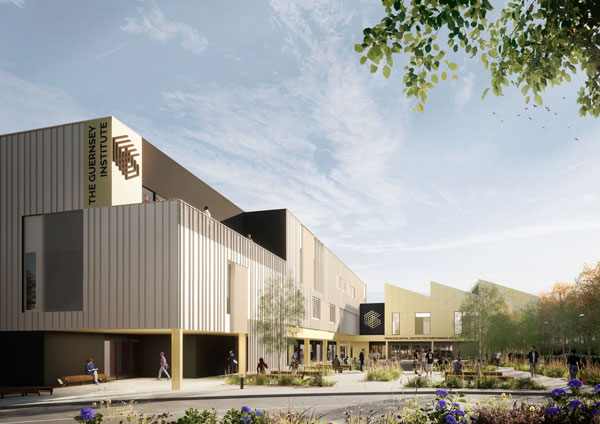
The remainder of the Main Building’s ground floor accommodates teaching areas, many of which are large open-plan spaces, featuring column-free spans.
A series of transfer beams are positioned at the underside of the first floor, creating the column-free ground floor spaces, while also supporting the extra columns that are required for the upper floors’ traditional educational configuration.
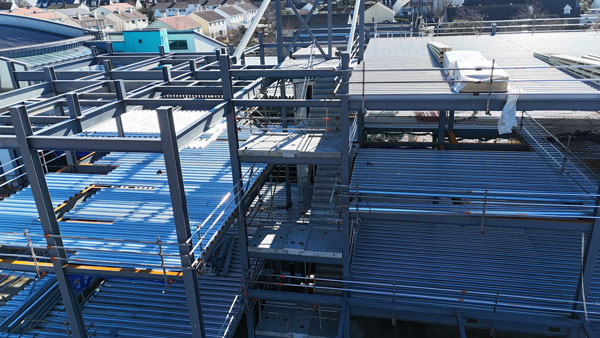
The two upper levels are both designed around a regular column grid, accommodating classrooms and IT rooms, arranged either side of a central corridor. The floors have been designed compositely, with steel beams supporting metal decking and a concrete topping.
Structurally-independent, the Construction and Engineering Building (C&EB) is another steel braced frame, which connects to the Main Building’s north elevation at ground and first floor.
Providing access between floors, in both buildings, are five precast staircases (weighing up to 36.5t and all supplied by Hambleton) and three precast lift shafts, which were all installed alongside the steelwork.
Rectangular in shape, topped with a feature saw-tooth roof and creating 2,735m² of space, the C&EB’s design follows the plot’s sloping topography, whereby the area furthest from the Main Building has a deeper (double-height) ground floor.
Housing vehicle maintenance and engineering workshops, the lower ground floor is predominantly a large column-free space, formed with the aforementioned 18.4m-long cambered beams. Large door openings and goods lifts will allow vehicles and large items of machinery to enter and leave the building.
Similar to the Main Building, the first floor of the C&EB accommodates teaching spaces, arranged either side of a central corridor and utilising a regular column grid pattern.
The Main Building, and the Construction and Engineering Building will complete by Spring 2027.