
Projects and Features
Steel provides south coast logistics boost
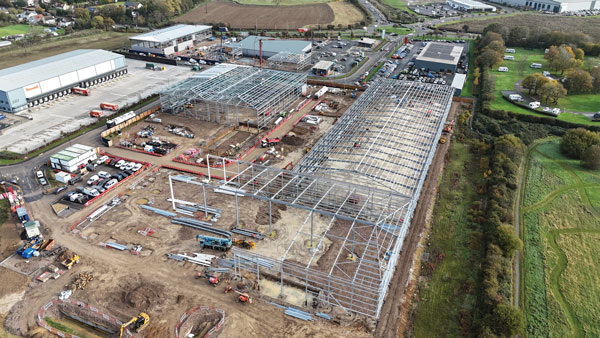
The use of structural steelwork has provided the required speed of construction for an 11-unit warehouse scheme in Bognor Regis.
FACT FILE
Trade City and Logistics City, Bognor Regis
Main client: Kier Property
Architect: Ian C King Associates
Main contractor: Mildren Construction
Structural engineer: HDR
Steelwork contractor: Nationwide Structures
Steel tonnage: 900t
Helping to satisfy an increasing demand for modern industrial and logistics space, the new Trade City and Logistics City development in Bognor Regis is set to be completed by August 2026.
Being built by Mildren Construction within the existing Saltbox Business Park, the scheme comprises six steel-framed structures that will provide 11 units ranging in size from 1,063m² to 16,141m².
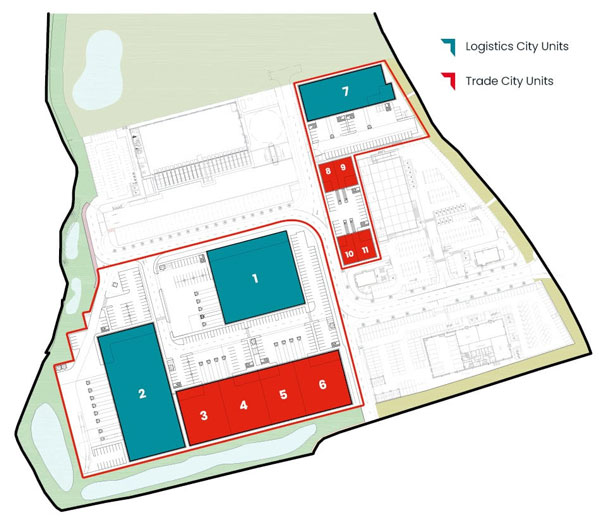
Offering flexible configurations to suit a diverse mix of occupiers, from SMEs to national logistics operators, the development consists of eight smaller Trade City units (up to 5,882m²) accommodated within three separate warehouses, while the remaining structures will house three Logistics City units.
The project forms part of the wider Enterprise Bognor Regis development, a 70-hectare government-supported employment initiative, which is poised to accommodate up to 150 businesses and create 4,000 new jobs.
Strategically located to the north of the town, the development consists of four distinct parcels of land (including the Saltbox Business Park) that have good road access to the ports of Portsmouth, Southampton and Shoreham, as well as being a short distance from Bognor Regis station, which offers a direct rail link to London.
Being developed by Kier Property, the Trade City and Logistics City scheme is designed with a strong emphasis on sustainability and operational efficiency. Aiming to achieve BREEAM ‘Excellent’ and EPC A ratings, the six buildings will have rooftop solar panels, fresh air ventilation systems and access to EV charging points.
The project is also making use of high-quality, sustainable construction materials, including around 900t of structural steelwork.
Attributes such as cost-effectiveness, adaptability and its contribution to the circular economy through reuse and recycling are all factors that continue to be valued by developers, contractors, designers and building users alike, making steelwork the go-to material for warehouse projects.
Mildren Construction Site Manager Dan Rose says: “The Trade City and Logistics City development will provide much needed commercial and industrial space for Bognor Regis.
“Utilising steelwork to construct the building’s frames was imperative, not only for the speed of construction, but also for the buildability. We wouldn’t have been able to erect all six structures in less than 10 weeks using any other framing solution.”
Making use of two erection teams, each with their own mobile crane, Nationwide Structures erected the steel frames in a sequence that followed on behind the completion of the scheme’s extensive groundworks programme.
Below the surface, the greenfield site consists of low strength clay and chalk deposits that required a ground improvement package to be carried out in order to make the ground suitable for the building work.
Carried out during the project’s initial phases, a combination of rigid inclusions and vibro stone columns were installed, followed by concrete pad foundations to support the building’s columns. After a plot’s ground was prepared, the erection of a steel frame was able to commence.
The Logistics City structures are known as Unit 1, Unit 2 and Unit 7 (see site plan). They have each been designed to accommodate a single tenant (although like most steel-framed warehouses they have the inbuilt flexibility to be easily sub-divided into two or more units) and have a floor loading capacity of up to 50kN/m², in keeping with typical industrial warehouse requirements. Allowing goods and products to be easily brought in and out of the buildings, they also feature dock levellers.
Within each of the structures there is a two-storey (ground and first-floor) office area. The offices are formed with a composite solution of steel beams supporting metal decking and a concrete topping.
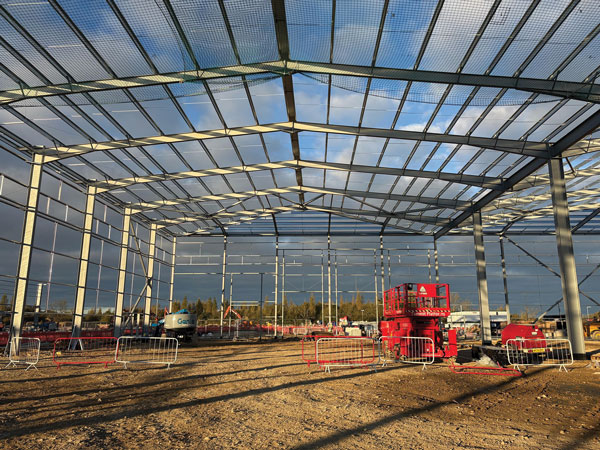
The first structure to be erected was Unit 7, which is a single-span warehouse measuring 68m-long × 28m-wide. Creating the open-plan column-free interior, the roof beams were brought to site in 14m lengths, which were assembled on-site into complete sections, before being lifted into place by a single mobile crane.
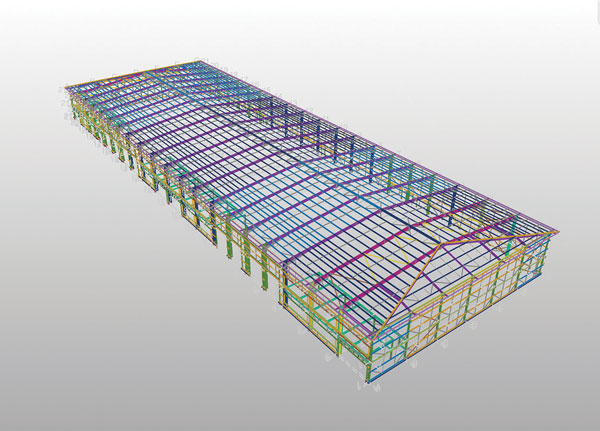
Units 1 and 2 are both larger twin-span structures, measuring 63m × 57m and 99m × 44.6m respectively. Both have a central column line dividing the building, and each of the two spans was installed using a series of spliced beams, in a similar procedure to Unit 7.
Four of the Trade City units (3, 4, 5 and 6) are accommodated in one 128m-long × 43.5m-wide structure. Further highlighting steelwork’s flexibility and ability to form open-plan spaces, the building is a single-span structure with no internal columns.
Each of the 32m-wide units will accommodate a single-storey office area and will be served by their own dedicated loading doors.
The other two Trade City structures consist of two identical buildings, positioned next to each other, close to the development’s entrance.
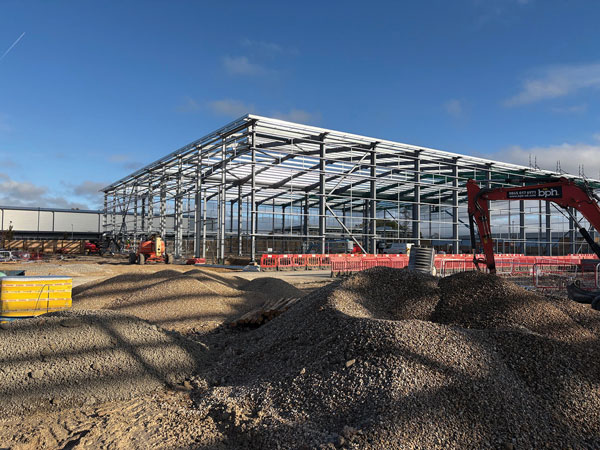
Each measuring 26m × 21m, the single-span structures will be divided down the middle and house units 8 and 9, and 10 and 11 respectively.
The Trade City and Logistics City development will be complete by August 2026.