Projects and Features
Steel frames dock on the Humber
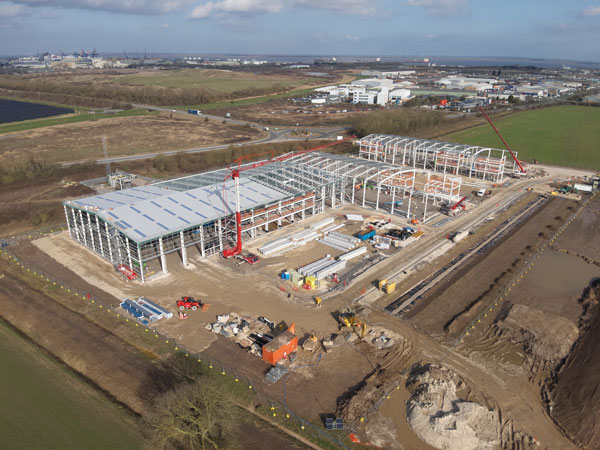
Associated British Ports is constructing the first phase of its major HELM industrial and logistics park at Immingham, one of the most significant developments of its kind in the Humber region.
FACT FILE
HELM industrial and logistics park, Immingham
Main client: Associated British Ports (ABP)
Architect: GGP Consult
Main contractor: CR Reynolds
Structural engineer: GGP Consult
Steelwork contractor: Billington Structures
Steel tonnage: 400t
Representing a major boost for local jobs and economic growth, Associated British Ports (ABP) has begun work on a large speculative warehouse and logistics development close to its two South Humber port facilities at Grimsby and Immingham.
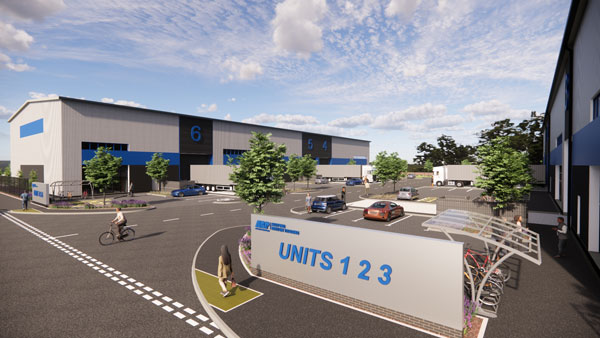
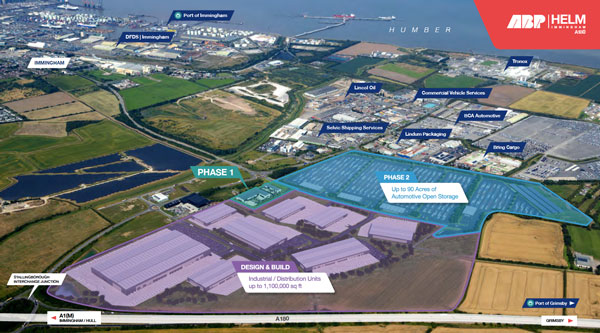
To be completed in three phases, the initial phase at the 227-acre HELM industrial and logistics park will provide modern, purpose-built space for businesses operating in sectors including manufacturing, ports logistics, energy and engineering. A total of eight warehouse units will be accommodated within three steel portal-framed structures.
As part of the client’s low-carbon development strategy, phase one at HELM is targeting BREEAM ‘Excellent’ and EPC A ratings.
Highlighting ABP’s ambition and confidence in the area, further phases could provide another 102,000m² of logistics and manufacturing space, along with 90 acres of automotive open storage with on-site renewable energy generation and extensive biodiversity improvements.
Andrew Dawes, ABP Regional Director of the Humber ports, says: “The development of new business units is a clear demonstration of ABP’s commitment to strengthening the UK’s trade infrastructure and reinforcing the Humber’s position as the UK’s No.1 gateway for global commerce.
“This investment is not only central to our strategy of ‘Keeping Britain Trading’ but also plays a key role in supporting the energy transition through on-site renewable energy solutions.
“We are creating opportunities that benefit local communities, underpin regional prosperity, and secure the UK’s competitiveness for the future.”
The HELM site has historically been used as agricultural land and is strategically positioned directly adjacent to the A180 dual carriageway, leading to Grimsby and local motorway networks. The site is also connected to the Humber Link Road, the port connection road that links Immingham and Grimsby.
Main contractor CR Reynolds started work on site in September 2025, with an enabling package that included the installation of piled foundations to support the three steel frames and their ground floor slabs.
The piles are up to 14.5m-deep, and were the chosen foundation solution as the ground conditions are challenging, due to the proximity of the River Humber.
Once the groundworks for the three warehouse plots had been completed, Billington Structures were able to begin their six-week steel erection package.
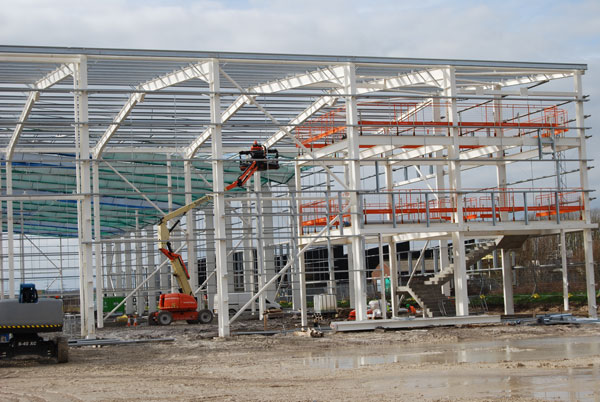
As well as the fabrication, supply and erection of the steelwork, the company’s work included installation of precast stairs (one in each unit), metal decking and edge protection.
GGP, the project’s architect and structural engineer, says that like most similar projects in the UK, using steelwork was the only viable framing solution for this project, as speed of construction and long clear internal spans are an essential requirement.
The largest of the portal frames, accommodating units 7 and 8, was the first structure to be erected. It is positioned furthest from the site’s entrance, and by starting with this structure, the erection team were able to sequentially work their way out of the plot. This made it easier for steel deliveries to be made and allowed the follow-on trades to start their work once each of the frames was installed.
A partition wall divides the largest warehouse in two, creating the slightly larger unit 8, which has a gross internal area (GIA) of 2,796m² and three loading doors, and unit seven with 2,050m² GIA and two loading doors.
Helping the scheme adapt to future tenant requirements and to create some structural flexibility, the internal configuration in each of the three warehouse structures can be altered, as partition walls could be removed, allowing tenants to create larger warehouse spaces by occupying multiple units.
Forming the required column-free internal space, the largest warehouse has a 10m-high × 46m-wide span. To erect the roof, which is supported by a series of 2.5t columns, individual roof rafters (measuring 23m-long and weighing up to 3.5t) were fabricated and delivered to site. Pairs of rafters were then bolted together on the ground to form the main span, before being lifted into place using two 70t-capacity mobile cranes.
Complementing the warehouse/logistics space, all of the project’s eight units have internal two-storey offices, consisting of ground and first floors. The largest office block is in unit 8 (240m²), while the smallest (72m²) are in units 1 and 3.
In all of the offices, the first floor and internal roofs have been compositely formed with steel beams supporting metal decking and a concrete topping.
Following on from the initial warehouse, the two remaining, slightly smaller structures were erected simultaneously, using a single mobile crane for each building’s steel frame.
Both of the structures have a similar design, with units 1, 2 and 3 housed in a 24m-span building, and units 4, 5 and 6 accommodated in a 29m-span warehouse.
The smaller warehouse units vary in size from 565m² (unit 3) up to 1,012m² (unit 5) and each has a single loading door.
Summing up, Humber Freeport CEO Simon Green says: “We’re delighted to have worked with ABP and North East Lincolnshire Council to support the HELM development, which will create high-quality, sustainable industrial space for growing businesses in the energy, ports, manufacturing and engineering sectors.
“Developments like HELM reinforce the Humber’s role as a gateway for international trade, broadening supply chain opportunities and underlining the region’s status as a leading cluster for manufacturing, clean energy and logistics.”
HELM industrial and logistics park, Immingham, phase one is due to complete in September 2026.