Projects and Features
Over rail transfer solution
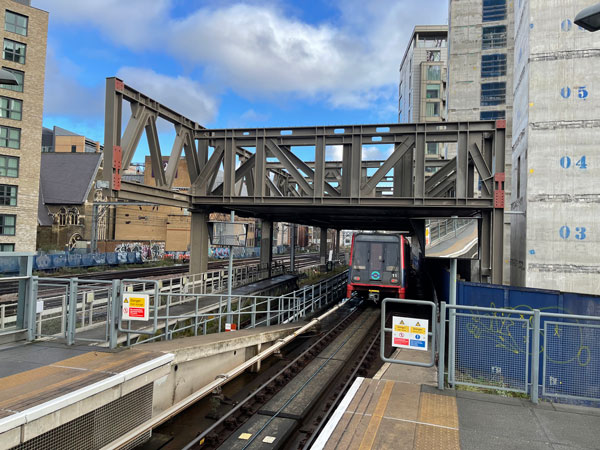
Maximising the available site footprint, two steel transfer structures are creating the platform for a hotel and apartment scheme to span over some important rail assets in East London.
FACT FILE
88 Royal Mint Street, London
Main client: IJM Group
Architect: BSBG
Main contractor: Midgard
Structural engineer: Whitby Wood
Steelwork contractor: Caunton Engineering
Steel tonnage: 1,200t
On a prominent and constrained site, close to the Tower of London, steelwork’s long-span attributes and ease of construction have come to the fore, as two large transfer structures are being erected to support a 14-storey mixed-use scheme, adjacent to and over-sailing a Network Rail viaduct, and above two encapsulated Docklands Light Railway (DLR) lines serving Bank station.
The second phase to be built on the former goods yard site, the scheme is being developed by IJM Group and constructed by its main contractor Midgard. 88 Royal Mint Street will include a 454-room aparthotel for Staycity and 79 high-end residential units.
The transfer structures unlock the constrained site’s potential, with the northern frame designed to allow the concrete-framed building to span over the part of the viaduct accommodating two DLR lines serving Tower Gateway (the remainder of the viaduct supports four railway lines going in and out of Fenchurch Street Station).
Because of its position, this steel structure has been entirely installed during a series of rail possessions, obtained from Network Rail and Transport for London (TfL). Consequently, the work has had to be undertaken overnight, during Sunday rail closures and on public holidays.
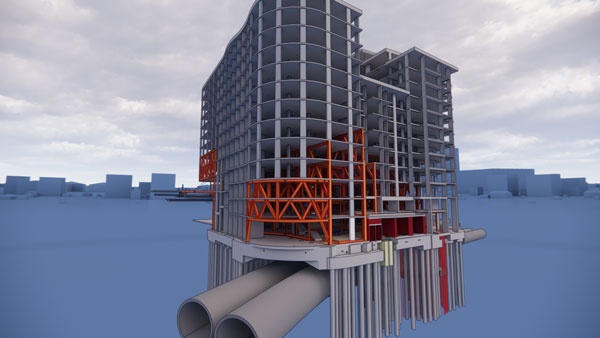
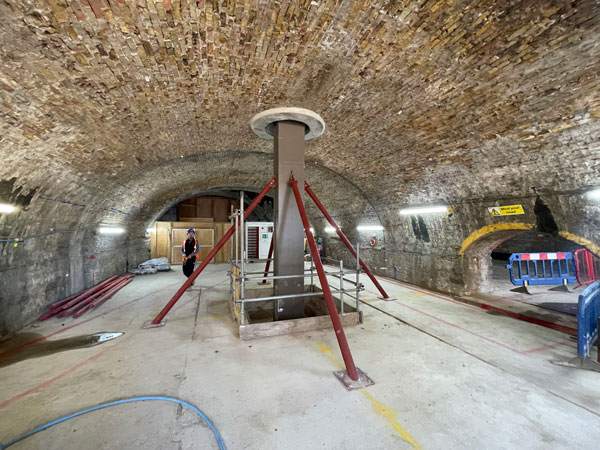
Adding some further complexity into the scheme, the other (southern) steel structure not only bridges over the Bank DLR encapsulated lines that are located beneath the site, but also has to span over an associated three-storey tall DLR plant room, which houses life safety fire extract equipment and a concrete-framed staircase structure providing a passenger escape route.
“Although the main part of the project is concrete-framed, steelwork has provided the most efficient solution to form two transfer structures that support the building. By working closely with Network Rail and TfL we have managed to find an efficient method of installing this structure, while minimising the effect on transport infrastructure,” explains Midgard Project Director Andrew Henderson.
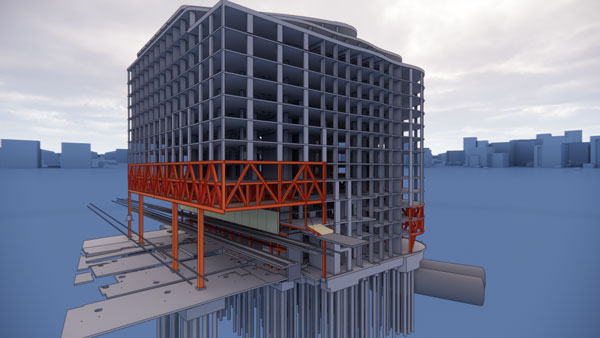
Positioned either side of the building’s main core, the northern structure was the first to be installed. In total, Caunton Engineering is fabricating, supplying and erecting 1,200t of steelwork for the project.
The steelwork for the initial transfer deck is supported along its northern elevation by four 12m-tall columns, weighing up to 13t each, that pierce the Victorian brick viaduct at a point between the DLR and mainline railway lines. To the south, and abutting the viaduct, there are further supporting columns that are sat within the footprint of the site.
Due to the proximity of the railway assets and to negate any ground-borne vibration potentially affecting the building, all of the columns are sat on concrete pads, lined with acoustic isolation bearings, and supported by pile caps.
On the north elevation of the transfer structure, the columns are linked by two-storey perimeter trusses, (brought to site in sections and bolted together during the erection process) which in turn support a series of nine 13m-long × 3.5m-high (single-storey) portal frames that span over the DLR lines, creating a 5m clearance for the trains.
Weighing up to 22t each, the portals were delivered to site as complete sections and lifted into place using a tower crane (there are three on site), which has been installed at the project specifically for the steel erection programme.
At the western end of the transfer structure there is a tenth portal frame, which has been designed as a two-storey element, as it cantilevers over the Mansell Street Rail Bridge at a point where there is no suitable location to install a supporting column.
The cantilevering frame will also accommodate a cable-stayed link bridge, creating a new entrance from the Royal Mint Street development into Tower Gateway station.
“One of the advantages of using a steel-framed option for the transfer structures is the fact that they can be installed, section by section, during a number of rail possessions,” explains Whitby Wood Associate Director Gioele Nunziatini.
“It would have been much more challenging to build the northern structure in any other material, without closing the rail lines for an extended period.”
Within the depth and on the top boom of the trusses, the steelwork supports precast flooring, forming the project’s fourth and fifth floors and an in-situ concrete slab at level six. Above this, the building converts to a concrete-framed structure.
While the initial transfer structure was being completed, work on its southern neighbour was begun.
As well as spanning over the encapsulated DLR tunnel and its associated assets, the southern transfer structure has had to take into account the massing of the building that it will be supporting.
The development is arranged around an open central courtyard, which is an important architectural feature that the transfer structure cannot intrude upon. Furthermore, the DLR tunnel also limits the number of locations where piles can be installed.
Working around the numerous constraints, the southern transfer structure incorporates a series of 1,200mm-thick plate girder tie beams, that bridge over the tunnel at ground level. The beams tie the trusses at ground level, due to the inability of the acoustic bearings to provide sufficient lateral resistance.
Vertically-positioned columns support the trusses and transfer the loads to piles cap locations at either end of each girder.
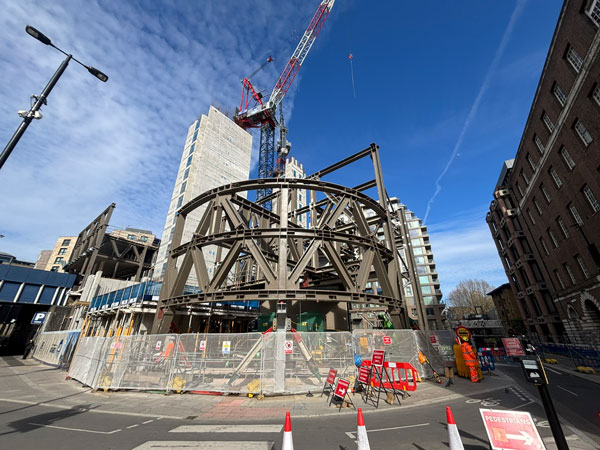
Because of the numerous constraints and the lack of space for piles, the southern transfer structure is arranged around a complex steelwork configuration, whereby multi-storey trusses (two and four-storeys high), spanning north to south, support a series of double-height trusses spanning east to west.
In the south west corner of the site, (at the junction of Mansell Street and Royal Mint Street) the steel transfer structure helps form the building’s main entrance. Positioned directly above the DLR lines, a 13m-long curved truss (with steel members bent to a radius of 7.7m) helps form the double-height lobby and feature corner elevation. The truss is supported on raking columns that are positioned either side of the tunnel, and restrained by orthogonal single and multi-storey trusses, positioned at levels one and three.
Summing up, Dominic Howson, IJM Land Project Director, says: “This is one of the most complex rail interfacing schemes ever attempted in London. It has taken a huge amount of collaboration between Network Rail, TfL and Midgard to achieve this level of progress. It shows what can be achieved on rail interfacing projects when you have the right team behind you and work in the right way.”
88 Royal Mint Street is due to be complete in 2027.
Advanced fire design for steel transfers
For this scheme, Whitby Wood developed an integrated fire engineering design methodology for concrete structures supported on steel transfers.
In addition to conventional single member design checks, a unified approach ensured implications associated with global effects under fire conditions were considered across the structure.
This method, which proved to be particularly relevant for 88 Royal Mint Street’s complex steel transfer systems, enhances efficiency and accuracy, and increases confidence in fire design for complex composite schemes.