Projects and Features
Leisure boost for the valleys
Steelwork’s ease of construction and flexibility have made it the framing solution of choice for a state-of-the-art leisure centre in the South Wales town of Caerphilly.
FACT FILE
Caerphilly Leisure and Wellbeing Hub
Main client: Caerphilly County Borough Council & Alliance Leisure
Architect: Watson Batty Architects
Main contractor: Morgan Sindall Construction
Structural engineer: Stantec
Steelwork contractor: Shufflebottom (part of Embrace Steel)
Steel tonnage: 450t
Known for having the largest castle in Wales and producing a traditional crumbly cheese, the town of Caerphilly will soon have one of the most up-to-date leisure centres in the region to add to this impressive roster.
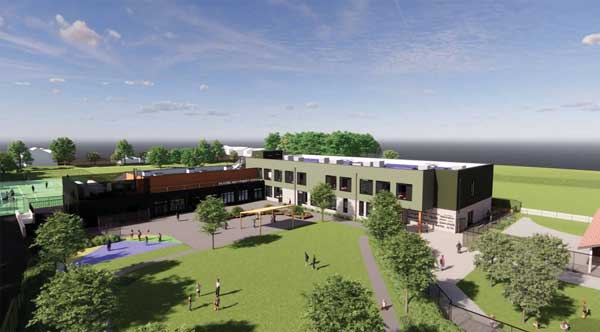
The £38 million Caerphilly Leisure and Wellbeing Hub is transforming an area of disused scrub land, close to the town centre, into a vibrant community centre that will support and encourage healthy, active lives.
Julia Goddard, Regional Director at Alliance Leisure (which has been appointed by Caerphilly County Borough Council to deliver the project), says: “Once open, the Hub will transform the lives of people living in the town and the surrounding areas.
“The facilities have been designed to accommodate the needs of everyone and to support individuals across their entire life journey. Children who will enjoy the facilities now will grow up and enjoy the facilities with their own children, and then their children’s children in years to come.”
When complete, the two-storey, timber-clad building will house a six-lane swimming pool and wet play area served by a large changing zone, a state-of-the-art health suite, a comprehensive fitness suite (gym), fitted out with cardiovascular and strength training equipment, two flexible studio spaces, a group cycle studio, and two squash courts.
The building also includes a café, a large adventure play facility, a TAG Active arena, lounge area, two flexible consultation rooms, and a dedicated social space for use by community groups.
Councillor Chris Morgan says: “The opportunity to create a purpose-built leisure and wellbeing centre designed to cater directly for the diverse social, health and wellbeing needs of our community is a once in a generation opportunity. Working with Alliance Leisure, through the UK Leisure Framework, we are engaging leisure expertise at all levels of the supply chain to design and build a leisure and wellness hub that will stand out as one of the finest in the UK.”
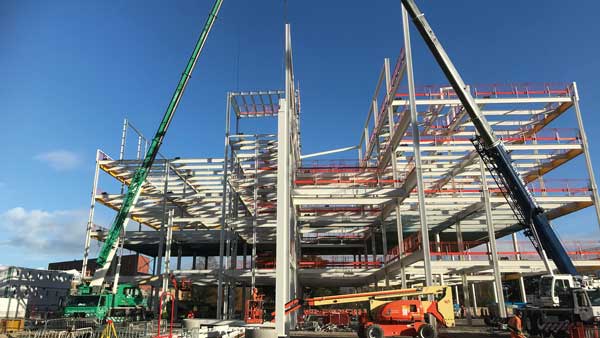
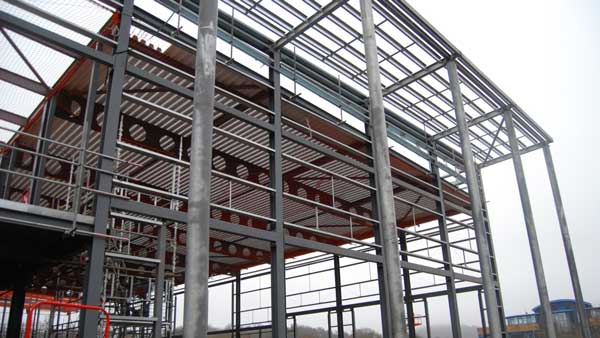
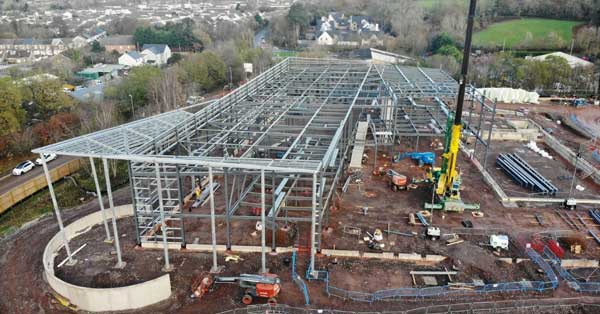
With a footprint of around 1,763m², the Hub has been designed as a large steel frame, which gains its stability from localised and vertically braced bays, as well as moment frames.
The material was chosen as it can easily and efficiently form the desired long span and column-free spaces that are a vital ingredient of leisure and sports centres.
Having considered a number of framing options, the design team chose steelwork as it best facilitated the architectural vision, while using cellular members meant services could be efficiently integrated into the depth of the beams, thereby reducing the required structural zones and the overall height of the building.
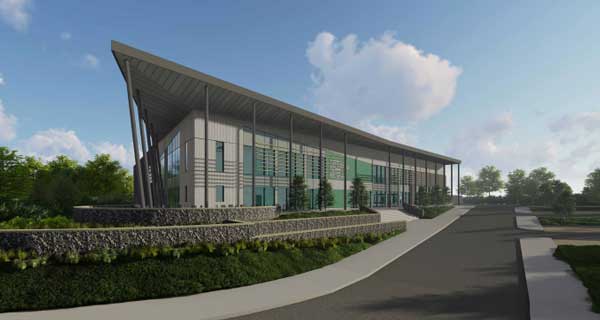
On plan, the building’s design includes a slight skew, whereby two of the structure’s four corners are not at right angles. In order to create this shape, the internal column grid pattern changes in these areas and the rotation of some beams has had to be altered.
Richard Wigley, Commercial & Technical Director, at Shufflebottom, says: “The project is a good example of how steelwork can support ambitious architectural and community-led outcomes. The long spans, complex geometry and integration of services required a considered and collaborative approach, particularly around connection design and buildability.
“Working closely with Morgan Sindall and the wider design team allowed us to deliver an efficient structural solution, while maintaining programme certainty.”
Elsewhere, a regular column grid pattern has been used as much as possible, offering opportunities for layout flexibility with the future use of the building.
Within the Hub, the two largest double-height long-span zones are positioned on opposite sides of the building. Separated by the main two-storey element of the structure, one area accommodates the swimming pool, while the other is a sports hall.
The pool hall, which is the longer of the two zones, accommodates the main 25m-long swimming pool as well as the wet play area that will include a two-storey high flume.
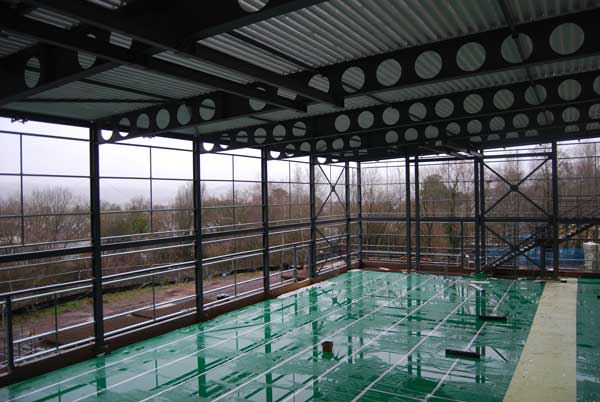
The roof of the pool hall and sports hall are both formed with a series of 20m-long cellular beams which were brought to site in two pieces and spliced together on the ground before being lifted into place using the erection team’s 90t-capacity mobile crane.
In line with the project’s efficiency aspirations, both sets of long-span beams will accommodate air-handling equipment within their respective cellular openings.
Supported by the cellular beams, the pool hall will have a green roof, the sports hall a standing seam, while the area in between, (over the two-storey part of the hub) will be covered with a felt roof. Throughout, the roof structure is made up of a mixture of solid and perforated acoustic decking.
Also at ground floor, there are two other significant column-free spaces. Accommodating the main entrance and extending into the adjacent café, one of these areas has been created by a 15m-long × 5m-tall truss, positioned at first-floor level and concealed within the gym’s main elevational façade,
Abutting this area, the TAG Active hall is an 11m-wide, double-height column-free space. It will provide a modern obstacle course where players wear illuminated wristbands (TAGs) to help gain points for speed and agility.
Located in the middle portion of the hub, the two-storey element accommodates the main changing facilities on the ground floor (both wet and dry areas), while on the upper floor there is the gym (with a 15m-wide clear span), studios and squash courts (15m-wide spans).
Using a composite solution, the upper floor has been formed with steel beams supporting metal decking and concrete topping.
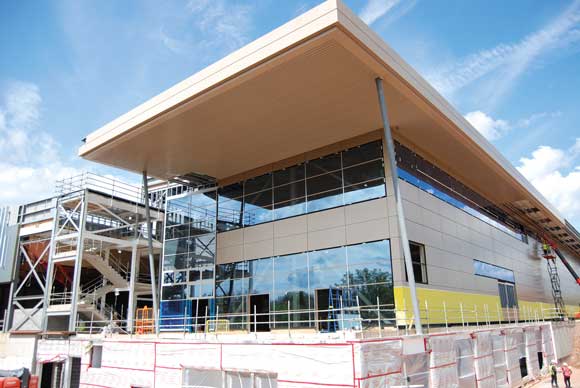
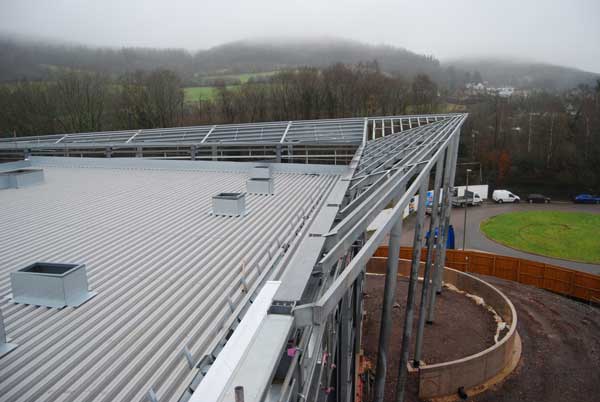
Externally, a stand-out feature of the project is created by a fully-galvanized canopy that wraps around the south-west corner and extends along the main (south) elevation, forming a covered walkway for the Hub’s entrance.
Thermally isolated from the main building, the canopy is supported on a series of raking 12m-tall × 400mm-diameter CHS columns. Reaching above the building’s parapet, the canopy is a geometrically-challenging structure that slopes in two directions.
The canopy deck, which is up to 5m-wide at the corner, is formed with a series of beams, bracings, moment connections and cold-rolled joists, that will be clad with a standing seam.
Including the canopy’s CHS columns, the majority of the Hub’s columns are founded on shallow spread footings. The exception is the pool hall, where a deep perimeter ring beam has been installed to share column loadings and allow the reduced dig in the area for the pools and the associated plant and services.
The foundations were installed following a programme of dynamic compaction, which was carried out across the entire site in order to improve ground conditions.
The Caerphilly Leisure and Wellbeing Hub is due to complete in March 2027.