
Projects and Features
Leadership that strengthens the steel supply chain
As quotas, tariffs, the Carbon Border Adjustment Mechanism and changing supply routes add complexity to steel procurement, Barrett Steel is investing in the stock, processing capability, market intelligence and infrastructure needed to give UK fabricators greater certainty and more options.
For steel fabricators, the days when procurement was simply a question of price, specification and availability are disappearing fast. Quotas can change. Tariffs can alter the economics of established supply routes, while the Carbon Border Adjustment Mechanism (CBAM) is bringing carbon data and traceability further into the purchasing conversation.
Meanwhile, projects must be delivered on time, workshops still need material when promised, and customers still expect competitive prices. In this environment, the strength of a supply chain is measured by how well it copes when the usual route doesn’t go to plan.
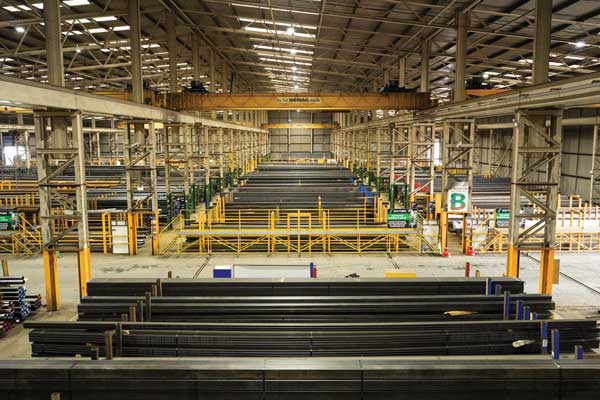
That is where Barrett Steel believes its role is changing. Founded in 1866, Barrett Steel is the UK’s largest independent steel stockholder, with more than 30 sites nationwide and over 120,000 tonnes of steel available for delivery. For today’s fabricator, the significance of that scale is not simply the amount of steel in the yard.
It is what that network makes possible: alternative sources, substantial stockholding, processing capacity, logistics, technical expertise, and a view of the market that can help customers make decisions before a supply problem becomes a project problem.
Certainty in a changing market
The UK steel market is going through a period of considerable change. Quota arrangements and tariffs are influencing where material can be sourced and at what cost, while CBAM is adding a new dimension to imported steel through carbon reporting and traceability requirements.
For fabricators, these changes can have consequences long after an order is placed. A seemingly straightforward purchasing decision can affect future availability, lead times, carbon reporting and ultimately the ability to keep a project on programme.
The question, therefore, is increasingly not simply: where can I buy this steel? But, how secure is that supply route?
Barrett Steel’s size and breadth give it more options when answering that question. Its international trading relationships, domestic stockholding, and network of sites allow the business to look across different sources and routes to market as conditions change.
That flexibility matters when a traditional source becomes constrained, a quota fills or tariffs make an established route less attractive.
Barrett Steel will also continue to quote fixed rates and take liability for any out-of-quota liability or CBAM costs, helping customers avoid taking on an element of uncertainty that can otherwise complicate purchasing decisions.
The company has also been active in representing the interests of the downstream steel sector in discussions around quotas, tariffs, and UK steel policy.
For stockholders, processors and fabricators, the argument is straightforward: measures intended to strengthen UK steelmaking also need to recognise the businesses that move, process, and ultimately turn steel into the structures and products the economy depends on.
Market intelligence is becoming another important part of procurement. Quota utilisation, tariff changes, country of origin and alternative supply routes can all affect the availability and cost of material. Keeping track of those issues requires more than checking the market when an order is due.
Barrett Steel’s free-to-use live Quota Tracker gives BCSA members another way to monitor developments, while the company’s position across domestic and international supply provides a wider view of changing market conditions.
The value of that information is ultimately practical. If one route becomes difficult, there may be another. If future availability looks uncertain, stock already held within the network may provide a solution. When material needs to reach a fabrication workshop quickly, processing can take place before delivery rather than adding another stage to the customer’s operation.
The aim is not to predict every disruption. It is to have enough visibility and flexibility to respond when conditions change.
More than stockholding
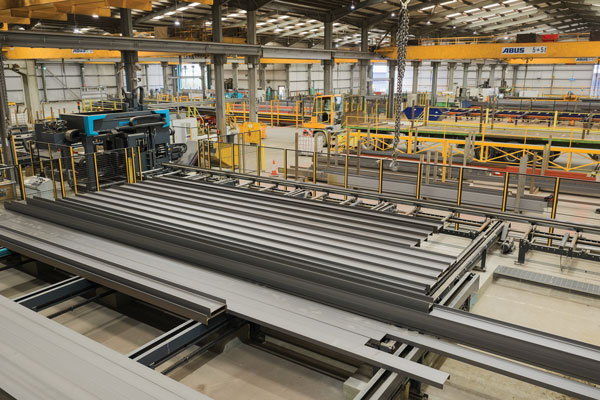
Barrett Steel offers cut-to-length, sawing, drilling, coping, profiling, 2D and 3D laser cutting, shot blasting and painting. For fabricators, the attraction is simple: material can arrive closer to the point at which it is needed, with some of the work already done.
In an industry facing persistent pressure on labour, workshop capacity, and programme times, taking processes out of the fabrication shop can make a meaningful difference.
Recent investment at Barrett Steel’s Scunthorpe Central Processing Hub illustrates the direction of travel. A new automated processing line brings shot blasting, painting, sawing, and drilling together within a single workflow.
The objective is straightforward: increase throughput, reduce lead times and minimise manual handling while giving customers access to more fabrication-ready material.
It is also a useful example of what resilience can look like in practice. Rather than simply responding to changes in the supply market, investment in processing capacity creates more options within the UK supply chain itself.
There is another advantage to scale that is easy to overlook: flexibility of stock. Barrett Steel’s nationwide network combines substantial stockholding with local teams and specialist businesses.
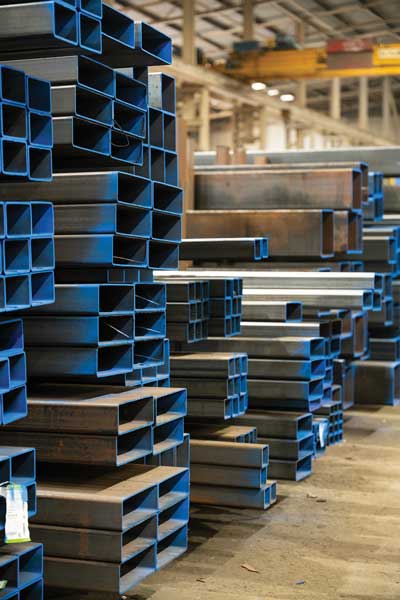
Material held in one part of the network can potentially help meet demand elsewhere, while local knowledge remains important when dealing with individual customers and projects. Its specialist divisions cover structural and constructional steel, engineering products, tubular products, processing, and access systems.
That is perhaps a better measure of a modern stockholder’s strength than the size of its inventory alone.
The question is not just: how much steel do you hold? But, how many ways can you help me get the steel I need?
Preparing for what comes next
Trade policy is not the only change reshaping steel procurement. Carbon is moving rapidly from a sustainability consideration to a commercial one.
As CBAM develops, customers will need greater confidence in the carbon information and traceability associated with imported steel. For fabricators, that means understanding not only the physical characteristics of the material but also the data that accompanies it.
Barrett Steel has responded with its Barrett Green Solutions offering and a commitment to achieve Net Zero Carbon. Its work includes supply-chain due diligence, Environmental Product Declarations, responsible sourcing, and engagement with initiatives such as SteelZero.
For customers, the important point is that lower-carbon steel still has to meet engineering requirements, be available when required and make commercial sense.
The ability to bring those considerations together – material, availability, carbon data and cost – will become increasingly important as regulation develops.
Resilience is also being built behind the scenes. Alongside investment in processing at Scunthorpe, Barrett Steel has expanded fleet capacity to support nationwide distribution and the delivery of processed material.
It is also investing in digital infrastructure, including an ongoing ERP migration and the development of data, analytics, and AI-supported processes.
These may not be the most visible changes to customers, but they can have a direct impact on how efficiently a supply chain operates.
Better data supports better planning. Automated processing increases throughput. More integrated logistics can improve delivery reliability. And stronger market information helps customers make decisions with a clearer view of the risks.
None of these removes uncertainty from the steel market. They do, however, make it easier to manage.
A different definition of leadership
The UK steel industry is entering a period in which the relationship between producers, stockholders, processors, and fabricators matters more than ever.
Quotas, tariffs, and CBAM are not issues confined to steel producers or government policy. They affect every business that buys, moves, processes, and fabricates steel.
For Barrett Steel, leadership is therefore less about being the biggest and more about being useful when the market becomes difficult.
More than 150 years of experience provides the foundation. National stockholding provides scale. Processing and logistics provide flexibility. Market intelligence helps customers see what is changing. Investment in carbon, technology and infrastructure prepares the business for what comes next.
For BCSA members, that combination offers something increasingly valuable: options.
In a market where supply routes can change, costs can move and regulations can evolve, the strongest supply-chain partner is not necessarily the one offering the lowest price on a single order.
It is the partner with the capability, knowledge, and flexibility to help keep the steel, and the project, moving when circumstances change… while still delivering against the original agreed terms.
That is where Barrett Steel is positioning itself to lead.