SSDA Awards
COMMENDATION – Vyshhorod Bridge, Kyiv, Ukraine
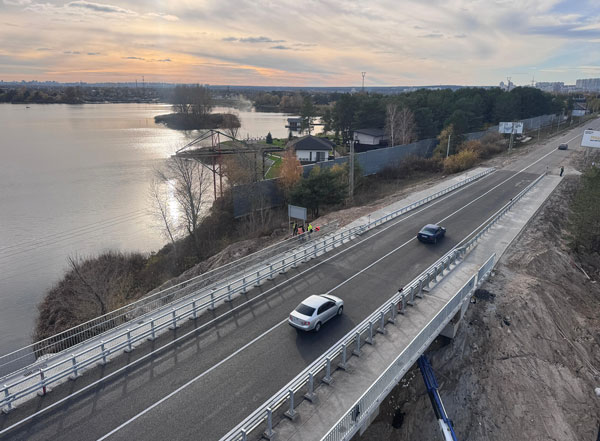
The repaired Vyshhorod Bridge restores a vital transport connection after the original crossing was partially demolished to obstruct the advance of Russian troops.
FACT FILE
Structural Engineer: Ukrainian State Road Research Institute
Steelwork Contractor: Cairnhill Structures Limited
Main Contractor: Dogus Insaat UK Limited
Client: Ministry of Regional Development and Construction of Ukraine
The restored Vyshhorod Bridge re-establishes a vital route into Ukraine’s capital and replaces a temporary crossing that could not carry heavy goods vehicles.
The UK allocated a £26.3 million loan guarantee via UKEF, enabling the Ukrainian government to secure financing for the project privately from Citibank. The initiative also enabled UK manufacturers to contribute essential materials and expertise, including the steelwork for the core structure, which was fabricated in Scotland by Cairnhill Structures.
Steel replacement spans, for the otherwise concrete structure, were selected to accelerate reconstruction and quickly return this critical infrastructure to service.
The three new bridge spans (replacing two old damaged spans) are formed from 1.5m-deep plate girders, fabricated in 15.6m sections and joined using bolted splices. The new steelwork had to replicate the structural depth of the original concrete deck while providing an efficient, rapidly erected replacement.
The fabrication demanded tight control of girder camber, sweep and flange rotation. Ukrainian design codes and specifications also had to be interpreted correctly across language and regulatory differences. Quality proposals were checked with the Ukrainian engineering authority, while the completed steelwork complied with Ukrainian Standard DSTU EN 1090-2.
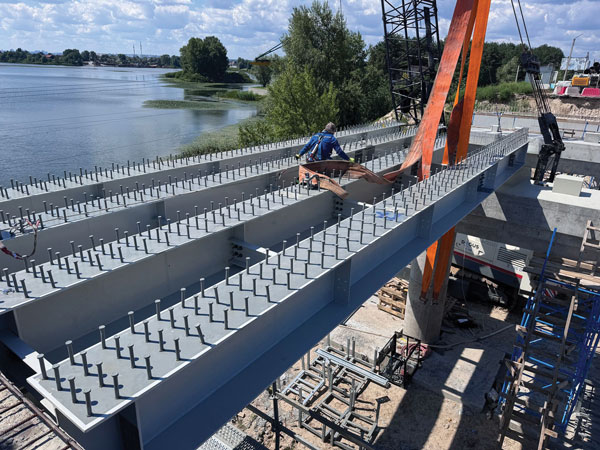
“The project’s main challenge was securing the client’s acceptance of European structural steel, produced to EN standards, as equivalent to Ukraine’s national norms and standards – all within a construction programme delivered under active wartime conditions,” says Dogus Insaat Country Representative Suha Canatan.
The severe Ukrainian winter introduced further technical requirements. S355 steel was tested for performance at temperatures of -40°C, with suitable welding procedures used during fabrication. A multi-coat protective system was closely monitored and inspected to ensure the required quality.
TCB bolts were proposed as an alternative to the specified conventional HSFG bolts. Before accepting the change, the Ukrainian client undertook mechanical testing using supplied bolts and installation equipment. This technical collaboration allowed a familiar bridge connection system to be adopted while satisfying the project’s requirements.
Following approval delays, manufacture was accelerated to meet the time limit associated with the UK Export Finance Guarantee and complete delivery during 2025. Maintaining quality and dimensional accuracy under this compressed programme was particularly important because the steelwork was destined for installation in an active conflict area.
Mr Canatan, adds: “The project stands as a flagship example of how the collective efforts of Ukrainian engineering, British steel production and financial support, together with international construction expertise, can be successfully integrated into a single solution under the most demanding wartime conditions.”
The judges say, an object lesson in ‘bridge building’ in most senses of those words, this project has enormous physical, social and emotional significance to the communities that it reconnects.