50 & 20 Years Ago
Cavern Walks – Liverpool
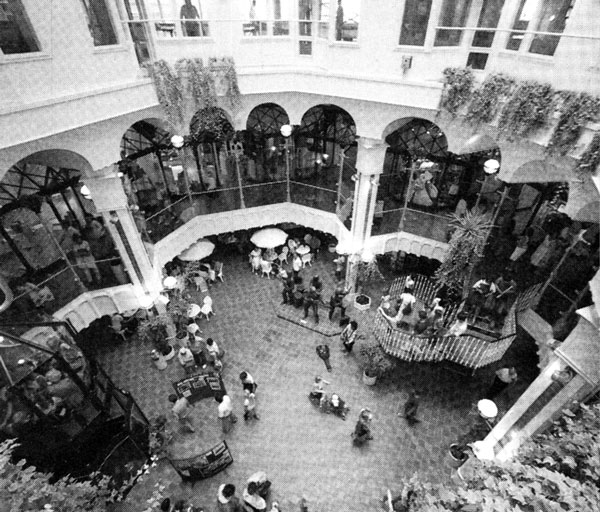
Cavern Walks occupies the site of the original Cavern Club where many of the Liverpool pop groups of the Sixties began their careers, the most famous being the Beatles.
As part of the scheme a replica of the Cavern Club has been created in the basement using the original bricks. A system of steel and concrete beams had to be provided to withstand the thrusts from the replica brick barrel vaults.
Royal Life Insurance, upon agreeing to fund the new project, put together the professional team, all of whom are Merseyside based, and decided to invite tenders for the works, interviewing a number of contractors. Finally, however, it was decided to negotiate the contract with Tysons (Contractors) pie, who had worked with Royal Life Insurance for a number of years, and had built their Liverpool headquarters.
It was essential for the opening of the project to coincide with the opening of the International Garden Festival in May 1984.
Work began on site at the beginning ot October 1982, with a completion date of the beginning of May 1984. To achieve this very tight programme the choice of building frame was crucial. A steel frame with pre-cast concrete floor units was selected, which permitted the desired rate of progress to be achieved.
A severe additional complication was caused by the very restricted nature of the site, and the neighbouring roads. The building covers the site to all four boundaries. Deliveries to it were exceptionally difficult, and a far greater than normal degree of co-ordination was required. A magnificent job was done by the site agent, and the team from Tysons.
The combination of programme and the complex shape of the building led to the decision to use a steel frame, keeping any concrete casing to a minimum and utilising dry fire protection wherever possible. As the building has more than five storeys it has been designed to comply with progressive collapse regulations.
Horizontal continuity is provided by the frame whilst pre-cast floor units provide resistance to debris loading.
960 tonnes of steelwork are used in the frame, about half being high yield steel, to save weight and floor depth. Architectural requirements limit the structural floor zone to under 600mm. The frame grid is 7.6 metres. For economy the bays were split into three by high yield steel secondary beams. Some end connections were designed to provide small fixed end moments which enabled beam weights to be reduced.
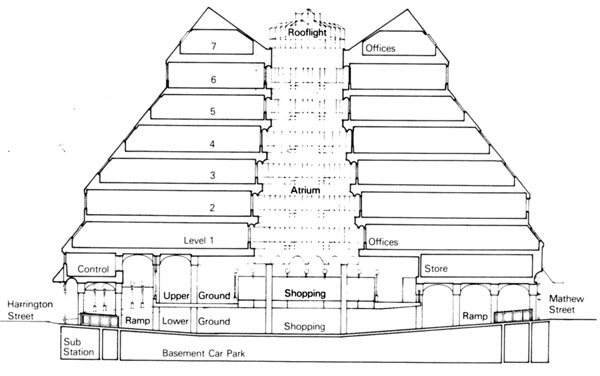
Wind on the structure is taken to foundation level by transferring the load from the cladding through the floors to the frame and cores. The pyramid shape is inherently stable as the raking steel members triangulate the structure. Hip rafters/stanchions span from the second to the sixth floor, and support the fourth, fifth and sixth floor steelwork. Welded tubular lattice girders span from first to fourth floor and are a feature of the solarium.
The atrium void extended from the lower ground floor to roof level, topped by a welded, vierendeel roof light. Throughout erection a tower crane was standing in the atrium. and the roof light had to be stored on site in pieces and erected after the removal of the crane. The pyramid shape of the building resulted in large areas of slate roofing, and a timber stressed skin solution was adopted. This was prefabricated off-site as much as possible. Once the steelwork was erected it was possible to work down from the top of the building which was vital in view of the condensed programme.
A. Long – BSC Sections and Commercial Steels
Client
Royal Life Insurance plc
Architect
David Backhouse RIBA
Consultant Architect
Dominic Mccannon RIBA
Consulting Engineer
Bjngham Blades & Partners
Quantity Surveyor
Tweed Atkinson Lewis & Partners
Service Engineer
Kevin Gaskell Associates
General Contractor
Tysons (Contractors) plc
Steelwork Fabricator
John Booth & Sons (Bolton)