Projects and Features
Retain and rebuild
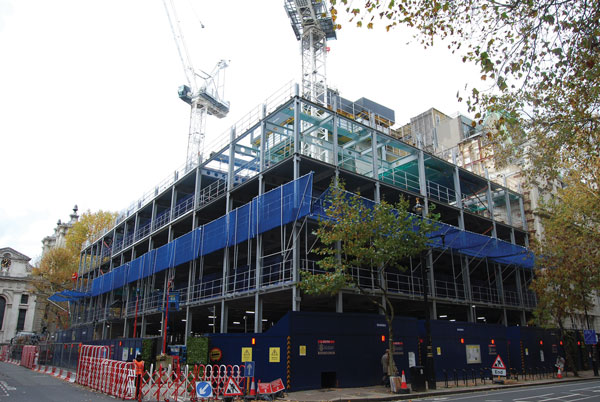
Preserving a historic streetscape, a modern steel-framed commercial development in central London will incorporate the previous building’s reinstated Portland stone façade.
FACT FILE
The Smith, 7 Millbank, London
Developer: Old Park Lane Management
Architect: Make Architects
Main contractor: Skanska
Structural engineer: Waterman Structures
Steelwork contractor: William Hare
Steel tonnage: 1,600t
Within sight of the Palace of Westminster and Big Ben, a stone-clad building, built in two phases between 1915 and 1929, is being redeveloped to create an environmentally sustainable structure with modern, adaptable workspaces.
Named The Smith (a nod to Smith Square, which is to the rear of the development), the project involves the demolition of the existing building, and the construction of a new nine-storey steel-framed structure.
Aiming to achieve the environmental standards of BREEAM ‘Outstanding’, WELL Platinum and NABERS Design for Performance 5* accreditations, the project’s design has sustainability at its core.
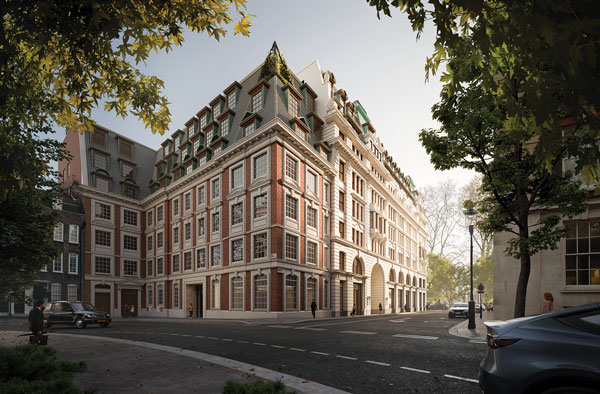
One initiative has seen the Portland stone that clad much of the original building carefully dismantled and safely stored for reuse. Once the new steel frame is fully erected, the stone will be returned to site and reinstalled, helping the neighbourhood maintain its historic character.
The process of rebuilding the Portland stone façade will enable the team to repair the pervasive structural damage caused by corrosion from the embedded steelwork of the building’s original frame. The work also provides an embodied carbon saving of 16% and a reduced construction programme, compared to the alternative façade retention option.
The Portland stone will be re-installed to the new building’s two main elevations along Millbank and Dean Stanley Street (where the main entrance will be). Meanwhile, the rear (Smith Square) façade will have new red brickwork cladding and reinstated Portland stone, similar to the elevation’s original design and also matching the surrounding premises.
Following the stonework removal, the demolition of the old building was begun during the summer of 2024. The preliminary works also included enlarging the existing single-level basement into a two-storey substructure.
The subterranean levels are partially formed with concrete encased steelwork (installed by the concrete contractor), creating a column grid, which is then replicated by the connected main steel frame.
From the ground floor upwards, subcontractor William Hare is fabricating, supplying and erecting 1,600t of steelwork for the project.
The initial steelwork erection sequence for the main steel frame would have ordinarily entailed the superstructure’s steelwork contractor (William Hare) splicing onto the basement columns. In order to make this work more efficient, a connection was devised that meant the encased steel columns were installed with a base plate that was left flush with the completed ground floor slab. This allowed William Hare’s erection team to reset the tolerances and setting out, and then begin their steel installation.
The original structure at 7 Millbank was one of the capital’s early examples of steel construction and using the same framing solution for the new build was the obvious choice.
“A steel frame is lighter than other solutions and meant we were able to minimise excavation, install fewer new foundations, and reduce the concrete volume,” says Skanska Project Director Neil Keogh. “The use of steelwork also allowed the design to have minimal internal columns and spans of up to 13m-long, creating the desired modern and flexible office floorplates.”
The sourcing of the steelwork was an important criteria for the client, allowing the design to achieve the desired sustainability credentials. Consequently, by using a blended mix of low-carbon steel sections and metal decking, a significant carbon saving on the project has been made.
“The total carbon saving against a standard steel-framed building with metal decked floors is circa 2,000t CO₂e, when considering UK average consumption rates,” adds Mr Keogh.
The nine-storey steel frame includes a ground floor with a 5.3m-high floor-to-ceiling soffit height (the upper office floors are 3.8m high) and terraces and a roof garden on the uppermost three levels, providing tenants with outdoor breakout spaces.
Allowing plenty of natural daylight into the floorplates, the new building also features a centrally-positioned full-height atrium that accommodates a feature steel staircase.
All of the floors above ground level are formed with long-span cellular beams, used to accommodate building services within their depth. The beams are designed compositely, supporting metal decking and a concrete topping.
The internal beams and services will be partially concealed by ceiling rafts in the completed building, creating a modern industrial-looking interior.
The floor beams connect back to the building’s main core, which is offset and positioned alongside the plot’s solitary party wall that separates the new building from its neighbour (4 Millbank).
Together with the diaphragm action of the completed floors, the slip-formed core provides stability to the steel frame.
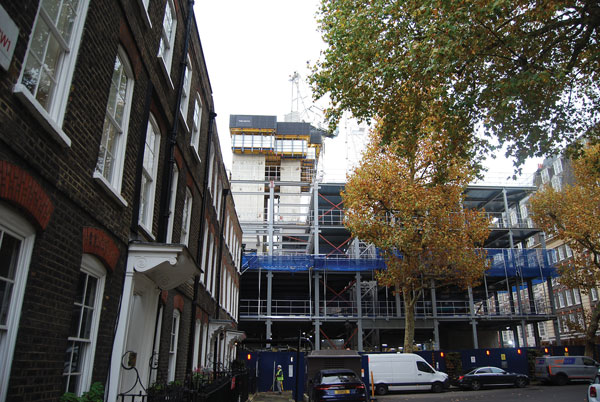
Making use of the site’s two tower cranes, the steel erection programme started in the third quarter of 2025. During the design stages, a lot of work went into ensuring each beam and column would be delivered in sections that were within the capacity of the cranes.
To this end, the heaviest steel element is a 13t box girder, positioned on level eight on the south elevation of the atrium.
Acting as a transfer beam, it was designed so that it could be installed without splicing, while remaining within the limits of the tower crane capacity.
For the most part, the steel erection has been following on behind the construction of the jump-formed core. With two major parts of the construction programme onsite at the same time, coordination between the two teams has been a key factor in the project’s success.
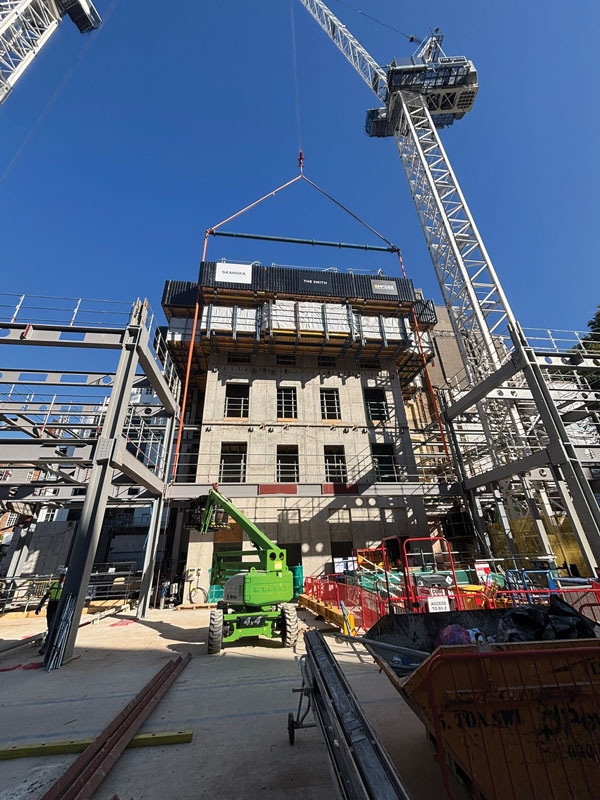
One of the most challenging aspects has been how to erect the beams that connect to the core, while the jump-formed concrete core construction is progressing above.
Positioning MEWPs directly underneath the core, while it was being constructed was not possible and so during the pre-construction phase, the installation methodology was coordinated with the jump-form rig design.
The team made adaptations to the rig that allowed William Hare to use a lifting beam (held by crane straps that straddled the core) to position the steelwork.
Erecting the steel floors inside the core, presented another logistical challenge. The tower cranes could not reach into the core, while the upper parts were being constructed and so small lifting equipment, that can be placed inside the jump-formed structure are being used.
The Smith is due to complete in May 2027.