Projects and Features
Mersey living
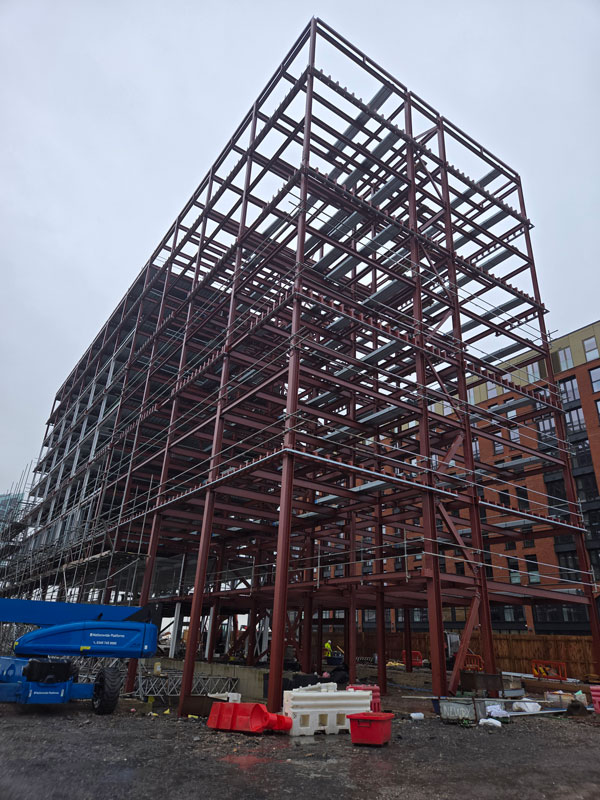
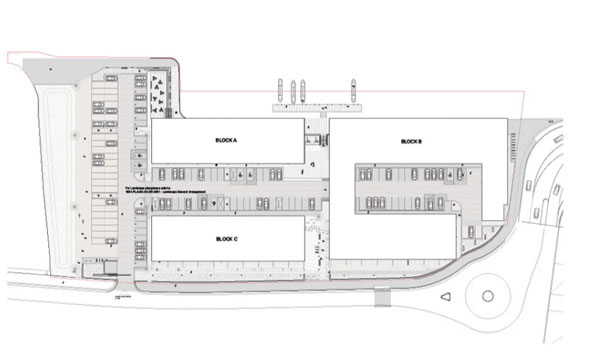
Forming part of the wider Liverpool Waters development, three residential blocks, comprising 330 units, are relying on steel construction for a speedy and timely delivery.
FACT FILE
West Waterloo Place, Liverpool
Main client: Romal Capital
Architect: Footprint Design
Main contractor: Newry Construction
Structural engineer: Thomas Consulting
Steelwork contractor: Walter Watson
Steel tonnage: 800t
An ambitious 30-year plan to transform the River Mersey’s redundant northern docks, the Liverpool Waters scheme is redeveloping a 2km-long stretch of riverfront into a new and vibrant mixed-use neighbourhood.
Creating an extension to Liverpool’s commercial business district and World Heritage waterfront, the development extends northwards to Everton FC’s new football stadium at Bramley Dock.
Historically, this area was a vital hub for global trade, but as industries shifted, the area fell into decline, leaving behind vast, unused spaces. Liverpool Waters seeks to honour its rich heritage by balancing modernisation with preservation through contemporary living spaces, commercial districts, and cultural venues. Once completed, the project will create thousands of jobs, attract tourism, and enhance the city’s global standing.
With planning permission for 60 hectares of land, the scheme will help drive economic growth for the city, as well as the wider Merseyside region.
Housing forms the backbone of the Liverpool Waters development, with hundreds of new homes planned for the area. One residential scheme, consisting of three residential blocks, is currently underway at West Waterloo Place (previously known as West Waterloo Dock).
As a nod to the Cunard shipping line, which had its headquarters nearby, the blocks are nautically named after three of its famous ocean-going liners.
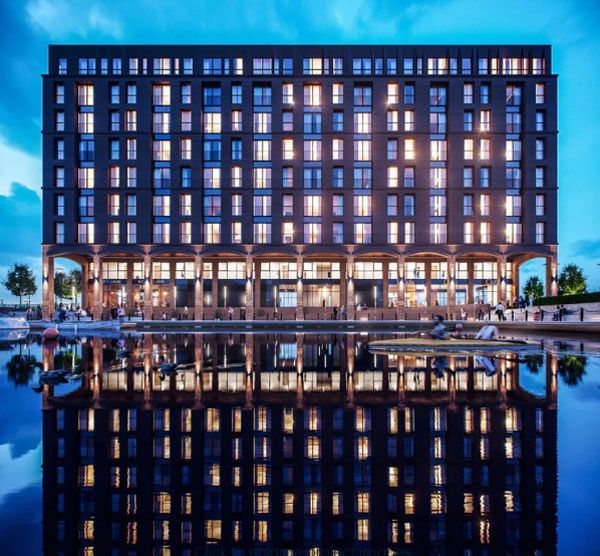
The nine-storey Aquitania was completed in early 2025 and its almost identical neighbour (Mauretania) is now underway. Completing the scheme, construction of the four-storey Lusitania is due to start in 2026.
Structural steelwork is the framing solution for each of the buildings, as it offers speed of construction and efficiency.
All steel construction uses pre-fabricated components that are rapidly installed on site. Short construction periods lead to savings in site preliminaries, an earlier return on investment and reduced interest charges.
Speed of construction in urban residential projects, such as West Waterloo Place, helps keep the neighbours happy by minimising disturbance to adjoining properties.
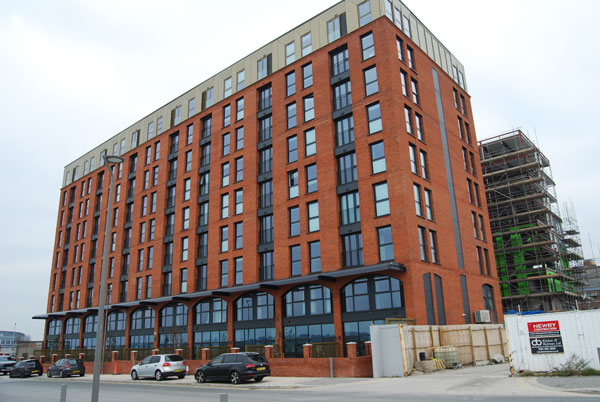
Having successfully completed another nearby steel-framed residential scheme a few years ago, project developer Romal Capital is familiar with steel construction’s benefits. Known as Park Central and Quay Central, the two blocks are eight-storeys and 14-storeys high, and have 129 and 108 one and two-bedroom flats respectively.
Having previously undertaken the steelwork package for Newry Construction on Park and Quay Central, Walter Watson has once again been contracted to work on West Waterloo Place.
So far, it has erected approximately 800t of steelwork for the Aquitania and Mauretania buildings.
Each of the steel frames was erected in approximately six weeks, using a single mobile crane. However, the speed and efficiency of the steel installation packages does not tell the entire story of the project.
Prior to the steelwork being erected, a large-scale ‘dock infill’ programme had to be undertaken, in order to create enough space for the project’s residential blocks. Following the installation of a tied sheet pile wall and a combi-wall, much of the former West Waterloo Dock basin was infilled, leaving adequate water to allow craft to enter and exit from the adjacent canal and waterways.
Once the engineered fill had been compacted, a series of piled foundations were installed, up to a depth of 16m, with a typical 2m rock socket provided into the sandstone. While this work was being done, continuous monitoring for adverse vibration or ground movements was needed, as one of Liverpool’s main underground transportation assets (the Kingsway/Wallasey road tunnel) is located only a few metres north of the site.
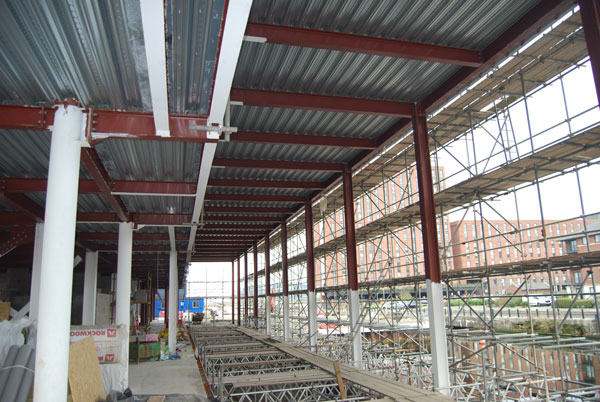
Arranged around a regular column grid pattern, each of the floors in Mauretania from the second floor upwards is identical. The layout consists of two rows of flats, positioned along the east and west elevations and separated by a central corridor.
All of the internal columns are located either side of the corridor, leaving the apartments as column-free and open-plan areas.
The blocks are all braced frames, with the stability-giving cross bracings positioned in partition walls and around the stairwells and lift shaft.
Sat beside the ground and first-floor accommodation is a double-height colonnade within the eastern half of the building. This pedestrian thoroughfare, which overlooks the remaining dock and a timber floating jetty, will also form part of a wider riverfront pathway scheme, connecting the city centre with the Everton football stadium.
Framing both sides of the colonnade are a series of CHS columns, chosen for their aesthetic appearance as these members are the only parts of the building’s steel frame to be left exposed in the completed scheme.
Fronting the colonnade in the western half of Mauretania’s ground floor there are retail units and a gym, while the first floor has a single row of river-facing flats.
The mixed-use design is another benefit of using steel construction, as a column-grid which is compatible for both residential and retail is easily achieved with a steel frame.
The usage of the two lowest floors is the main difference between the Aquitania and Mauretania blocks, as the former accommodates apartments on every floor.
In both blocks, the upper floors are formed with steel beams that support metal decking and concrete topping. This creates a composite flooring solution that also provides additional stability, once complete, via its diaphragm action.
Positioned below the steel floor beams, the building’s major service runs are located in the corridors, with smaller amounts of MEP in each of the flats.
Summing up, Romal Capital says, “With climate change at the forefront of urban planning, we are leading by example. Our developments focus on sustainability through energy-efficient technologies, green building materials (like steel), and designs that encourage eco-friendly living. The addition of communal green spaces, rooftop gardens, and bike-friendly infrastructure reflect Liverpool’s commitment to a greener, more sustainable future. This aligns with the city’s broader goals of becoming a net-zero city by 2040, enhancing both the quality of life for residents and the value of investments in the area.”
Mauretania is due to be complete by August 2026.