SSDA Awards
MERIT – Spectra, University of Hertfordshire
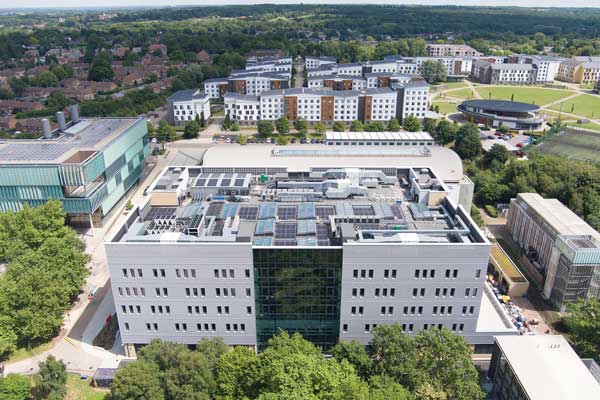
The Spectra Building is the largest and most flexible building on the University of Hertfordshire’s Hatfield campus.
FACT FILE
Architect: ADP
Structural engineer: AECOM
Steelwork contractor: Elland Steel Structures Ltd
Main contractor: Morgan Sindall Group
Client: University of Hertfordshire
Formed with a composite steel frame, Spectra has brought together the University’s numerous STEM faculties into one multi-functional building.
The design of the five-storey building creates four separate teaching zones, divided by full-height atriums, feature stairs and central open-plan collaboration spaces.
The regular 9m x 9m column grid, lack of transfer structures, robust vibration resistance and flexible floorplates, have created an adaptable structure ideal for modern education and research hubs.
“The columns are on a regular grid across the entire floorplate with secondary beams at repeated 3m centres, meaning that any future adaptation of a space is simplified by the avoidance of an inconveniently irregular structure,” explains AECOM Senior Structural Engineer Jack Bennett.
“The repeated nature of the slab soffit also lends itself to simplified future reconfiguration of internal partitions and service distributions.”
The upper floors accommodate offices, IT laboratories, dark rooms, simulator suites, clean rooms, wind tunnels and robotics workshops, while the ground level houses workshops, with an internal crane and a strong floor, capable of withstanding large forces.
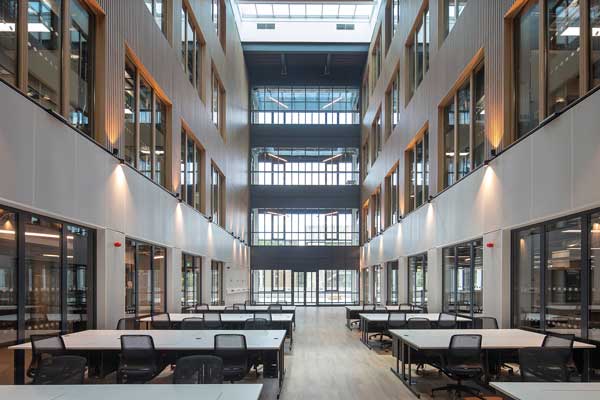
The majority of the steel columns and beams are exposed and on show, creating the desired modern industrial-looking interior of the building. However, in some spaces, a selection of columns and beams is encased to provide the required fire protection and acoustic performance.
In conjunction with the steel superstructure, the design team chose to use metal decked flooring, as it acts in composite action with the concrete slab, functioning as a diaphragm to distribute lateral loads. This reduces the lateral load demands on the cores and shear wall elements. Alongside these physical benefits, using a metal decked floor solution also boosted the project’s speed of construction and flexibility.
It also provides the building with the desired flexibility to be reconfigured and reused for numerous functions, if the requirement arises in the future.
“A steel frame with metal decking allows for the simple creation of new openings (for MEP risers and interior stairs) with minimal structural interventions,” says Mr Bennett.
“Even larger openings can be made with only the introduction of minor trimming steelwork within the existing structural depth.”
The majority of the steelwork, which is exposed throughout the completed building, was sourced from Electric Arc Furnace production facilities, providing a low-carbon content to the primary frame.
Summing up, the judges say the Spectra Building is an inspiring new university facility, designed within strict parameters. Constructed in steel, the long spans provide flexibility, enabling spaces to adapt as funding and study needs evolve. This forward-looking approach delivers functionality, sustainability, and design excellence, creating a building the university can rightly be proud of. ■