
Projects and Features
Generation2 snow loads
BS EN 1991-1-3:2025 was published in the early part of 2025 and will lead to significant changes in practice in how “drifted” snow is considered. David Brown of the Steel Construction Institute considers some of the more important changes.
Exceptional Snow
At the SCI offices in Berkshire, any snow at all is greeted with surprise. Not quite exceptional, but uncommon and usually gone before it can be enjoyed. “Exceptional snow” is a term in both the current version of BS EN 1991-1-3 and the Gen2 version. The current UK National Annex helpfully states that exceptional snow load on the ground is not considered to occur in the UK, meaning that certain following clauses are not applied in the UK. The Gen2 version also refers to exceptional conditions, but it is again expected that the UK NA will determine that these do not occur in the UK. The reason is the UK’s maritime climate. Snow accumulations in the UK generally result from one single snow event, or a small number from one weather system. In the UK there is not usually an accumulation from several successive snowfalls which build up without melting, which would be an “exceptional snow load on the ground”.
Accidental design situations
The Gen2 version of BS EN 1991-1-3 specifies in clause 4.1(2) that accidental design situations should be considered where exceptional conditions apply. The corollary is that in the absence of exceptional conditions, there are no accidental design situations. All conditions in the UK will be normal (i.e. a persistent design case, subject to the usual partial factors). This is likely to be a surprise to most designers in the UK, who for many years have treated drifted snow (in valleys, behind parapets etc.) as an accidental situation. The background document to the new standard explains that snow loads occur in either “normal” or “exceptional” conditions and confirms that the former Annex B “exceptional snow drifts” are included in the main text as persistent load cases.
Get my drift?
Another change which will take some time to get used to is a change in terminology. “Drifted” is no longer used and will be known as “unbalanced”. The second condition is obviously “balanced” rather than the “undrifted” we might commonly use today. This is to reflect the fact that drifting is only one effect that leads to an unbalanced situation. An unbalanced situation can also result from erosion due to wind, or, with no wind at all, from melting and sliding. The general term “unbalanced” is used to cover all of these effects.
In the UK, we have some experience of “unbalanced” load cases, since the current code requires partial removal of snow from one roof slope of a duopitch frame. The UK NA revises this to require the removal of all snow from the second slope. Many in the UK seem to ignore this load case, but it is in the current code. In the future, the unbalanced load cases will become more important, as described later.
Changes to UK practice
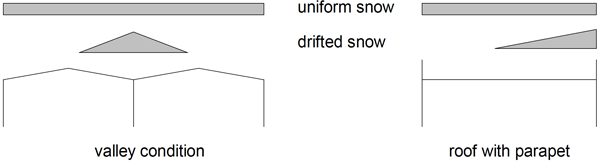
Currently, most designers consider a uniform snow load and then, as an entirely separate condition, an accidental load case with snow drifted (sorry, an “unbalanced” case) in valleys and behind parapets. In that accidental load case the remainder of the roof has no snow at all. Typical current cases are indicated in Figure 1.
The Gen2 version of the code has what we previously know as the drifted snow in addition to the uniform snow load on the roof. This is shown in Figure 2. In the balanced load arrangement on the double span structure, the snow is not necessarily “uniform” over the building – but potentially a higher value between the apex of the two spans. The increased snow load shape coefficient between the two apex is to be based on a fixed slope of 30°, and a constant value of 1.0 replacing the exposure coefficient Ce. However, the UK National Annex is likely to adopt Ce = 1.0, and the snow load shape coefficient does not vary until the roof is more than 30°. For most steelwork designs therefore, case (i) of Figure 2 will be uniform.

The immediate implication of having drifted snow in addition to the uniform snow is that the load will be increasing, but comparisons are not easy. The maximum intensity of the redistributed snow in the Gen2 code in combination with the uniform snow load, can be less than the current drifted snow currently considered in isolation. This conclusion includes the effect of the different partial factors on normal/accidental loads of 1.5 and 1.0. The length of the snow drift also changes. Design loads will change, but it is not straightforward to identify a trend.
Example of a valley in the current code
Assuming that in Figure 2, the characteristic value of snow load on the ground, sk = 0.4kN/m², each span is 25m and the roof slope is 6°, then according to Annex B of the current code:
μ₁ = 3.0 and the drift length is 12.5m.
In current practice therefore, the ultimate load from the drift alone (assuming this to be an accidental limit state and using a partial factor of 1.0) is:
2 × 0.5 × 12.5 × 0.4 × 3.0 × 1.0 = 15.0kN per metre of building.
In current practice, a uniform case is also considered. Both Table 5.2 of the current code and the UK NA have μ₂ = 0.8
The ultimate load from the uniform case (over the valley alone) as a persistent combination using a partial factor of 1.5 is:
0.8 × 0.4 × 2 × 12.5 × 1.5 = 12.0kN per metre of building.
In this case in the current code the total design load from the drifted snow exceeds the uniform snow case when considering the valley alone.
Example valley in the Gen2 code
In the Gen2 code, the uniform case is identical to the current code, assuming the exposure coefficient Ce = 1.0. The snow load shape coefficients are no longer a Nationally Determined Parameter (NDP).
The snow load shape coefficient for the example valley is μ₃=1.04.
The snow load shape coefficients for the valley are shown in Figure 3.

The ultimate load in this redistributed case, taken as a persistent combination using a partial factor of 1.5 is therefore:
1.5 × [0.8 × 0.4 × 25 + (1.04 – 0.8) × 0.4 × 12.5] = 13.8kN per metre of building.
In this example, considering the total load in the valley alone, the Gen2 code still has the redistributed snow as the more onerous case, but not as heavily loaded. The Gen2 code results in an 8% reduction in the design loading, despite the change to a persistent case and partial factor of 1.5.
The background document observes that the current code can lead to snow depths in the valley that exceed the ridge of the roof by several metres, which has been corrected in the Gen2 version. This situation can occur in the current code when μ₁ = 5, but the frame geometry that leads to this value is a rather unusual arrangement – the value of μ₁ = 3 in the previous example is the usual situation.
Example of a parapet in the current code
Assuming that in Figure 2, the characteristic value of snow load on the ground, sk = 0.4 kN/m², the building width is 12m and the parapet is 0.75m, then according to the current code:
μ₁ = 3.75 and the drift length is 3.75m.
In current practice therefore, the ultimate load from the drift alone (assuming this to be an accidental limit state and using a partial factor of 1.0) is:
0.5 × 3.75 × 0.4 × 3.75 × 1.0 = 2.81kN per metre of building.
In current practice, a uniform case is also considered. Table 5.2 of the current code specifies μ₁ = 0.8. The current UK NA modifies this in Figure NA.2 such that
μ₁ = 1.0
The ultimate load from the uniform case as a persistent combination using a partial factor of 1.5 is:
1.0 × 0.4 × 12 × 1.5 = 7.2kN per metre of building.
Example of a parapet in the Gen2 code
In the Gen2 code, μ₁ = 0.8 for a flat roof.
The snow load shape coefficient for the example arrangement is μ₇ = 3.0 and the drift length is 5.0m. The snow load shape coefficients and drift length are shown in Figure 4.

The ultimate load in this redistributed case, taken as a persistent combination using a partial factor of 1.5 is therefore:
1.5 × [0.8 × 0.4 × 12 + 0.5 × (3 – 0.8) × 0.4 × 5] = 9.06kN per metre of building.
In this example, Gen2 is 25% more onerous than the current code.
Unbalanced cases on duo span roofs
The cases to be considered are shown in Figure 5, for a roof with the same slopes each side of the apex.

Although Figure 5 looks as though snow has simply been completely removed from one roof slope in case (ii), this is not the complete picture. In the unbalanced cases, there is additional wind-driven snow on the remaining snow (the original “balanced” snow). Whilst snow is being entirely lost from one slope, some snow is blown onto the other, increasing the load.
At typical steel frame roof slopes of 6°, the additional wind driven part of the snow is very small; at 20°, the wind driven part of snow accounts for an additional 12% and at 30°, 20% additional load.
Snow around PV
One brand new feature is a snow load arrangement for flat roofs with tilted panels – typically photovoltaic (PV) panels. There are many issues with PV on flat roofs, noting that a large part of the industry is concerned not with new build (where the loads should be included in the design) but on fitting PV to existing buildings. It seems highly unlikely that all original designs allowed for PV. The problem becomes more acute when PV panels are ballasted to keep them in place – and will become more onerous again when (quite correctly) drifted snow around and among the panels must be considered.
The snow load shape coefficient over and around the panels depends on the overall height of the installation above the flat roof. PV panels on commercial and industrial buildings tend to be relatively shallow, so the increased snow load over the area is typically 25%. The increased loading extends for a drift length around the area of panels. An additional complication is that where the width of the panel array exceeds twice the height of the panels (every case, one imagines, for shallow sloped panels on a roof) then the front row and end row are treated like a parapet, where the snow load coefficient can easily be double that on a flat roof.
Snow on low buildings adjacent to taller structures
The Gen2 calculation of the unbalanced load on a low roof abutting a taller structure is undoubtedly quite involved. There is:
- The balanced (currently called “undrifted”) snow on the lower roof, plus
- A contribution from snow sliding off the upper roof, plus
- A contribution from wind driven snow off both the lower and upper roofs.
The coefficients and unbalanced arrangement is illustrated in Figure 6.

Climate change
The Gen2 code requires designers to look into the future – in Clause 6.1(3) the code states that “the effects of climate change shall be taken into account”. Note the word “shall” – there is no avoiding this requirement. Climate change is to be taken into account by multiplying the characteristic value of snow load on the ground (sk) by a scaling factor fs,cc which is greater or equal to 1.0. The National Annex can give a different approach to account for climate change, or can set a minimum value for the scaling factor.
The question then becomes: what scaling factor should be applied, if any? Informative Annex A notes that climate change scenarios may be used to look at future trends, but also notes that “Special care should be taken when predicting climate change effects”. One wonders how “special care” should be assessed, and how “special care” differs from the care taken when designing beams and columns.
Sorry, Margate
One interesting note in the UK NA work is that the current UK snow load map has a small mistake at the very eastern end of Kent. The current NA map shows Margate, Ramsgate and Broadstairs to be in Zone 2 – the area should be Zone 3, which will be corrected in the Gen2 NA.
Conclusions
Perhaps the most significant change is that the redistributed snow load cases are “normal” or “persistent” cases to be considered and no longer “accidental”. As persistent design situations, the redistributed cases are likely to have an impact on the primary structure. In some situations Gen2 is more onerous, in other arrangements, less so.
In common with many Gen2 codes, the changes involve a different calculation process to determine the outputs – in this case the snow load shape coefficients and drift lengths. Software provided by manufacturers of secondary steelwork and used to verify purlins under unbalanced (“drifted”) conditions will need revision.
Current activities
A group of interested individuals is meeting to try and determine what should be presented in the UK National Annex, though the opportunity for national choice is limited and data to make an informed decision is scarce. One of the most important pieces of information is the snow zone map, where it is hoped that the Meteorological Office will assist. The UK NA to BS EN 1991-1-3 is due to be published for public comment later in 2026.