Projects and Features
Five go to Chippenham
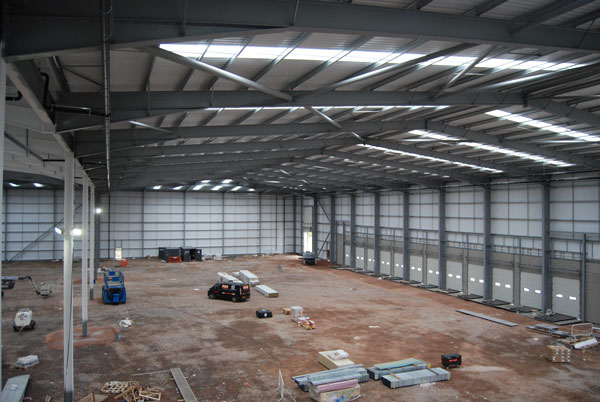
Helping to boost the South West’s available stock of logistics space, structural steelwork is playing a leading role in the construction of five warehouse units in Wiltshire.
FACT FILE
Indurent Park, Chippenham
Main client: Indurent
Architect: UMC
Main contractor: Bowmer + Kirkland
Structural engineer: Stantec
Steelwork contractor: Caunton Engineering
Steel tonnage: 1,376t
Logistics provider Indurent is increasing its north Wiltshire offering with the phase 3 expansion of its Chippenham distribution park.
Strategically located at junction 17 of the M4, Indurent Park Chippenham provides direct access to the national motorway network and is less than 30 miles from the major UK port of Avonmouth.
Taking advantage of its convenient geographic position, in the heart of the South West’s established logistics triangle, and helping to satisfy the need for more warehouse and logistics space, five steel-framed warehouse units, aiming for BREEAM ‘Excellent’ and EPC A+ ratings, are under construction.
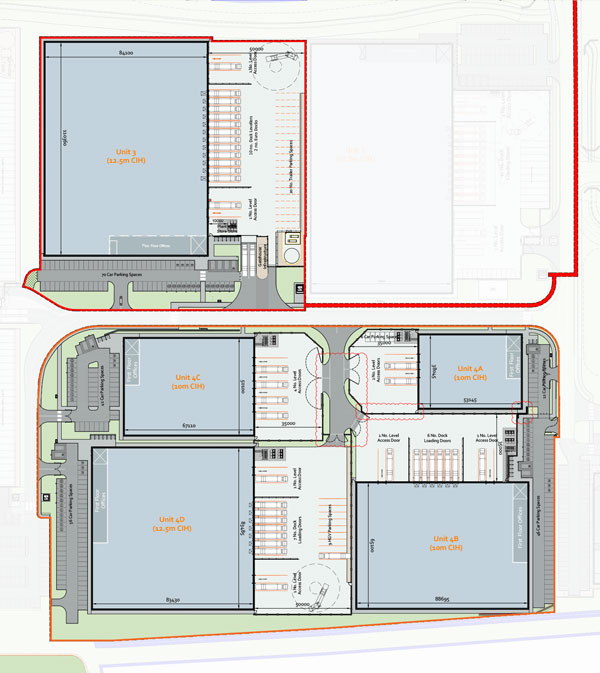
Positioned within the established 78-acre logistics park, all of the speculatively-built units have 50kN/m² floor loading, service yards and ample car parking.
The three largest warehouses (Unit 3, measuring 110m × 84m; Unit 4B, measuring 88m × 65m; and Unit 4D, measuring 83m × 83m) have dock loading doors and level access doors, while the two smaller buildings (Unit A, measuring 53m × 38m, and Unit 4C, measuring 67m × 50m) have the latter.
It comes as little surprise that the units are all steel-framed, as traditionally, steelwork has dominated the single-storey non-domestic building (warehouses) market and during 2024 it had an impressive 94.1% market share.
According to the annual survey commissioned by Steel for Life and the British Constructional Steelwork Association (BCSA), and conducted by independent market research consultants Construction Markets, this important sector accounts for almost 50% of the overall UK structural steelwork market by tonnage.
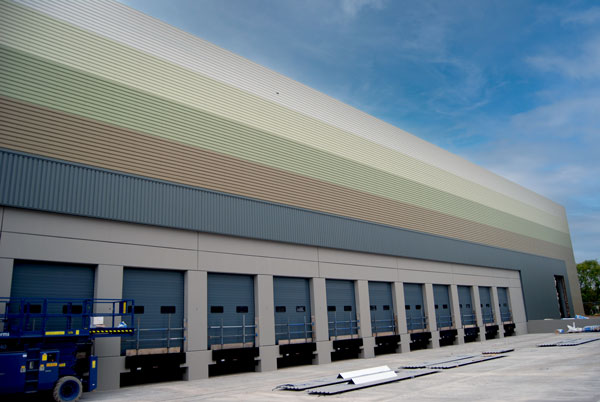
Attributes such as cost-effectiveness, adaptability and its contribution to the circular economy through reuse and recycling, are all factors that continue to be valued by developers, contractors, designers and building users alike, making steelwork the go-to material for warehouses.
Sustainability is an important factor in the design of warehouses; their large expansive roofs offer the ideal location for the installation of photovoltaic (PV) panels. This is the case at Indurent Park Chippenham, as all of the units have rooftop solar PV panels, ensuring net zero operational carbon for the buildings’ offices, and helping tenants reduce energy costs and carbon footprints.
Working on behalf of main contractor Bowmer + Kirkland, Caunton Engineering has fabricated, supplied and erected 1,376t of steelwork for the project.
“By using pre-fabricated steelwork, Caunton was able to overcome any logistical hurdles to meet our required construction programme, delivering the necessary long-span structures with precision,” comments Bowmer + Kirkland Project Manager Alistair Nicholls.
Prior to the steelwork programme commencing, the ground had been levelled and prepared, and the foundations (which are a combination of piles and pads, depending on the location and ground conditions) had been installed.
Starting with the largest warehouse (Unit 3), the buildings were erected in a sequential manner during a 12-week programme. Using a combination of MEWPs and two mobile cranes, Caunton employed a single gang of erectors for the project.
Reaching a height of 12.5m to the haunch, Unit 3 is a twin-span structure accommodating an internal two-storey office (ground and first floor) and plant deck.
The lowest floor of office accommodation is founded on the warehouse slab and is positioned within an undercroft. Above, the first-floor offices and second floor plant deck are both compositely formed with steel beams supporting metal decking and a concrete topping.
The initial part of the steel erection involved installing the gable end containing the office. As this area requires the most fit-out work, it is usually the first part of any warehouse scheme to be installed. Erecting this area first, also provides the main structure with some much-needed stability and negates the requirement for large pieces of temporary steelwork.
The main perimeter columns are spaced at regular 8m centres, while the solitary line of internal valley columns is arranged in a hit-and-miss configuration. Spaced at 16m intervals, this arrangement creates more valuable column-free space within the warehouse.
The unit’s two 42m-wide spans are formed with a series of spliced rafters. Brought to site in 22m-long sections, each span was formed with the aid of two cranes, each lifting a beam into place, until the central connection was made.
Three of the other units (4B, 4C and 4D) have a similar twin-span design accommodating a two-storey office.
“Although the site is quite confined, we had plenty of space for materials when we erected the first units,” says Caunton Engineering Contracts Manager, Dean Linthwaite.
“Our procedure involved erecting the steelwork with the mobile cranes sat within the footprint of each structure. However, by the time we started on Unit 4C and Unit 4A – the smallest and last warehouse to be erected – we had to position the cranes outside of the footprints because of the proximity of the other erected structures.”
Completing Caunton Engineering’s programme, Unit 4A is the only single-span structure and required a total steel tonnage of 119t. Its 38m-wide span was also created with two spliced rafters, while internally, the warehouse accommodates a single-storey office.
Practical completion is due in January 2026 for Unit 3, and March for the other four units.