50 & 20 Years Ago
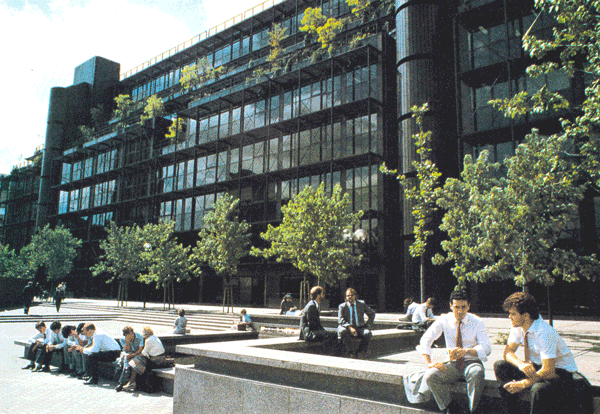
1 Finsbury Avenue, London EC2
For Rosehaugh Greycoat Estates Ltd
SSDA AWARD
1985
Architects: Arup Associates
Structural Engineers: Arup Associates
Steelwork Contractors: Graham Wood Structural Limited
The building is the first of a three phase office development totalling about 50,000 square metres. It contains 25,000 square metres of rentable office space as well as a small leisure centre with sports facilities.
Eight storeys high, with stepped back landscaped terraces down the long sides at the fifth and sixth floor levels, the building is planned around a full height central atrium space capped with a large glazed dome. Two separate circulation cores give access to large office floor areas of over 3,000 square metres each. Generally, the building is designed to benefit as much as possible from natural daylight, while at the same time being very economical in its use of energy with external shading devices to protect the building from the effects of solar gain.
The client’s brief required a design for the building which was efficiently planned, functional, cost effective and of high quality to attract potential tenants in a highly competitive letting market. Part of the solution to this brief was the need for an assured and early completion of the building.
The choice of steel as the material for the structural frame reflects this need and it was designed using universal beam and column sections in Grades 43B and 50B steel. To achieve maximum economy the design was based on a simple rectilinear form with repetitive elements and bolted connections using a common size of M20 grade 8.8 bolts. Horizontal stability is achieved by diagonally braced frames in the core areas. An early decision was taken to commence the steel frame columns at pile cap level and they were fabricated and erected in 3 storey high lifts. The beams are designed to act compositely with the concrete floor slabs 130mm thick overall, constructed on 1.1 mm profiled steel sheeting spanning 3.0m and using a lightweight aggregate 30N/sq.mm pumped concrete mix. The concrete slab acts compositely with the profiled steel sheeting as well as the frame beams. Shear connections to the steel beams were achieved by 100mm long 20mm diameter studs.
The steel frame within the internal air conditioned office environment has not been treated other than by light cleaning before fabrication. Outside the building envelope steel members were cased in concrete and wherever possible beams were pre-encased at the fabrication works. Fire protection to steelwork above the suspended ceiling is provided by a sprayed vermiculite cement whilst within the habitable areas it is protected by steel sheet faced boarding. Corrosion protection is generally a straightforward paint specification based on a zinc chromate primer with white gloss paint finish. Inaccessible areas received two coats of bitumastic paint or are protected by butyl rubber sheet.
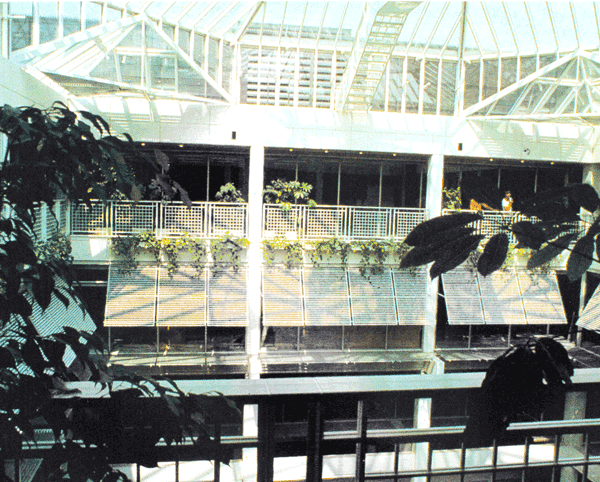
The atrium roof structure is an octagonal sided dome of rectangular hollow section steelwork. The steelwork and glazing design were integrated with all glazing bars as structural members which allowed smaller steel sections lei be used to create a spiders web effect. The steelwork of the roof is fully welded to form a continuous dome. Maintenance of the underside of the roof is carried out from a rotating tubular steel gantry with mesh sides which can be wound around a circular rail by hand. The centre support hanger has two thrust bearings to form a maintenance free pivot.
The early completion of the external cladding and roofing, together with maximum fabrication off site, was also seen as a very important part of the fast track approach in the design of the cladding. An additional requirement was that it should be heated to counteract the perimeter heat losses to the air conditioned space. The solution to these problems was found to be bay width by storey height elements of cladding which could be erected as single units. These were fabricated at works using 120mm x 60mm RHS as a structural frame. The RHS acts as the heating surface and waterway for the low pressure hot water heating system. The steel staircases were fabricated offsite in specially designed folded plate pans with 16mm thick flat stringers. These were erected at the same time as the main frame to aid access for construction operatives with the pans subsequently being filled with concrete.
When the future phases are constructed, an additional open ‘atrium’ will have been created to enhance the existing pedestrian route. This new intimate area, typical of the spaces found in the City of London, will be surrounded by various shops, restaurants and pubs which are included as a part of the development.
The scheme was approved in March 1982, construction began in December 1982 and the building was completed in September 1984. The steel frame contains 1,500 tonnes of steel erected in 13 weeks and 32,000m2 of steel composite floors. The total cost was approximately £20 million.
Judges’ Comments:
The best design techniques for the steel frame, floor construction and fire protection, have been used to create a most attractive, efficient and quickly constructed building.